
Atomic Rituals Book Variant 2
I’m currently working on two different ways to structure and convey the content and learning opportunities for “Atomic Rituals” the book. I’m calling the “Variant 2”. This book is about a fictitious company; however, it is modeled after real world experiences using examples from the various disruptive tech companies where I’ve been a leader over the last four decades bringing it all into the new world of massive data and AI.
Introduction: The Power of Tiny Changes
In the heart of Silicon Valley, a tech startup called Nova Labs was on the brink of collapse. Despite its innovative AI-powered platform for decentralized finance, the company faced a crisis: funding had dried up, key employees were leaving, and the pressure was mounting. Alex, the CEO, a visionary leader with a touch of the maverick, knew drastic measures were needed. But instead of resorting to mass layoffs, they made a bold decision: a temporary but significant reduction in pay and benefits across the board.
This unexpected move sparked a surprising transformation. Instead of demoralizing the team, it ignited a fire of determination and collaboration. Employees rallied together, united by a shared purpose and a sense of ownership. They worked harder and smarter, not just to save their jobs, but to build something meaningful. And they did. Nova Labs not only survived but thrived, becoming a shining example of resilience and innovation.
This is the power of Atomic Rituals.
Like atoms, the building blocks of matter, Atomic Rituals are small, seemingly insignificant actions that, when combined and repeated consistently, create a powerful force for change. They are the subtle shifts, the daily practices, the intentional interactions that shape a thriving organizational culture.
This book is not about grand, sweeping overhauls that disrupt and disorient. It’s about the subtle shifts, the daily practices, the seemingly insignificant rituals that, when performed consistently, create a compounding effect, leading to remarkable transformations.
Atomic Rituals builds upon the foundation of James Clear’s “Atomic Habits,” extending the concept of individual habits to the collective practices that shape an organization’s DNA. It’s a practical and actionable framework for leaders at all levels, from CEOs to team leads, who want to create a more human-centered and high-performing workplace.
This is your Leader’s Journey. Like the hero’s quest, it’s a path filled with challenges and triumphs, setbacks and breakthroughs. It’s a journey of self-discovery, where you’ll confront your own limitations, embrace vulnerability, and learn to lead with humility and courage.
Throughout this book, we’ll explore the key stages of the Leader’s Journey, drawing inspiration from experts like Simon Sinek, Brené Brown, and Adam Grant, as well as from my own experiences leading teams and building successful companies. We’ll delve into the core principles of Atomic Rituals, providing practical guidance and real-world examples to help you implement them in your own organization.
We’ll uncover the power of meta-rituals – the foundational elements of vision, values, purpose, strategy, and feedback – and explore a diverse toolkit of molecular rituals – the small, daily practices that reinforce these foundations and drive positive change.
This book is for anyone who wants to contribute to a more positive and productive work environment. Whether you’re leading a small team or a large corporation, Atomic Rituals provides a framework for creating a culture where people feel valued, respected, and empowered to do their best work.
It’s about fostering collaboration, embracing vulnerability, and building trust. It’s about creating a ripple effect of positive change that extends beyond the walls of your organization and into the world.
Join me on this journey of transformation. Together, let’s unlock the power of Atomic Rituals and build organizations that thrive.
Atomic Habits
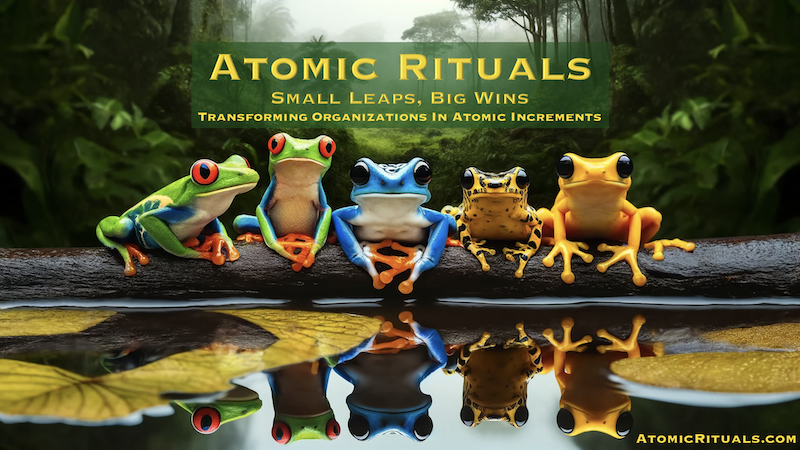
5 frogs on a log, one decides to leap, how many are left?
You might think: 4.
However, likely 5 will be left on the log. Deciding to leap is easy; actually taking the leap is hard.
Imagine you want 5 unique frogs to leap simultaneously into the same unknown puddle.
Chapter 1: The Call to Adventure – A Spark in the Chaos
Sarah stepped out of the Uber and into the sleek, modern lobby of Nova Labs. Silicon Valley sunshine streamed through the floor-to-ceiling windows, reflecting off the polished concrete floors and minimalist décor. It was her first day as the new CTO, and a mix of excitement and trepidation churned in her stomach.
Nova Labs, a fintech startup on the cusp of disrupting the world of decentralized finance, had lured her away from a comfortable, predictable role at a large corporation. The challenge of leading a team at a fast-growing company, building cutting-edge AI-powered technology, had been impossible to resist. But now, facing the reality of her new environment, doubts crept in.
She recalled the advice in “The First 90 Days,” a book she had re-read on the flight over. Promote yourself. Accelerate your learning. Match strategy to situation. The words swirled in her mind as she approached the reception desk. This wasn’t just a new job; it was a new adventure, a new chapter in her Leader’s Journey.
Sarah was no stranger to challenges. As a woman in tech, she had faced her share of obstacles and biases. But she had always persevered, driven by a deep passion for technology and a belief in its power to transform the world. She had honed her skills, built her expertise, and earned her place at the table.
But this was different. This was a chance to not just build technology, but to build a team, a culture, a company. To create something truly special, something that reflected her values and her vision for a more human-centered workplace.
As she waited for her new boss, Alex, the CEO, Sarah’s gaze fell on a distinguished-looking man across the lobby. He had an air of quiet authority and a warm smile that put her at ease. She couldn’t quite place him, but she felt a sense of familiarity, as if she’d seen his picture in a business magazine or perhaps read about him in a leadership book. Maybe he’s a renowned consultant or a successful entrepreneur, she mused. Someone who’s navigated the challenges of the tech world and emerged wiser.
Before she could dwell on it, Alex appeared, radiating energy and enthusiasm. “Sarah! Welcome aboard! Ready to dive in?”
Sarah smiled, her apprehension momentarily forgotten. “Absolutely. I’m eager to get started.”
Little did she know that this was just the beginning of her adventure, a journey that would test her limits, challenge her assumptions, and ultimately transform her as a leader. This was her call to adventure, and she was ready to answer it.
Chapter 2: Entering the Unknown – The First Rituals
Sarah’s first few weeks at Nova Labs were a whirlwind. The energy was palpable, the pace frenetic. Engineers huddled around whiteboards, their faces illuminated by the glow of multiple monitors. Product managers debated features with passionate intensity. The air crackled with the electricity of innovation.
But beneath the surface, Sarah sensed a current of unease. The rapid growth had created a culture of silos and competition. Teams operated in isolation, guarding their knowledge and accomplishments. Communication was fragmented, and a sense of distrust lingered in the air.
Remembering the advice from “The First 90 Days,” Sarah focused on accelerating her learning. She met with every team lead, not just to understand their projects, but to grasp their challenges, their frustrations, and their aspirations. She observed the daily rhythms of the company, the patterns of interaction, the unspoken rituals that shaped the culture.
One recurring theme emerged: a lack of trust. Engineers were hesitant to share their work, fearing criticism or having their ideas stolen. Product managers felt misunderstood by the engineers, their requests often met with resistance or delays. A sense of “us vs. them” permeated the organization.
Sarah knew that building trust was crucial, not just for improving collaboration, but for fostering a culture of psychological safety, where people felt comfortable taking risks and expressing their ideas without fear of judgment. This was her first challenge, her first step into the unknown.
Drawing on her own experiences and the principles of Atomic Rituals, Sarah decided to implement a simple but powerful practice: daily stand-up meetings. These brief, focused gatherings would bring together engineers, product managers, and designers to share updates, identify roadblocks, and foster a sense of shared responsibility.
Initially, there was resistance. Some engineers grumbled about the “unnecessary meetings,” while some product managers questioned their value. But Sarah persisted, patiently explaining the purpose and benefits, and modeling the behavior she wanted to see.
Gradually, the resistance faded. As teams began to see the value of open communication and shared understanding, a sense of camaraderie emerged. Engineers started proactively seeking input from product managers, and product managers began to appreciate the complexities of the engineering process. The daily stand-ups became a ritual that not only improved communication but also fostered a sense of shared purpose and collective ownership.
This was Sarah’s first victory, a small but significant step in her Leader’s Journey. She had entered the unknown, faced the challenge, and emerged with a renewed sense of confidence. The journey was just beginning, but she knew that with each small step, with each Atomic Ritual, she was building a stronger, more collaborative, and more human-centered organization.
Chapter 3: Tests, Allies, and Enemies – Navigating the Currents of Change
The initial excitement of Sarah’s arrival at Nova Labs began to give way to the realities of leading change in a complex environment. The daily stand-up meetings, while helpful, were just the first step. Deeper challenges lurked beneath the surface, threatening to derail her efforts to build a more collaborative and innovative culture.
One of the first hurdles was the entrenched resistance from certain team leads, particularly David, a veteran engineer with a traditional mindset. He saw Sarah’s emphasis on collaboration and open communication as a threat to his authority and a distraction from “real work.” His skepticism was palpable in team meetings, and his subtle undermining of her initiatives created a ripple effect of negativity.
Sarah knew she needed to address this resistance head-on, but she also recognized the importance of building alliances. She sought out Maya, the rising star engineer, whose passion for innovation and collaborative spirit had impressed her from the start. Maya quickly became a valuable ally, offering fresh perspectives and championing Sarah’s initiatives within the engineering team.
Together, Sarah and Maya began to identify other potential allies, individuals who shared their vision for a more positive and productive work environment. They found support in Chris, the Head of People, who was equally passionate about fostering a culture of psychological safety and trust.
With a growing coalition of allies, Sarah felt empowered to confront the resistance. She scheduled a one-on-one meeting with David, approaching the conversation with empathy and a genuine desire to understand his perspective. She acknowledged his concerns and validated his experience, but also firmly articulated her vision for a more collaborative and innovative team.
The conversation was tense at times, but Sarah remained calm and focused, drawing on the principles of “Humilitas” and “Humble Consulting.” She asked open-ended questions, listened actively, and sought to understand David’s underlying motivations.
Gradually, the tension dissipated. David began to open up, sharing his fears about losing control and his concerns about the impact of change on his team’s productivity. Sarah responded with empathy and reassurance, emphasizing the benefits of collaboration and the importance of everyone’s contributions.
By the end of the meeting, a shift had occurred. While David wasn’t fully on board, he was no longer actively resisting. He agreed to give the new initiatives a chance and to work with Sarah and Maya to find solutions that addressed his concerns.
This was a crucial victory for Sarah. She had navigated a challenging confrontation, built a valuable alliance, and begun to turn the tide of resistance. She was learning to navigate the currents of change, building a stronger team, and moving closer to her vision of a truly thriving organization.
Chapter 4: Approaching the Inmost Cave – Unveiling the Hidden Challenges
With the initial Atomic Rituals in place, a sense of cautious optimism settled over Nova Labs. The daily stand-up meetings fostered better communication, and the cross-functional brainstorming sessions sparked new ideas. Yet, Sarah sensed deeper challenges lurking beneath the surface.
She recalled the “Data” stage of Human Transformation, the need to gather objective information and confront uncomfortable truths. To truly transform Nova Labs, she needed to delve into the “inmost cave” of the organization, to uncover the hidden obstacles hindering their progress.
Sarah began by gathering data. She conducted anonymous surveys, held one-on-one meetings with employees at all levels, and analyzed performance metrics. Patterns emerged, revealing a disconnect between teams, a lack of clarity around goals, and a culture of fear that stifled creativity and risk-taking.
She also sought guidance from Bill, her mentor. He listened intently, then offered a simple yet powerful question: “What are the ‘jobs to be done’ within your organization?” This question, inspired by Clayton Christensen’s theory, prompted Sarah to think beyond tasks and processes, to consider the underlying needs and motivations of her team.
Sarah realized that the “job to be done” wasn’t just to build innovative technology; it was to create an environment where people felt valued, empowered, and inspired to contribute their best work. This realization shifted her perspective, guiding her towards Atomic Rituals that addressed not just the symptoms, but the root causes of the company’s challenges.
Chapter 5: The Ordeal – A Trial by Fire
The air in Nova Labs was thick with tension. The news of the funding round falling through had sent shock-waves through the company. Alex, with Sarah’s backing, had made the difficult decision to implement a temporary pay cut across the board, a last-ditch effort to avoid layoffs and keep the company afloat.
The initial reaction was a mix of disbelief and anger. Some employees felt betrayed, questioning the leadership’s commitment to their well-being. Others worried about their financial security, the weight of mortgages and bills pressing down on them.
Sarah, though, saw a spark of resilience ignite within the team. The shared sacrifice, the understanding that they were all in this together, created a sense of camaraderie she hadn’t seen before. The daily stand-ups became more focused, the brainstorming sessions more intense. People were working harder, not just for themselves, but for each other and for the future of Nova Labs.
One evening, as Sarah was leaving the office late, she found Alex staring out the window, the city lights reflecting in their tired eyes. “This reminds me of that time I almost died,” Alex said quietly. Sarah listened as Alex recounted a harrowing tale of a near-fatal accident, the long recovery, and the profound shift in perspective it had brought.
“It taught me that fear is healthy, panic is deadly,” Alex continued. “And this, Sarah, this is our trial by fire. We’re facing our own near-death experience, and it’s going to forge us into something stronger.”
Sarah felt a surge of admiration for Alex’s vulnerability and resolve. She thought of her own challenges, the biases she had faced as a woman in tech, the doubts she had wrestled with. This crisis, this ordeal, was an opportunity to prove not just to the world, but to herself, that she had the strength and resilience to lead.
Drawing on the principles of “The Hard Thing About Hard Things,” Sarah and Alex worked tirelessly to navigate the crisis. They communicated openly and honestly with the team, acknowledging the challenges while also inspiring hope. They made tough decisions, cutting costs and streamlining processes, while always prioritizing the well-being of their employees.
And they leaned on each other, their contrasting personalities complementing each other’s strengths. Alex, the visionary, kept their eyes on the horizon, while Sarah, the pragmatist, ensured they stayed grounded in reality.
Slowly but surely, the tide began to turn. The team’s dedication and innovative solutions started to attract attention. A new investor emerged, impressed by their resilience and the potential of their technology. The crisis wasn’t over, but they had weathered the storm, and a renewed sense of optimism filled the air.
Chapter 6: The Reward – Harvesting the Fruits of Change
A sense of relief and cautious optimism settled over Nova Labs. The crisis had passed, the company was on a path to recovery, and the team had emerged stronger and more united than ever. The pay cuts were reversed, benefits were restored, and a renewed sense of purpose permeated the organization.
Sarah, reflecting on the tumultuous journey, felt a deep sense of satisfaction. The challenges had been immense, but the rewards were even greater. She had witnessed firsthand the transformative power of Atomic Rituals, not just on the company’s performance, but on the individuals within it.
The daily stand-up meetings, once met with resistance, had become a cornerstone of collaboration. Engineers and product managers now worked together seamlessly, sharing ideas, identifying roadblocks, and celebrating successes. The cross-functional brainstorming sessions sparked a wave of innovation, leading to new features and product improvements that delighted customers.
The culture of fear had dissipated, replaced by a sense of psychological safety and trust. Employees felt comfortable speaking up, sharing their concerns, and offering suggestions. The feedback sessions, once dreaded, were now welcomed as opportunities for growth and development.
The impact on the company’s performance was undeniable. Productivity soared, projects were completed ahead of schedule, and customer satisfaction reached new heights. But the most significant reward was the transformation of the team itself.
Sarah noticed a newfound sense of camaraderie and shared purpose. People were genuinely excited to come to work, not just to build innovative technology, but to be part of something meaningful. The company had become more than just a workplace; it was a community, a place where people felt valued, respected, and supported.
This was the essence of Human Transformation, the realization that organizations, like individuals, could evolve and grow, adapting to challenges and emerging stronger. Sarah saw the parallels to the “Information” and “Knowledge” stages she had read about on your website. Nova Labs was no longer just processing data; it was generating insights, learning from its experiences, and becoming a more intelligent and resilient organization.
As Sarah walked through the office, she observed the subtle but profound changes in the team’s interactions. Laughter filled the air, ideas flowed freely, and a sense of shared ownership permeated every conversation. This was the reward, the culmination of their collective efforts, the harvest of the seeds they had sown through Atomic Rituals.
She thought of Bill, her mentor, and his advice: “The best leaders create an environment where everyone feels valued and empowered to contribute their unique talents.” Sarah realized that she had been so focused on the technical challenges that she had overlooked the human element. She needed to create a space where people felt safe, supported, and inspired to do their best work.
This was the true reward of the Leader’s Journey, the transformation not just of an organization, but of the individuals within it. And as Sarah looked towards the future, she knew that this was just the beginning. The journey of growth and transformation was ongoing, a continuous cycle of learning, adaptation, and collective achievement.
Chapter 7: The Road Back – Embedding the Transformation
The dust settled at Nova Labs, and a newfound sense of calm replaced the frenetic energy of the crisis. The company had survived its near-death experience, emerging stronger and more unified. But Sarah knew the journey wasn’t over. The real challenge now was to ensure the positive changes they had fought so hard for would endure.
“We can’t just go back to business as usual,” she emphasized during a leadership team meeting. “We need to embed these lessons, these rituals, into the very fabric of Nova Labs.”
Alex nodded in agreement. “We’ve proven that Atomic Rituals work. Now we need to make them a permanent part of our DNA.”
The team embarked on a process of reflection and analysis. They revisited the challenges they had faced, the decisions they had made, and the impact of the rituals they had implemented. They identified the key takeaways, the core principles that had guided them through the storm.
“Open communication was essential,” Maya, the rising star engineer, pointed out. “The daily stand-ups and the increased transparency kept everyone informed and aligned.”
“Vulnerability was key,” Chris, the Head of People, added. “When we were willing to share our struggles and ask for help, we built trust and created a stronger sense of community.”
“And we learned to embrace feedback,” David, the once-skeptical team lead, chimed in. “The blameless post-mortems helped us learn from our mistakes without fear of judgment.”
Sarah listened intently, capturing their insights on the whiteboard. She then introduced the concept of the OODA Loop, drawing a parallel to their own journey.
“We observed the challenges, oriented ourselves to the situation, decided on a course of action, and then acted,” she explained. “But the key is to keep looping back, to continuously observe, orient, decide, and act. That’s how we ensure we’re always adapting and improving.”
They brainstormed ways to embed the Atomic Rituals into their daily routines and processes. The daily stand-ups were formalized, with clear guidelines and rotating facilitators. Feedback mechanisms were integrated into every project, ensuring continuous learning and improvement. And a culture of vulnerability and open communication was fostered through regular team-building activities and leadership vulnerability exercises.
Sarah also emphasized the importance of individual responsibility. “Each of us needs to own our role in maintaining this culture,” she stressed. “We need to hold each other accountable and continue to practice these rituals, even when things are going well.”
The team left the meeting with a renewed sense of purpose. They had not only survived the ordeal; they had emerged with a roadmap for a sustainable future. The road back was not about returning to the old ways, but about forging a new path, one paved with the principles of collaboration, trust, and continuous learning.
As Sarah reflected on their progress, she realized that the journey itself had become a meta-ritual, a powerful process of transformation that had reshaped not just the company, but the individuals within it. And as they continued on this path, she knew that Nova Labs would not only survive but thrive, becoming a beacon of innovation and a testament to the power of human connection.
Chapter 8: Resurrection – Emerging Stronger and More Resilient
The storm had passed. The clouds of uncertainty that had loomed over Nova Labs parted, revealing a brighter horizon. The company had not only survived its near-death experience but had emerged stronger, more resilient, and more unified than ever.
Sarah, reflecting on the tumultuous journey, felt a sense of profound transformation. The ordeal had tested her limits, pushing her to confront her own vulnerabilities and embrace a new way of leading. She had witnessed the power of collective action, the resilience of the human spirit, and the transformative potential of Atomic Rituals.
The company, once fractured and siloed, now operated with a newfound sense of collaboration and trust. The daily stand-up meetings, the cross-functional brainstorming sessions, and the open feedback loops had woven a tapestry of interconnectedness, where every voice was heard and valued.
The near-death experience had forced them to confront their weaknesses and embrace change. They had learned to adapt, to innovate, and to find strength in their shared vulnerability. The pay cuts, initially a source of anxiety and resentment, had become a symbol of their collective commitment to the company’s success.
Sarah recalled the “Wisdom” stage of Human Transformation, the culmination of the journey where individuals and organizations alike learn and grow from their experiences. Nova Labs had reached this stage, emerging from the crucible of crisis with a deeper understanding of its values, its strengths, and its potential.
The Atomic Rituals, once a set of practices, had become ingrained in the company’s DNA. They were no longer just actions; they were a way of being, a reflection of their shared commitment to continuous learning and improvement.
The leadership team, once divided by ego and personal agendas, now operated as a cohesive unit. Alex, the visionary CEO, had learned to balance their bold ambitions with empathy and vulnerability. Sarah, the pragmatic CTO, had embraced the power of collaboration and open communication. And Chris, the passionate Head of People, had fostered a culture of trust and psychological safety.
Together, they had created an environment where every employee felt valued, empowered, and inspired to contribute their best work. The company was no longer just a place to earn a paycheck; it was a community, a shared endeavor where everyone had a stake in the outcome.
As Sarah looked towards the future, she saw a company poised for greatness, not just in terms of financial success, but in its impact on the world. Nova Labs was building technology that would revolutionize the financial industry, but more importantly, it was building a culture that would inspire and empower generations of leaders.
The resurrection was complete. Nova Labs had risen from the ashes, stronger, wiser, and more resilient than ever. And as they embarked on the next chapter of their journey, they carried with them the lessons learned, the bonds forged, and the unwavering belief in the transformative power of Atomic Rituals.
Bibliography
Much of the content I draw upon in creating Atomic Rituals is derived from content I’ve created over the last eight years while reflecting on four decades of leadership at disruptive tech companies. That content can mostly be found in two places. What’s missing from the following pages are a couple dozen work-in-progress drafts – as they reach completion, they’ll be added to the blow pages. Note also that the pages and posts undergo continuously incremental evolution as my Leader’s Journey continues with experiences, books read, talks listened to and conversations had.
- Talent Whisperers’ blog posts.
- Talent Whisperers’, Human Transformation’s Atomic Rituals’ pages.
Books Relevant and Complimentary to Atomic Rituals
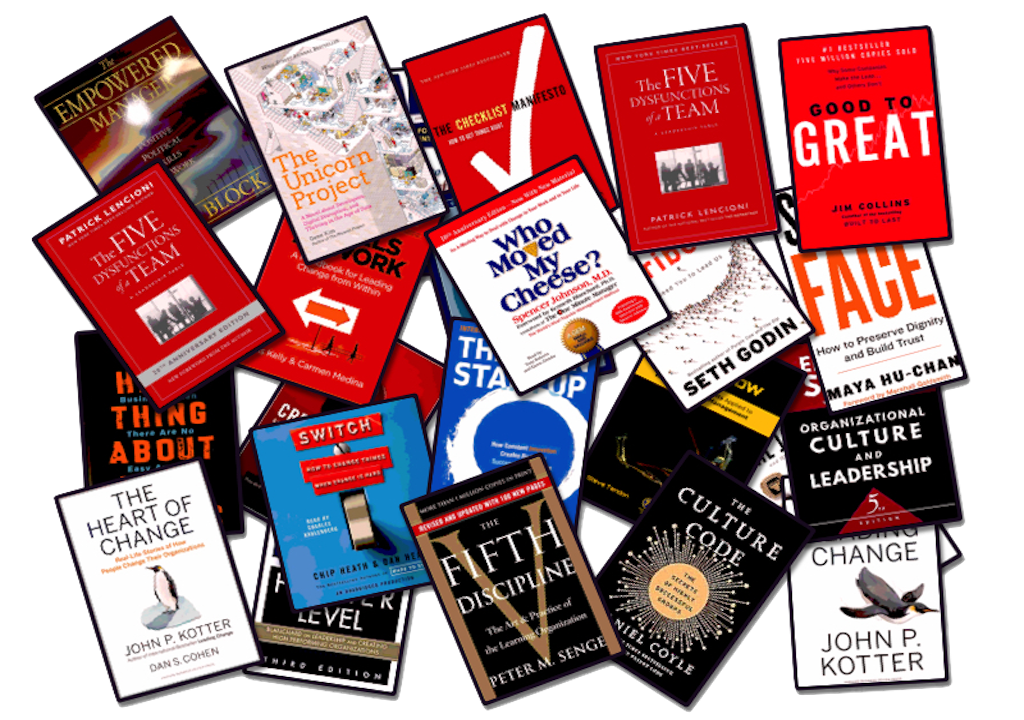
Note, the books below is a small sampling of books consumed, often more than once, to specifically benefit in systemically understanding and incrementally improving rituals within teams and organizations. A longer list, though also not entirely current can be found here.
Atomic Habits by James Clear
An Easy & Proven Way to Build Good Habits & Break Bad Ones. While this book specifically address the habits we hold and live by as individuals, many of the concepts and approaches can be extrapolated to apply to teams and organizations. This is especially true for teams and organizations that have matured to a point of functioning as one entity or organism comprised of symbiotic/complimentary members.
Leading at a Higher Level by Ken Blanchard
Emphasizes on continuous improvement and developing leadership at all levels with an incremental approach
Organizational Culture and Leadership by Edgar H. Schein
Discusses the role of leaders in shaping culture through consistent, small actions and rituals.
Primal Leadership by Daniel Goleman, Richard E. Boyatzis, and Annie McKee
Focuses on the role of emotional intelligence in leadership. It stresses the importance of incremental, emotionally intelligent interactions in shaping a supportive and effective leadership style.
The Dichotomy of Leadership by Jocko Willink and Leif Babin is interesting because it seems to have notably fewer readers than their first book “Extreme Ownership” and yet a primary focus of the second book is to correct for nuances missed in the first. The Dichotomy emphasizes the importance of balance in leadership actions. Suggesting that small, balanced adjustments in leadership style can lead to significant, positive changes in team dynamics and performance.The book’s focus on balancing dichotomies suggests that leaders must adapt their behaviors incrementally, depending on the situation. This adaptability is a key aspect of “Atomic Rituals,” where small, context-sensitive changes drive overall improvement.
Better Thinking, Better Results: Case Study and Analysis of an Enterprise-Wide Lean Transformation by Bob Emiliani
Emphasizes the importance of continuous improvement through small, incremental changes. Lean principles advocate for identifying and eliminating waste, improving processes bit by bit.
The Checklist Manifesto – How to Get Things Right by Atul Gawande
The use of checklists breaks down complex tasks into smaller, manageable steps, ensuring that each step is completed correctly. Gawande emphasizes the importance of a systematic approach to complex tasks, using checklists to ensure no steps are overlooked.
The Unicorn Project – A Novel About Developers, Digital Disruption, and Thriving in the Age of Data by Gene Kim
Highlights the need for continuous improvement and small, iterative changes to drive progress. The protagonists implement DevOps practices and agile methodologies, which focus on incremental improvements.
The Book of TameFlow: Theory of Constraints Applied to Knowledge-Work Management by Steve Tendon
Tendon advocates for identifying and addressing constraints in knowledge work processes through small, manageable changes. This iterative process ensures that the most critical issues are tackled first, leading to continuous improvement.
The Fifth Discipline by Peter Senge
Introduces the idea of the “learning organization,” where teams are continually learning and evolving together. Senge emphasizes the importance of systems thinking, which views the organization as a complex, interrelated system where the whole is greater than the sum of its parts.
- Personal Mastery – small, incremental changes to their behaviors and practices.
- Mental Models – small, new rituals, to shift and improve team perspectives and processes
- Shared Vision – ensuring movement in one direction through consistent, small actions.
- Team Learning – fostering an environment of collaboration and continuous feedback.
- Systems Thinking – small changes with significant impact on the larger system
- Empowerment and Engagement – encouraging/enabling personal and collective growth
The Culture Code by Daniel Coyle
Explores how successful groups create a sense of belonging and shared identity. He emphasizes the importance of creating safety, sharing vulnerability, and establishing purpose. These elements foster a strong collective identity and make the team function seamlessly as a unit.
The Empowered Manager: Positive Political Skills at Work by Peter Block
Emphasizes small actions to build political skills and drive change aligns well with the concept of incremental organizational transformation.
Saving Face: How to Preserve Dignity and Build Trust byMaya Hu-Chan
Preserving dignity through small, respectful actions
Rebels at Work: A Handbook for Leading Change from Within by Lois Kelly and Carmen Medina
Leading change from within through incremental actions
Tribes by Seth Godin
Explores the idea of leadership and community-building within organizations, emphasizing the importance of forming tribes. Within these tribes, rituals play a crucial role in defining and reinforcing group identity, cohesion, and culture.
Dare to Lead by Brené Brown
Highlights the importance of vulnerability and courage in leadership, similar to how “Atomic Rituals” encourages leaders to embrace small acts of openness and honesty to build a strong, trust-based organizational culture.
The impact of small, consistent acts of vulnerability and authenticity in creating a resilient and transparent leadership culture.
Leaders Eat Last by Simon Sinek
Discusses how leaders who prioritize their team’s well-being create environments of trust and cooperation to focus on building a supportive culture through small, consistent acts of care and leadership.
Supernormal – The Untold Story of Adversity and Resilience by Meg Jay
Explores the concept of resilience and how individuals can overcome significant challenges and adversity to achieve remarkable success. This theme aligns with the concept of “Atomic Rituals” in several meaningful ways:
- Overcoming Adversity Through Small Steps
- Building Resilience through Continuous Improvement and Adaptability
- The Power of Rituals and Habits
- Coping Mechanisms and Adaptability
Leading Change by John P. Kotter
Outlines his eight-step process for leading change in organizations, which has become a foundational framework for change management.
Switch: How to Change Things When Change Is Hard by Chip Heath and Dan Heath
Delves into the psychology of change, exploring how to harmonize the rational and emotional aspects of the human mind to drive successful change.
The Hard Thing About Hard Things – Building a Business When There Are No Easy Answers by Ben Horowitz
Offers essential advice on building and running a startup – practical wisdom for managing the toughest problems business school doesn’t cover,
Creativity, Inc. – Overcoming the Unseen Forces That Stand in the Way of True Inspiration by Ed Catmull
Reflects on the management principles that built Pixar’s singularly successful culture.
Who Moved My Cheese? by Spencer Johnson and Kenneth Blanchard
Good to Great by Jim Collins
A business fable about two mice and two small people in a maze, dealing with change in their search for cheese, which serves as a metaphor for achieving goals.
Introduces the idea of Level 5 Leadership and the importance of having the right people in the right seats. He emphasizes creating a culture of discipline and humility, which leads to a cohesive, high-performing team that operates with a strong collective identity.
The Five Dysfunctions of a Team by Patrick Lencioni
Discusses the importance of building a cohesive leadership team. He argues that when trust, conflict, commitment, accountability, and results are properly managed, the team functions as a unified entity.
The Heart of Change: Real-Life Stories of How People Change Their Organizations by
John P. Kotter and Dan S. Cohen – Building on Kotter’s earlier work, this book uses real-life stories to illustrate how emotional connections can drive successful change.
ADKAR: A Model for Change in Business, Government and our Community by Jeffrey M. Hiatt
Provides a structured approach to change management, focusing on five key building blocks: Awareness, Desire, Knowledge, Ability, and Reinforcement.
Eleven Rings The Soul of Success by Phil Jackson
Through his rituals of bringing teams together, Jackson led his teams to the ultimate goal: the NBA championship – six times with the Chicago Bulls and five times with the Los Angeles Lakers.
The Lean Startup – How Today’s Entrepreneurs Use Continuous Innovation to Create Radically Successful Businesses by Eric Ries
Describes a method for developing businesses and products that aims to shorten product development cycles and rapidly discover if a proposed business model is viable. The book focuses on creating hypotheses about what the product should be, developing minimal viable products (MVPs) to test these hypotheses, and using customer feedback to iterate and optimize. However, while I worked at the Lean Startup (IMVU) I introduced Atomic Rituals to improve organization processes as well as further improving product development cycles.
Glossary of Terms and Concepts for Atomic Rituals
This glossary captures all essential concepts and terms as an authoritative resource for Atomic Rituals. Note, the hyperlinks on the titles drill down further on the concept or term in greater detail.
10x Growth
The concept of achieving exponential improvement through small, consistent actions that amplify individual or team performance.
Allies
Positive forces, behaviors, or dynamics that support growth, innovation, and alignment. Allies often help individuals and teams overcome challenges and reach their potential.
Andon Cord
A concept from the Toyota Production System where workers can halt production to address quality issues immediately, promoting a culture of continuous improvement and problem-solving.
Atomic Constraint Cycle
An iterative framework for identifying the most critical constraint in a system, improving it through focused, incremental actions, and then reassessing to address the next constraint. This cycle ensures continuous, high-impact growth.
Atomic Rituals
Small, intentional practices embedded into daily routines or organizational processes that drive incremental, meaningful improvements over time. They compound to create significant personal, team, or organizational transformation.
Autonomy, Mastery, Purpose
Key motivators identified by Daniel Pink in his book Drive, suggesting that individuals are driven by the desire for autonomy (control over work), mastery (improvement of skills), and purpose (meaningful work).
Best Practices
Context-specific actions or strategies derived through iterative improvement. Unlike static, one-size-fits-all solutions, best practices emerge from experimentation and refinement in specific environments.
Build-Measure-Learn Cycle
A feedback loop popularized by Eric Ries in The Lean Startup, emphasizing rapid prototyping, measuring results, and learning from the outcomes to drive continuous improvement.
Ceremonies
Defined, often rigid, activities or events in Agile frameworks, such as sprint planning or retrospectives. Differentiated from rituals by their prescribed nature, ceremonies may evolve into rituals when personalized and embedded into team culture.
Confidence Villains
Self-sabotaging beliefs or behaviors that undermine confidence. Rituals that emphasize incremental progress and reflection help individuals overcome these obstacles.
Constraint Theory
A concept popularized by The Phoenix Project, which focuses on identifying and improving the bottleneck in a system to maximize its overall performance.
Deep Practice
Engaging in practice methods that involve breaking down skills into smaller components, practicing them slowly, and gradually increasing complexity to build mastery.
Deliberate Practice
A focused and purposeful approach to practicing skills, emphasizing continuous improvement through targeted exercises and feedback.
Empowerment
The practice of enabling teams and individuals to take ownership of their processes and evolve practices incrementally. Empowerment acknowledges that what works for one group may not work for another, fostering adaptability and autonomy.
Experiments
Small, controlled trials designed to test new ideas or processes. Atomic improvements often stem from experiments, where the small scale ensures minimal risk if results are negative, while offering valuable insights for refinement.
Feedback Loops
Mechanisms for gathering continuous input from individuals, teams, or systems. Feedback loops are critical for assessing the effectiveness of rituals and identifying areas for improvement.
Group Evolution
The process by which teams grow and transform over time through shared experiences, challenges, and rituals. Atomic rituals serve as catalysts for navigating and accelerating this evolution.
Groupthink
A collective saboteur where the desire for harmony suppresses dissent and innovation. Rituals that encourage diverse perspectives can mitigate this dynamic.
Huddles
Brief, structured meetings where teams align on goals, share updates, and address constraints. A foundational ritual for building trust and collaboration.
Incremental Improvement
The philosophy of making small, manageable changes to systems, processes, or behaviors. These changes compound over time to drive sustained growth and innovation.
In-game Focus Rituals
Practices that help maintain composure and focus under pressure, such as breathing techniques or self-affirmations.
Kaizen
A Japanese philosophy of continuous improvement through small, incremental changes, fostering a culture of sustained development and efficiency.
Lean Out
A leadership philosophy of stepping back to empower teams, fostering autonomy and accountability while ensuring leaders focus on enabling systems rather than micromanaging.
Meta-Rituals
The “rituals of rituals”—processes or practices that reflect on, refine, and improve existing rituals to ensure their relevance and effectiveness. Meta-rituals create a framework for continuous cultural and operational evolution.
Myelination
The process of forming a myelin sheath around nerve fibers, which increases the speed and efficiency of neural connections. Repetitive practice leads to myelination, enhancing performance.
Organizational Patterns
Reusable frameworks for addressing common constraints and challenges within teams or systems. These patterns provide a foundation for designing effective rituals.
Post-game Reflection Rituals
Structured moments for analyzing outcomes, celebrating successes, and identifying areas for growth. These rituals ensure continuous learning and improvement.
Pre-game Routines
Rituals designed to mentally and physically prepare individuals or teams for performance. Common in sports, these routines also translate effectively to professional contexts.
Primal Cues
Intrinsic signals or motivations that drive individuals to engage deeply in practice and learning, often linked to fundamental human desires for competence and autonomy.
Psychological Safety
The sense of security individuals feel to take risks, share ideas, and communicate openly without fear of judgment or retribution. Rituals like structured feedback sessions help foster psychological safety.
Radical Candor
A cultural practice that encourages honest, constructive feedback while fostering trust and respect. Rituals around communication help teams embrace candor as a norm.
Regenerative Organizations
Organizations that continually renew and adapt by embedding rituals that sustain resilience, innovation, and alignment with evolving goals.
Relentless Incrementalism
A mindset that prioritizes small, consistent improvements as a means to drive transformative outcomes over time.
REPS Approach
A deliberate practice framework that stands for:
- Reaching/Repeating: Stretching beyond current abilities.
- Engagement: Focused participation.
- Purposefulness: Practicing with clear goals.
- Strong, Direct Feedback: Immediate corrections for improvement.
Ritual Audits
A systematic review of existing rituals to evaluate their effectiveness and alignment with organizational goals. Audits help identify which rituals should be refined, replaced, or removed.
Ritual Design Workshops
Collaborative sessions where teams co-create or refine rituals to ensure alignment with shared values and goals.
Ritual Resilience
The adaptability and durability of rituals, ensuring they evolve alongside changing organizational needs while maintaining their purpose and effectiveness.
Saboteurs
Internal or external forces that undermine growth, progress, or alignment. These can manifest as individual behaviors (e.g., procrastination) or collective dynamics (e.g., resistance to change).
Sports Rituals
Rituals used by athletes and teams to enhance focus, build discipline, and foster unity. These serve as a metaphor and practical guide for applying rituals in non-sports contexts.
Talent Whispering
A coaching approach that focuses on unlocking individual and collective potential through subtle, intentional actions. Atomic rituals are a key tool in this methodology.
The Talent Code
A framework for skill development through deliberate practice, which aligns with creating atomic rituals for consistent improvement.
Value Stream Mapping
A tool for visualizing workflows to identify inefficiencies and constraints within processes. Essential for targeting areas where rituals can be improved or introduced.
Target Audience
The audience for Atomic Rituals includes individuals who resonate with the principles in Atomic Habits and are now eager to explore how small, intentional practices can create transformation not just within themselves but across their groups, teams, or organizations. These readers are curious, growth-oriented individuals who recognize the power of incremental change and are seeking to harness it in fostering collaboration, trust, and alignment in the contexts where they lead.
The target audience is on their own Leader’s Journey—one of continuous growth and evolution while navigating the complexities of leadership in various forms. They relate to the challenges and triumphs of leadership as portrayed through the narrative of Sarah and the practical frameworks provided, finding inspiration and tools for their own path.
Primary Audience
- Leaders and Aspiring Leaders:
- Managers, executives, and team leaders seeking practical tools to improve team performance and organizational culture.
- Professionals newly stepping into leadership roles who need a roadmap to build trust and cohesion within their teams.
- Experienced leaders looking for incremental methods to enhance their leadership style and strengthen their teams.
- Professionals and Entrepreneurs:
- Founders, startup leaders, and innovators managing the dual challenges of scaling their businesses and aligning their teams.
- Individuals who recognize the importance of personal and team rituals in driving collective success.
- Coaches, Educators, and Mentors:
- Executive coaches, leadership coaches, and organizational development professionals who want actionable frameworks to guide their clients.
- Teachers, sports coaches, and mentors guiding groups toward shared goals and growth.
Secondary Audience
- Personal Growth Enthusiasts:
- Readers of Atomic Habits who are inspired to extend their understanding of small changes from personal habits to team dynamics.
- Individuals leading informally in their communities, families, or peer groups, recognizing that leadership happens in everyday life.
- Teams and Organizations:
- Companies fostering leadership development, group cohesion, and adaptability through intentional practices.
- HR professionals and organizational development specialists embedding meaningful rituals into workplace culture.
Why This Audience Will Find Atomic Rituals Valuable
Whether in Ries’ The Lean Startup, Boyd’s OODA Loop, Epstein’s Range, Coyle’s Talent Code’s REPS, Toyota’s TPS, Collins’ Great by Choice, or Christensen’s Jobs to be Done the notion of small, iterative steps in cycles of continuous refinement and improvement echo’s through much literature about building effective teams and businesses.
The Leader’s Journey Connection:
Readers will see their own experiences reflected in Sarah’s story and Bill’s mentorship, connecting deeply with the relatable challenges and opportunities of leadership.
The book mirrors the arc of growth they seek—starting with self-awareness and trust-building and evolving into navigating challenges, fostering collaboration, and celebrating success.
Alignment with Atomic Habits:
Just as Atomic Habits demonstrated the power of small actions for individual transformation, Atomic Rituals extends this to group and organizational dynamics, offering a logical next step for readers inspired by incremental change.
Relatable and Actionable:
Through its narrative and practical exercises, the book ensures readers can both envision the transformation and implement it immediately in their contexts.
Universal Applicability:
The broad appeal of the book recognizes that leadership isn’t confined to formal titles; it exists in every facet of life. This inclusivity ensures readers from varied backgrounds see themselves in the journey.
Practical Guidance for Change:
The embedded exercises and rituals serve as adaptable tools, encouraging readers to experiment and tailor the ideas to their unique situations and goals.
Building on Proven Success:
Concepts such as trust-building, psychological safety, and the Leader’s Journey provide a rich framework for collective transformation, bridging the gap between personal development and team growth.
The book also resonates as relevant as it draws heavily on the author’s own Leader’s Journey that spans four decades of leadership role at disruptive tech companies that beat the odds to achieve tremendous success. A journey that combined learning on the job with continuous reading of leadership books and listening to expert talks on leadership.

