
MIT: Anchoring Focus with Atomic Rituals
Introduction
The concept of MIT (Most Important Task) serves as a practical anchor for productivity, emphasizing prioritization, focus, and meaningful progress. When integrated with the framework of Atomic Rituals, MIT becomes a tool for systematically addressing constraints, fostering alignment, and driving individual and collective growth. By treating each day as a cycle to identify and address the most critical constraint, MIT reflects the principles of Constraint Theory and aligns with the incremental progress model of MVPs (Minimum Viable Products).
In this context, MIT is not just a productivity tool but a ritual for leaders and teams to navigate complexity, ensure alignment, and achieve sustainable growth.
The MIT Cycle as an Atomic Ritual
- Daily Prioritization as an MVP:
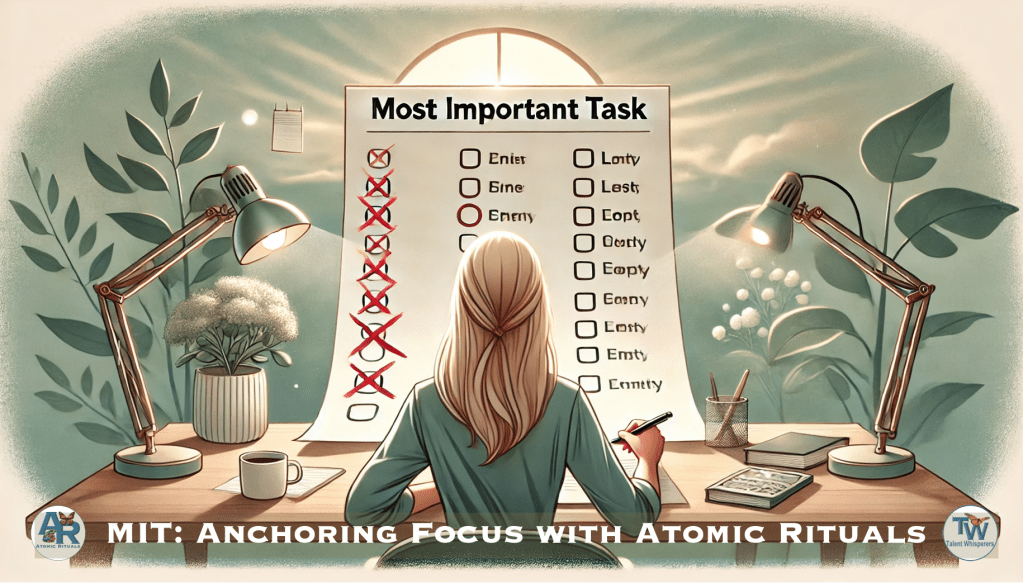
- At the start of each day, identify 10 key tasks (or fewer, depending on the scale of work).
- Circle the single Most Important Task that will have the highest impact on progress for the day. This mirrors the idea of focusing on the most critical constraint within a system.
- Focused Execution:
- Dedicate uninterrupted time to completing the MIT. Treat it as an atomic ritual—a deliberate, meaningful step forward.
- Avoid multitasking or shifting focus until the task is completed, reinforcing the principle of achieving depth over breadth.
- Reassessment and Iteration:
- Once the MIT is accomplished, reassess the current state of the system or project. Just as improving one constraint may reveal a new bottleneck, completing an MIT sets the stage for identifying the next most critical task.
- Continue iterating throughout the day or week, using each cycle to build momentum.
Why the MIT Method Resonates with Atomic Rituals
- Alignment with Constraints and Prioritization:
- MIT focuses energy on what matters most, aligning with the philosophy of addressing the most significant constraint to achieve progress.
- By narrowing focus to one critical task, the MIT method embodies the principle of solving for high-leverage areas first.
- Incremental Progress with Rituals:
- Just as Atomic Rituals emphasize small, intentional steps, the MIT method encourages daily wins that build momentum and reinforce positive habits.
- Each MIT completed is a micro-achievement that contributes to long-term goals.
- Simplicity and Clarity:
- The MIT method eliminates decision fatigue by simplifying priorities, enabling individuals and teams to focus on impactful actions rather than being overwhelmed by lengthy to-do lists.
- Feedback Loops for Continuous Improvement:
- Similar to Constraint Theory cycles, MIT incorporates reflection and reassessment. This ensures that each day begins with clarity on the next critical task, fostering a culture of adaptability and continuous learning.
Adopting MIT as a Daily Atomic Ritual
- Morning Ritual for Prioritization:
- Begin each day by identifying your MIT. Frame it as a deliberate choice to address the most impactful constraint or opportunity.
- Align the task with overarching goals and team objectives to ensure strategic focus.
- Time-Blocking for Focused Work:
- Dedicate a specific time block to working on the MIT, preferably during peak productivity hours. Treat this time as sacred, free from interruptions or distractions.
- Celebrate Wins and Reflect:
- Upon completing the MIT, take a moment to acknowledge the progress made. Use this opportunity to reassess the current state and identify the next constraint or priority.
- Example: A team completing a crucial debugging task might use a retrospective to celebrate the improvement while identifying the next technical bottleneck.
MIT in Team and Organizational Contexts
- Shared MITs for Alignment:
- Teams can adopt the MIT framework collectively by identifying the day’s most critical shared task or objective. This ensures alignment and prevents diffusion of focus.
- Example: A product team prioritizing a user feedback analysis session as their MIT ensures clarity and collaboration.
- Integrating MIT with Constraint Theory:
- Organizations can scale the MIT concept by aligning it with systemic constraints. Each team’s MIT can address a specific area of improvement, creating a cascading effect of progress throughout the organization.
- Example: While one team focuses on improving deployment speed, another may tackle customer onboarding processes, each addressing a key bottleneck.
- Embedding MITs into Rituals:
- Incorporate MIT discussions into existing team rituals, such as daily stand-ups or weekly planning sessions. This keeps the focus on high-priority tasks while reinforcing accountability and alignment.
Practical Tips for Effective MIT Rituals
- Anchor MITs to Long-Term Goals:
- Ensure that each MIT is connected to broader objectives, creating a direct line between daily actions and strategic outcomes.
- Example: For a startup scaling its infrastructure, an MIT might involve optimizing a critical database query to improve system performance.
- Limit the Scope:
- Focus on one MIT per day to avoid splitting attention. If the task is completed early, reassess and identify the next priority.
- Create Feedback Loops:
- Use retrospectives or end-of-day reviews to evaluate the impact of completed MITs. This builds a culture of continuous improvement.
- Celebrate Small Wins:
- Recognize and celebrate the completion of MITs, reinforcing the value of incremental progress and maintaining motivation.
Conclusion
The MIT method, when integrated into the framework of Atomic Rituals, becomes a powerful tool for achieving focus, alignment, and sustainable progress. By anchoring daily efforts to the most critical task and treating it as a meaningful ritual, leaders and teams can navigate complexity, address constraints, and drive transformation. Like the iterative cycles of Constraint Theory, the MIT approach ensures that progress is both intentional and adaptive, creating a foundation for long-term success.
MIT: Anchoring Focus with Atomic Rituals
Introduction
The concept of MIT (Most Important Task) serves as a practical anchor for productivity, emphasizing prioritization, focus, and meaningful progress. When integrated with the framework of Atomic Rituals, MIT becomes a tool for systematically addressing constraints, fostering alignment, and driving individual and collective growth. By treating each day as a cycle to identify and address the most critical constraint, MIT reflects the principles of Constraint Theory and aligns with the incremental progress model of MVPs (Minimum Viable Products).
In this context, MIT is not just a productivity tool but a ritual for leaders and teams to navigate complexity, ensure alignment, and achieve sustainable growth.
The MIT Cycle as an Atomic Ritual
- Daily Prioritization as an MVP:
- At the start of each day, identify 10 key tasks (or fewer, depending on the scale of work).
- Circle the single Most Important Task that will have the highest impact on progress for the day. This mirrors the idea of focusing on the most critical constraint within a system.
- Focused Execution:
- Dedicate uninterrupted time to completing the MIT. Treat it as an atomic ritual—a deliberate, meaningful step forward.
- Avoid multitasking or shifting focus until the task is completed, reinforcing the principle of achieving depth over breadth.
- Reassessment and Iteration:
- Once the MIT is accomplished, reassess the current state of the system or project. Just as improving one constraint may reveal a new bottleneck, completing an MIT sets the stage for identifying the next most critical task.
- Continue iterating throughout the day or week, using each cycle to build momentum.
Why the MIT Method Resonates with Atomic Rituals
- Alignment with Constraints and Prioritization:
- MIT focuses energy on what matters most, aligning with the philosophy of addressing the most significant constraint to achieve progress.
- By narrowing focus to one critical task, the MIT method embodies the principle of solving for high-leverage areas first.
- Incremental Progress with Rituals:
- Just as Atomic Rituals emphasize small, intentional steps, the MIT method encourages daily wins that build momentum and reinforce positive habits.
- Each MIT completed is a micro-achievement that contributes to long-term goals.
- Simplicity and Clarity:
- The MIT method eliminates decision fatigue by simplifying priorities, enabling individuals and teams to focus on impactful actions rather than being overwhelmed by lengthy to-do lists.
- Feedback Loops for Continuous Improvement:
- Similar to Constraint Theory cycles, MIT incorporates reflection and reassessment. This ensures that each day begins with clarity on the next critical task, fostering a culture of adaptability and continuous learning.
Adopting MIT as a Daily Atomic Ritual
- Morning Ritual for Prioritization:
- Begin each day by identifying your MIT. Frame it as a deliberate choice to address the most impactful constraint or opportunity.
- Align the task with overarching goals and team objectives to ensure strategic focus.
- Time-Blocking for Focused Work:
- Dedicate a specific time block to working on the MIT, preferably during peak productivity hours. Treat this time as sacred, free from interruptions or distractions.
- Celebrate Wins and Reflect:
- Upon completing the MIT, take a moment to acknowledge the progress made. Use this opportunity to reassess the current state and identify the next constraint or priority.
- Example: A team completing a crucial debugging task might use a retrospective to celebrate the improvement while identifying the next technical bottleneck.
MIT in Team and Organizational Contexts
- Shared MITs for Alignment:
- Teams can adopt the MIT framework collectively by identifying the day’s most critical shared task or objective. This ensures alignment and prevents diffusion of focus.
- Example: A product team prioritizing a user feedback analysis session as their MIT ensures clarity and collaboration.
- Integrating MIT with Constraint Theory:
- Organizations can scale the MIT concept by aligning it with systemic constraints. Each team’s MIT can address a specific area of improvement, creating a cascading effect of progress throughout the organization.
- Example: While one team focuses on improving deployment speed, another may tackle customer onboarding processes, each addressing a key bottleneck.
- Embedding MITs into Rituals:
- Incorporate MIT discussions into existing team rituals, such as daily stand-ups or weekly planning sessions. This keeps the focus on high-priority tasks while reinforcing accountability and alignment.
Practical Tips for Effective MIT Rituals
- Anchor MITs to Long-Term Goals:
- Ensure that each MIT is connected to broader objectives, creating a direct line between daily actions and strategic outcomes.
- Example: For a startup scaling its infrastructure, an MIT might involve optimizing a critical database query to improve system performance.
- Limit the Scope:
- Focus on one MIT per day to avoid splitting attention. If the task is completed early, reassess and identify the next priority.
- Create Feedback Loops:
- Use retrospectives or end-of-day reviews to evaluate the impact of completed MITs. This builds a culture of continuous improvement.
- Celebrate Small Wins:
- Recognize and celebrate the completion of MITs, reinforcing the value of incremental progress and maintaining motivation.
Conclusion
The MIT method, when integrated into the framework of Atomic Rituals, becomes a powerful tool for achieving focus, alignment, and sustainable progress. By anchoring daily efforts to the most critical task and treating it as a meaningful ritual, leaders and teams can navigate complexity, address constraints, and drive transformation. Like the iterative cycles of Constraint Theory, the MIT approach ensures that progress is both intentional and adaptive, creating a foundation for long-term success.
Appendix 2: MIT, Constraint Theory Rituals using Talent Code’s REPS
Introduction
The REPS framework (Repetition, Engagement, Purposefulness, and Support) described in Talent Code complements the MIT (Most Important Task) method and Constraint Theory by emphasizing deliberate practice, focus, and incremental improvement. When integrated into Atomic Rituals, REPS provides a structure for leaders and teams to continuously refine their approach to constraints and critical tasks, ensuring consistent and meaningful progress.
This appendix explores how REPS enhances the effectiveness of MIT and Constraint Theory rituals, creating a foundation for long-term adaptability and growth.
Understanding Talent Code’s REPS Framework
- Repetition:
- Emphasizes consistent practice to develop mastery and confidence.
- Example: Revisiting a system bottleneck daily to ensure progress and alignment with goals.
- Engagement:
- Focuses on fully immersing oneself in the task or challenge at hand, with active participation and concentration.
- Example: Prioritizing a Most Important Task that demands critical thinking and hands-on involvement.
- Purposefulness:
- Aligns actions with clear goals and objectives, ensuring that every step contributes to meaningful outcomes.
- Example: Addressing constraints in a way that directly impacts team performance or project success.
- Support:
- Builds an environment where individuals and teams receive guidance, feedback, and encouragement to sustain progress.
- Example: Engaging in collaborative retrospectives to identify lessons and next steps.
Coupling REPS with MIT and Constraint Theory
- Repetition: Consistent Cycles of Constraint Improvement
- Integrate REPS’ emphasis on repetition into MIT rituals by consistently revisiting the most critical constraint.
- Example: A team working on reducing deployment time focuses daily efforts on specific parts of the pipeline, refining the process through repeated iterations.
- Engagement: Active Focus on the MIT
- Leverage REPS’ engagement principle to ensure focused attention on the MIT. Encourage deep involvement rather than surface-level effort.
- Example: Engineers dedicating uninterrupted blocks of time to debugging a core issue, fully immersing themselves in the task.
- Purposefulness: Aligning MIT with Broader Goals
- Use REPS’ purposefulness to align the MIT with overarching objectives, ensuring that efforts address high-priority constraints.
- Example: Prioritizing infrastructure improvements that enable long-term scalability aligns immediate efforts with strategic goals.
- Support: Feedback and Collaboration
- Incorporate REPS’ support principle by creating collaborative environments where teams share insights, provide feedback, and refine their approaches to MITs.
- Example: Using team stand-ups or retrospectives to discuss progress on the MIT and adjust strategies based on feedback.
Practical Steps for Integrating REPS into MIT Rituals
- Daily Repetition as Ritual:
- Start each day by revisiting the MIT and its associated constraint. Repetition ensures consistent progress and reinforces focus on high-impact areas.
- Example: A marketing team starts each day by addressing the most critical audience feedback.
- Engagement through Deep Work:
- Dedicate uninterrupted time to the MIT, fostering full engagement and minimizing distractions.
- Example: Developers allocate specific hours for focused work on optimizing system performance.
- Purposeful Planning and Reflection:
- Plan MITs that align with long-term goals and conduct daily reflections to assess their impact.
- Example: A product manager prioritizes a user survey analysis as an MIT, ensuring that insights align with product development objectives.
- Supportive Collaboration:
- Foster a culture of shared responsibility and feedback, where teams work collectively to overcome constraints.
- Example: Teams conduct weekly reviews to discuss MIT outcomes, share lessons, and plan for future cycles.
MIT, REPS, and Constraint Theory in Practice
- Feedback Loops for Continuous Improvement:
- REPS reinforces the importance of feedback in addressing constraints. By integrating regular feedback cycles, teams can refine their approach to MITs and constraints.
- Example: A sales team uses customer feedback to iteratively improve their pitch, addressing constraints in client engagement.
- Scaling Repetition Across Teams:
- Apply the repetition principle to organizational goals by aligning team MITs with systemic constraints, creating a ripple effect of improvement.
- Example: While one team focuses on improving code deployment, another optimizes user onboarding workflows, collectively enhancing the product.
- Purposeful Rituals for Systemic Change:
- Purpose-driven MITs align individual efforts with organizational transformation, ensuring that every action contributes to broader goals.
- Example: A cross-functional initiative prioritizes reducing time-to-market for new features, using REPS principles to maintain focus and alignment.
Conclusion
By integrating REPS with MIT rituals and Constraint Theory, leaders and teams can create a structured approach to continuous improvement. Repetition builds mastery, engagement fosters focus, purposefulness ensures alignment, and support sustains momentum. Together, these principles form the foundation for iterative progress, driving meaningful outcomes and fostering a culture of adaptability and resilience within the framework of Atomic Rituals.
Appendix 3: MIT, Constraint Theory Rituals using BML – Build Measure Learn
Introduction
The Build-Measure-Learn (BML) loop, popularized by The Lean Startup by Eric Ries, aligns seamlessly with the MIT (Most Important Task) method and Constraint Theory. This iterative framework emphasizes rapid experimentation, learning from feedback, and continuous improvement—principles that resonate deeply with Atomic Rituals. By integrating BML, leaders and teams can enhance their approach to addressing constraints, focusing on high-impact tasks, and fostering organizational agility.
This appendix explores how BML complements MIT and Constraint Theory rituals, creating a structured path for innovation and progress.
Understanding the BML Loop
- Build:
- Create a small, testable version of a solution (e.g., an MVP or experiment).
- Focus on speed and simplicity to validate hypotheses with minimal investment.
- Example: Develop a prototype for a new feature that addresses a key customer pain point.
- Measure:
- Collect data and feedback from users or stakeholders to assess the impact of the solution.
- Ensure metrics align with the desired outcomes and goals.
- Example: Use customer surveys or analytics to determine whether the new feature improves user engagement.
- Learn:
- Analyze the data to identify insights, validate assumptions, and refine the approach.
- Use these insights to iterate, pivot, or proceed with the next cycle of improvement.
- Example: Discover that users prefer a simplified version of the feature and adjust development priorities accordingly.
Coupling BML with MIT and Constraint Theory
- Build: Creating Focused MITs
- Use the “Build” phase to define an MIT that directly addresses the current constraint or highest-priority task.
- Example: If slow deployment times are the constraint, the MIT might involve creating a script to automate part of the deployment process.
- Measure: Evaluating Progress and Impact
- Leverage the “Measure” phase to assess whether the MIT effectively addresses the constraint.
- Example: After automating the deployment script, measure the reduction in deployment times and its impact on team efficiency.
- Learn: Refining Future MITs
- Use insights from the “Learn” phase to identify the next constraint or refine the approach for greater impact.
- Example: Discover that while deployment times improved, testing remains a bottleneck, setting the stage for the next MIT.
Practical Steps for Integrating BML into MIT Rituals
- Define a Clear Hypothesis for Each MIT:
- Treat each MIT as an experiment with a specific hypothesis to test.
- Example: “Automating code reviews will reduce average cycle times by 20%.”
- Rapidly Build and Test Solutions:
- Focus on creating small, actionable solutions that address the constraint. Avoid over-engineering or perfectionism.
- Example: Develop a simple dashboard to visualize team workflow bottlenecks as a first step.
- Collect Meaningful Metrics:
- Use data to measure the effectiveness of the MIT. Ensure metrics align with the broader goals of the organization.
- Example: Monitor the number of pull requests processed per day to evaluate the impact of a new review workflow.
- Incorporate Feedback Loops:
- Regularly review results with the team to identify lessons and refine future MITs.
- Example: Conduct a weekly retrospective to discuss the outcomes of the current BML cycle and plan the next iteration.
BML, MIT, and Constraint Theory in Action
- Streamlining Workflows:
- Use the BML loop to iteratively address constraints in workflows, with each MIT focusing on a specific improvement.
- Example: A DevOps team cycles through automating builds, improving test coverage, and optimizing deployment times.
- Enhancing Customer Experience:
- Combine BML and MIT rituals to experiment with customer-facing features, measuring their impact on satisfaction and engagement.
- Example: A product team tests different onboarding flows to identify the most effective approach for user retention.
- Scaling Organizational Learning:
- Apply the BML loop across teams to create a culture of experimentation and continuous improvement.
- Example: Marketing, sales, and engineering teams align their MITs around a shared objective, such as improving lead conversion rates.
The Role of Metrics in BML and MIT Rituals
- Actionable Metrics vs. Vanity Metrics:
- Focus on metrics that drive meaningful action rather than surface-level indicators.
- Example: Track customer retention rates instead of raw sign-up numbers.
- Feedback-Driven Prioritization:
- Use data to inform the next MIT, ensuring that each cycle builds on the insights of the previous one.
- Example: If a marketing campaign improves click-through rates but not conversions, the next MIT might focus on refining landing pages.
- Systemic Metrics for Constraint Theory:
- Track metrics that reveal system-wide constraints, such as throughput, lead times, or defect rates.
- Example: Monitor bottlenecks in production workflows to guide MIT prioritization.
Conclusion
Integrating BML with MIT rituals and Constraint Theory creates a dynamic framework for iterative improvement and innovation. By treating each MIT as a focused experiment within the BML loop, leaders and teams can address constraints systematically, learn from feedback, and drive meaningful progress. This approach embodies the principles of Atomic Rituals, fostering adaptability, clarity, and sustained success in a rapidly changing environment.

