
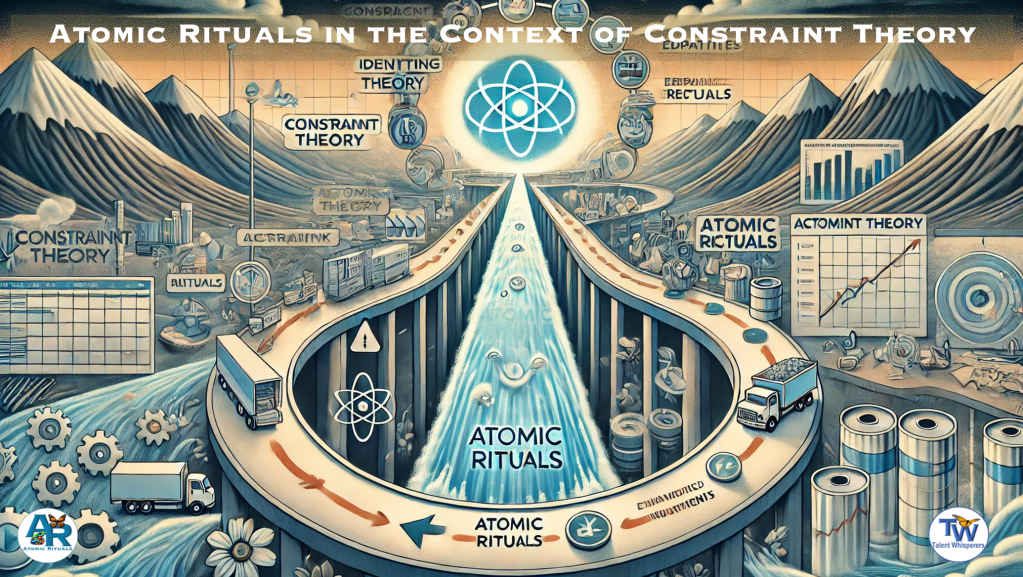
A cyclical approach to identifying and addressing constraints in team rituals—viewing these as “atomic” steps of incremental improvement—creates a virtuous cycle that drives sustained progress and adaptability. By framing the resolution of the Most Critical Constraint (MCC) as the Most Important Task (MIT), teams focus their energy on the area with the highest potential impact. Incorporating ROI considerations ensures resources are applied efficiently, with enough effort to alleviate the constraint without over-compensating or misallocating effort. This balance shifts the constraint to a new area, prompting a continuous cycle of re-evaluation and targeted improvement. The result is an iterative, strategic methodology that fosters alignment, momentum, and resilience, enabling organizations to achieve optimal outcomes even with finite resources or time.
Contents
- Cautionary Warning
- Common Challenges in Building Disruptive Tech
- Key Learning Points: Rituals for Navigating Complexity and Growth
- Key Relevant Atomic Rituals
- Real-World Examples
- Counter Examples
- Key Takeaways
- Further Reading
Cautionary Warning
The focus on incremental improvements, while valuable, can sometimes lead to unintended consequences if not carefully managed. It’s crucial to maintain alignment with strategic objectives and avoid creating technical debt or process debt.
Here are some considerations that could be deadly if overlooked in blindly applying the approach of cyclically, incrementally addressing critical constraints:
- Tactical Adjustments vs. Strategic Alignment: It’s important to ensure that incremental improvements are aligned with the overall strategic goals of the organization. Without this alignment, tactical adjustments can lead to wasted effort and derail the long-term vision.
- Tech-Debt and Process Debt: The constant patching and incremental changes can introduce technical debt, making the software or systems more complex and difficult to maintain. Similarly, process debt can accumulate if incremental improvements are not carefully integrated into existing processes, leading to inefficiencies and inconsistencies.
- ROI of Incremental Improvements: It’s important to consider the return on investment (ROI) of each incremental improvement. Not all improvements will be equally valuable, and some may even create more problems than they solve. It’s crucial to prioritize improvements based on their potential impact and avoid making changes that are too small or insignificant.
- The Importance of Learning: Incremental improvements provide an opportunity to learn and adapt. By continuously evaluating the impact of changes and gathering feedback, organizations can refine their approach and ensure that they are moving in the right direction.
- The Role of Leadership: Effective leadership is essential for ensuring that incremental improvements are aligned with strategic objectives and that the potential risks and trade-offs are carefully considered. Leaders should also foster a culture of learning and experimentation, where teams are encouraged to take risks and try new things.
By being mindful of these considerations and incorporating them into the “Atomic Rituals” approach, organizations can maximize the benefits of incremental improvements while minimizing the risks.
Common Challenges in Building Disruptive Tech
Building a disruptive tech company is akin to navigating uncharted waters. The journey demands constant evolution, rapid innovation, and the ability to adapt in the face of uncertainty. Each company’s path is unique, shaped by its stage of development, market dynamics, competitive landscape, and the strengths and idiosyncrasies of its team. Yet, amidst this diversity, certain foundational rituals emerge as universal. These rituals, which must be customized to fit the unique characteristics of each organization, offer time-tested frameworks for fostering resilience, scalability, and adaptability.
At its core, the success of disruptive tech companies lies not in grand leaps but in cycles of incremental, purposeful improvement. By focusing on identifying and addressing the Most Critical Constraint (MCC) at any given time, organizations can navigate complexity with clarity and efficiency. These foundational rituals create the scaffolding for continuous improvement, ensuring that teams remain aligned with strategic objectives while adapting to the ever-changing demands of their industry.
Key Learning Points: Rituals for Navigating Complexity and Growth
- Constraint Theory as a Guiding Framework:
- Disruptive tech companies must embrace the reality that resources are finite, and progress is determined by their ability to identify and alleviate the most pressing bottleneck. Constraint Theory offers a systematic approach to focus efforts where they will have the most impact.
- Key Insight: By treating each identified constraint as a Most Important Task (MIT), organizations can address challenges methodically, creating a virtuous cycle of improvement.
- Tailoring Rituals to Unique Circumstances:
- Foundational rituals—such as Hiring, Onboarding, Scaling, and Reliability—are critical to every company’s success but must be adapted to the organization’s unique stage, market, and culture.
- Example: A startup addressing rapid growth might prioritize Scaling Rituals, while a more mature company may focus on Reliability Rituals to meet enterprise customer expectations.
- Balancing Tactical and Strategic Alignment:
- While iterative improvements are vital, organizations must avoid the pitfalls of over-correction or patching without purpose. Aligning tactical actions with strategic objectives ensures progress contributes to long-term goals.
- Key Insight: Regular retrospectives and strategic reviews can help teams avoid flip-flopping and maintain cohesion between short-term actions and broader ambitions.
- Embedding Feedback Loops:
- Continuous improvement relies on gathering feedback at every stage of the journey. This includes not only measuring progress but also reassessing constraints to ensure efforts remain focused on high-impact areas.
- Example: Using Build-Measure-Learn (BML) loops, teams can validate assumptions, learn from experiments, and pivot when necessary.
- Investing in Scalability and Adaptability:
- Building for flexibility ensures organizations are prepared to adapt as new constraints emerge. This includes addressing technical debt proactively, designing systems for scalability, and fostering a culture of experimentation.
- Key Insight: Balancing technical improvements with customer needs prevents the accumulation of inefficiencies that can hinder long-term growth.
- Fostering Resilience Through Atomic Rituals:
- Resilience is built on the foundation of small, incremental improvements—atomic steps—that create meaningful progress without overwhelming the system.
- Example: Introducing MVPs and iterative problem-solving cycles can help teams build momentum and address complex challenges without losing focus.
MIT / Critical Constraint Decision Matrix
One possible way to inform prioritization is to leverage a matrix. Creating a matrix to determine the Most Important Task (MIT) or Critical Constraint for a disruptive tech startup or its teams involves a structured way to evaluate and prioritize tasks. Such a matrix would balance strategic alignment, impact, and feasibility while avoiding short-term distractions or misaligned efforts.
A MIT Matrix should balance practicality and efficiency while incorporating elements of established prioritization frameworks like R.I.C.E.. Data-informed decision-making and avoiding the false precision of overly detailed scoring aligns with the need for a pragmatic approach that saves time and avoids over-analysis.
Here’s a simple, single-digit weighted version of an MIT Matrix, inspired by R.I.C.E. and other prioritization methods, but designed to be practical, intuitive, and quick to use:
Here’s what such a matrix might look like:
| Criteria | Weight (1-3) | Description | Score (1-5) | Weighted Score |
| Strategic Alignment | How closely does this task align with long-term company goals or objectives? | |||
| Customer Impact | Does this address a pain point for customers? Does it affect one, some, many, or all customers? Does it strain trust or enable opportunity? | |||
| Business Impact | What is the financial, market, or reputational impact of completing this task or resolving this constraint? How significant is the overall benefit of completing this task? Does it solve a major issue or unlock key value? | |||
| Engineering Velocity Impact & Effort | Will this improve team productivity or remove barriers slowing down progress? How much effort is required relative to the expected benefit? (Lower effort scores higher.) | |||
| Time Sensitivity & Urgency | How urgent is the task? Are there deadlines, external dependencies, or opportunities at risk? Will delays cause significant risks, lost opportunities, or customer frustration? | |||
| Feasibility / ROI | How achievable is the task with current resources, and what is the expected return on investment? | |||
| Risk if Unaddressed | What are the consequences of not completing this task or leaving this constraint unresolved? | |||
| Cross-Functional Impact | Will this task or resolution benefit multiple teams or departments? | |||
| Learning / Innovation Opportunity | Does this task foster learning, innovation, or exploration of new opportunities? |
How to Use the Matrix
1. Assign weights (1 for low, 2 for medium, 3 for high) to each criterion based on its importance to your team or organization.
2. Score each task/constraint on a scale of 1-3 for each criterion.
3. Multiply the weight by the score for each criterion to calculate a Weighted Score.
4. Sum the Weighted Scores to prioritize tasks.
5. The task/constraint with the highest total score informs the decision on the MIT or Critical Constraint.
Example Application – Scenario: Engineering Team at a Disruptive Tech Startup
Potential Tasks:
1. Fix a critical performance bottleneck affecting all users.
2. Implement a new feature requested by a strategic partner.
3. Address mounting tech debt in core systems.
4. Conduct compliance updates for a regulatory deadline.
Enhanced Scoring Example – Tasks for Engineering Team:
1. Resolve database performance bottleneck for an unhappy customer.
2. Address compliance update for regulatory deadline.
3. Implement a new feature for a strategic partner prospect.
4. Rework legacy code to remove tech debt.
Weighted Scores:
| Task | Customer Impact | Impact | Effort | Urgency | Strategic Alignment | Cross-Team Benefit | Total Score |
| Database Bottleneck | 3 | 3 | 2 | 3 | 3 | 3 | 17 |
| Compliance Update | 2 | 3 | 2 | 3 | 2 | 2 | 14 |
| Feature for Strategic Partner | 3 | 2 | 2 | 2 | 3 | 3 | 15 |
| Legacy Code Rework | 1 | 2 | 1 | 2 | 3 | 2 | 11 |
Prioritization Insights:
1. Database Bottleneck (17): Resolving this for an unhappy customer has the highest overall score due to its significant customer impact, urgency, and cross-team benefit.
2. Feature for Strategic Partner (15): Important for securing a potential strategic customer, with high strategic alignment and cross-team benefits.
3. Compliance Update (14): Urgent and impactful but with less customer-specific impact compared to other tasks.
4. Legacy Code Rework (11): Important for long-term goals but not pressing compared to other tasks.
Why This Matters:
1. Customer-Centric Prioritization: Explicitly accounts for how tasks affect customer trust and relationships.
2. Business Impact Awareness: Highlights that not all customer impacts are equal; existing, happy customers and potential strategic prospects may require different approaches.
3. Effort Balancing: Keeps focus on high-value, low-effort opportunities without over-prioritizing minor issues.
4. Data-Informed Judgments: Ensures customer context is part of prioritization discussions, not just technical or operational considerations.
5. Reduces Flip-Flopping: Encourages disciplined focus on tasks with the highest overall value.
6. Balances Long-Term vs. Short-Term: Accounts for strategic alignment and urgency without losing sight of feasibility and ROI.
7. Empowers Cross-Team Decisions: Provides transparency for decision-making across departments.
8. Iterative Improvement: Encourages revisiting priorities as constraints shift and organizational needs evolve.
Conclusion:
The principles of Atomic Rituals and Constraint Theory provide a roadmap for navigating the complexities of building a disruptive tech company. By adopting a structured, iterative approach, organizations can address constraints, tailor rituals to their unique context, and align tactical improvements with strategic goals. This journey of incremental progress ensures that companies remain agile, resilient, and poised for long-term success in an ever-evolving landscape.
Key Relevant Atomic Rituals Include:
Incremental (atomic) and cyclical improvements in rituals that exist within a company take various vectors into consideration
- Group Evolution: How rituals guide teams through stages of growth and transformation.
- Leadership Influence: The subtle yet powerful role leaders play in shaping cultures of trust, collaboration, and candor.
- Team Dynamics: The practical rituals that boost motivation, communication, and resilience.
- Cultural Transformation: Using atomic rituals to create regenerative organizations and embed values that stick.
Key Rituals
- Hiring Rituals, which focus on attracting talent not just for what they know, but for why they know it and their ability to grow and adapt alongside the company.
- Hiring 10x Engineers – Hire them not for what they know, but for why they know it.
- Hiring Engineering Leaders – 15 “Speed-Dating” questions to get to the core of how they will lead.
- Hiring Product Managers – Understanding the mindset of Product Managers in their relationship to Engineering
- Interview Questions to Consider – A mixed collection of thought-provoking questions to consider from various experts.
- Onboarding Rituals ensure that new hires are integrated seamlessly into the culture, mission, and processes, enabling them to contribute meaningfully from the outset.
- Exit Rituals, while often overlooked, play a critical role in maintaining organizational morale and minimizing disruption by addressing how and when to let people go in a way that balances empathy and pragmatism.
- Scaling Rituals for managing growth without sacrificing agility,
- Reliability Rituals to ensure systems and processes meet high standards of performance and resilience, and
- Building for Adaptability/Flexibility to prepare the company to pivot as market dynamics shift. Additional examples include
- Innovation Rituals to foster creativity,
- Customer Feedback Rituals to stay aligned with user needs,
- Tech Debt Management Rituals for maintaining long-term engineering velocity, and
- Leadership Development Rituals to ensure leaders evolve alongside the company. By drawing on time-proven approaches and customizing them to their specific circumstances, companies can effectively navigate the complexities of building a disruptive tech business while laying a strong foundation for continuous improvement.
Real-World Examples
Here are real-world examples of improvements aligned with Constraint Theory—focusing on identifying and addressing the critical constraint, improving it incrementally, and iterating as new constraints emerge.
See Counter Examples below.
1. Uber: Shift to Driver Availability
Early Stage Constraint: Initially, Uber’s biggest constraint was connecting riders with drivers quickly and reliably. They focused on building a user-friendly app with accurate GPS tracking and efficient dispatch algorithms.
Shifting Constraints: As their network grew, the constraint shifted to driver availability. They addressed this by offering incentives to drivers and implementing surge pricing during peak demand. Later, safety and regulatory compliance became major constraints, leading to investments in background checks, safety features, and lobbying efforts.
Outcome: By iteratively addressing constraints, Uber disrupted the transportation industry and achieved massive scale.
2. Airbnb: Shift to Operations and Customer Support
Early Stage Constraint: Airbnb initially faced the challenge of building trust between hosts and guests. They focused on developing a robust platform with secure payments, verified profiles, and a review system.
Shifting Constraints: As the platform gained traction, the constraint shifted to scaling operations and customer support. They addressed this by investing in infrastructure, automating processes, and building a global customer support network. Later, regulatory hurdles and competition from established players became significant constraints, leading to legal battles and strategic partnerships.
Outcome: By overcoming constraints through iterative improvements, Airbnb revolutionized the travel and hospitality industry.
3. Slack: Shift to Scaling
Early Stage Constraint: Slack’s initial constraint was user adoption and engagement. They focused on creating a user-friendly interface, integrating with existing tools, and building a strong community.
Shifting Constraints: As Slack grew, the constraint shifted to scaling infrastructure and ensuring reliability. They invested heavily in data centers, network capacity, and security measures. Later, competition from other communication platforms and the need to expand beyond workplace collaboration became key constraints, leading to feature additions and strategic acquisitions.
Outcome: By addressing constraints iteratively, Slack became a leading workplace communication platform and achieved widespread adoption.
4. SpaceX Rocket Reusability: Incremental Constraint Elimination
Scenario: SpaceX aimed to reduce the cost of space travel by reusing rockets, but early challenges in landing them created a bottleneck.
Approach:
- The first constraint was precision landing. SpaceX improved guidance and control systems incrementally, ensuring rockets landed on droneships.
- Once landing was resolved, the constraint shifted to turnaround time for refurbishing rockets. They improved inspection and refurbishment processes to reduce time and costs.
- The next focus became fuel efficiency, leading to incremental advancements in engine design.
Outcome: SpaceX now reuses rockets routinely, dramatically reducing launch costs and enabling higher launch frequencies.
5. Netflix Streaming Infrastructure: Addressing Technical Constraints
Scenario: Netflix experienced constraints in streaming delivery due to bandwidth limitations and server capacity.
Approach:
- The first bottleneck was server performance. Netflix incrementally upgraded its servers and introduced a global content delivery network (CDN).
- With server capacity improved, the constraint moved to bandwidth usage. Netflix optimized video compression algorithms to reduce bandwidth without compromising quality.
- The next bottleneck became data analytics for personalized recommendations. Incremental improvements in AI and machine learning models addressed this.
Outcome: These iterations enabled Netflix to handle massive global traffic while maintaining high-quality streaming and personalized recommendations.
6. Spotify: Shift to User Acquisition and Engagement
Early Stage Constraint: Spotify’s initial constraint was licensing music from major record labels. They focused on building relationships with labels and creating a compelling value proposition for both artists and users.
Shifting Constraints: As Spotify grew, the constraint shifted to user acquisition and engagement. They addressed this through freemium models, social sharing features, and personalized recommendations. Later, competition from other streaming services and the need to expand into podcasts and other audio content became key constraints, leading to strategic acquisitions and original content creation.
Outcome: By overcoming constraints through negotiation, innovation, and strategic partnerships, Spotify became a dominant player in the music streaming industry.
7. Robinhood: Shift to Scaling and Reliability
Early Stage Constraint: Robinhood’s initial constraint was attracting users to its commission-free trading platform. They focused on building a mobile-first experience, simplifying the onboarding process, and offering fractional shares to appeal to younger investors.
Shifting Constraints: As Robinhood gained popularity, the constraint shifted to scaling infrastructure and ensuring reliability during periods of high trading volume. They invested in technology upgrades and risk management systems. Later, regulatory scrutiny and concerns about gamification became significant constraints, leading to policy changes and educational initiatives.
Outcome: By addressing constraints through technology, user experience design, and regulatory compliance, Robinhood democratized access to investing and disrupted the brokerage industry.
8. Tesla: Shift to Charging Infrastructure and Consumer Adoption
Early Stage Constraint: Tesla initially faced the challenge of producing electric vehicles at scale and achieving profitability. They focused on building a strong brand, securing battery supply chains, and developing innovative manufacturing processes.
Shifting Constraints: As Tesla scaled production, the constraint shifted to charging infrastructure and consumer adoption. They addressed this by building a Supercharger network and investing in marketing and education to promote the benefits of electric vehicles. Later, competition from established automakers and concerns about safety and reliability became key constraints, leading to ongoing innovation and improvements in vehicle technology.
Outcome: By overcoming constraints through vertical integration, technological advancements, and a relentless focus on customer experience, Tesla became a leader in the electric vehicle market and accelerated the transition to sustainable transportation.
9. Intel Microprocessor Production: Managing Throughput Constraints
Scenario: Intel faced constraints in its microprocessor production due to bottlenecks in lithography, the process of etching circuits onto silicon wafers.
Approach:
- They optimized the lithography process by improving precision in light projection and chemical etching.
- Once lithography was no longer the bottleneck, the constraint shifted to wafer inspection for defects. Intel introduced advanced automated inspection tools.
- As production scaled, the bottleneck moved to packaging and testing, leading to innovations in assembly-line configurations.
Outcome: These cycles of identifying and resolving constraints allowed Intel to maintain its industry leadership and scale production for new processor generations.
10. Dell’s Supply Chain Optimization: Shift to Supplier Delivery Times
Outcome: Dell became an industry leader in supply chain efficiency, allowing for rapid scaling and cost savings.
Scenario: Dell’s direct-to-consumer model faced constraints in meeting demand spikes due to inefficiencies in its supply chain.
Approach:
- Initially, the bottleneck was inventory management. Dell introduced build-to-order systems, minimizing excess inventory and waste.
- Once inventory was optimized, the constraint shifted to supplier delivery times. Dell worked closely with suppliers to ensure faster delivery of components.
- As operations scaled, shipping logistics became the constraint, leading to partnerships with global carriers to optimize delivery speed.
Outcome: Dell became an industry leader in supply chain efficiency, allowing for rapid scaling and cost savings.
11. Amazon Fulfillment Centers: Dynamic Constraint Management
Scenario: Amazon’s fulfillment centers faced constraints in picking and packing during peak shopping seasons.
Approach:
- The bottleneck was first identified as inefficient item retrieval. Amazon introduced robotic systems (e.g., Kiva robots) to improve item picking efficiency.
- After resolving that, the bottleneck shifted to packing and quality assurance. They automated aspects of the packing process to address the new constraint.
- As orders increased, the constraint moved to shipping logistics. Amazon optimized delivery routes and expanded its own logistics network.
Outcome: Continuous iteration has enabled Amazon to handle exponential growth while maintaining rapid delivery times.
12. Starbucks: Reducing Queue Times
Scenario: Starbucks faced long customer wait times during peak hours, leading to customer dissatisfaction.
Approach:
- The initial bottleneck was order-taking. They introduced mobile ordering to allow customers to bypass lines.
- As order-taking improved, the bottleneck shifted to drink preparation. Starbucks streamlined barista workflows and introduced machines that automated repetitive tasks like milk steaming.
- With preparation times optimized, the constraint moved to drink delivery. They reorganized pickup areas and introduced clear signage to speed up customer retrieval.
Outcome: Incremental improvements across multiple cycles significantly reduced wait times and enhanced the customer experience.
13. Boeing Aircraft Production: Assembly Line Constraints
Scenario: Boeing’s production of commercial airplanes was constrained by inefficiencies in assembly line processes.
Approach:
- The bottleneck was first identified in fuselage assembly. Boeing redesigned fixtures and tools to simplify the process.
- After resolving fuselage constraints, wing assembly became the bottleneck. Incremental improvements in materials handling reduced delays.
- The final constraint shifted to supply chain issues, which Boeing addressed by diversifying suppliers and implementing real-time inventory tracking.
Outcome: These iterative improvements allowed Boeing to scale production while reducing delays and costs.
14. Toyota Production System (TPS): Iterative Bottleneck Management
Scenario: In the early development of TPS, Toyota focused on increasing manufacturing efficiency with limited resources.
Approach:
- Engineers identified bottlenecks in specific assembly line stations, such as slow painting processes.
- They optimized painting by redesigning spray nozzles, which significantly reduced time and waste, resolving the bottleneck.
- The next constraint emerged in part delivery logistics, leading to the development of just-in-time delivery, where parts arrive precisely when needed.
Outcome: Toyota’s iterative improvements resulted in a globally admired production system that continuously adapts to constraints.
15. U.S. Navy Aircraft Maintenance: Cycles of Operational Bottleneck Resolution
Scenario: The U.S. Navy struggled with maintenance delays on aircraft, impacting operational readiness.
Approach:
- The first constraint identified was the availability of spare parts. They implemented inventory tracking and just-in-time ordering systems to eliminate shortages.
- The next bottleneck was technician efficiency. Incremental improvements in training programs and tools reduced turnaround times.
- Once technician productivity improved, delays in scheduling maintenance became the new constraint. Advanced scheduling systems were introduced to optimize workflows.
Outcome: This iterative approach significantly reduced aircraft downtime and improved mission readiness.
16. Other, More Generic Scenarios
16.1 Emergency Room Operations:
Scenario: A busy urban hospital’s ER faced long patient wait times and overcrowding.
Approach: The hospital identified the initial bottleneck as triage assessment. They streamlined the process with additional staff and improved technology for faster patient evaluation. This shifted the constraint to bed availability. They optimized bed turnover by improving discharge procedures and communication with inpatient wards. As patient flow improved, the next constraint became diagnostic imaging wait times. They addressed this by optimizing scheduling and adding imaging equipment.
Outcome: The iterative approach significantly reduced ER wait times, improved patient satisfaction, and enhanced overall efficiency.
16.2 Software Development:
Scenario: A software company struggled with long development cycles and frequent delays in releasing new features.
Approach: They identified the initial constraint as inefficient code review processes. They implemented automated code analysis tools and streamlined review workflows. This shifted the bottleneck to testing and quality assurance. They introduced automated testing and continuous integration/continuous delivery (CI/CD) pipelines. As development velocity increased, the next constraint became deployment and release management. They addressed this by automating deployment processes and improving communication with operations teams.
Outcome: The iterative approach shortened development cycles, reduced delays, and improved the quality of software releases.
16.3 Restaurant Kitchen:
Scenario: A popular restaurant experienced long ticket times and inconsistent food quality during peak hours.
Approach: The initial constraint was identified as inefficient order processing. They implemented a point-of-sale (POS) system with order routing to specific kitchen stations. This shifted the bottleneck to food preparation. They optimized kitchen layout, cross-trained staff, and introduced standardized recipes. As food preparation improved, the constraint moved to plating and expediting. They streamlined plating procedures and improved communication between the kitchen and front-of-house staff.
Outcome: The iterative approach reduced ticket times, improved food quality and consistency, and enhanced the overall dining experience.
Counter Examples
The focus on incremental improvements, while valuable, can sometimes lead to unintended consequences if not carefully managed. It’s crucial to maintain alignment with strategic objectives and avoid creating technical debt or process debt. Here are some cautionary counter examples:
1. Pandora: New Features and Incremental Improvements without Context
- Focus on Incremental Features: Pandora prioritized adding a constant stream of new features and incremental improvements to their music streaming service, often driven by internal ideas rather than validated user needs.
- Neglect of Core User Experience: This led to a cluttered and confusing user interface, with a lack of focus on the core user experience of music discovery and enjoyment.
- Missed Opportunities: While Pandora was iterating on minor features, competitors like Spotify focused on a more streamlined experience and strategic partnerships, ultimately overtaking Pandora in the market.
- Note: Marty Cagan’s views that call out the Pandora counter-example can be found at Product Strategy – FocusProduct Strategy – Focus
2. MySpace: Falling Victim to Feature Creep
- Feature Creep and Bloated Design: MySpace, an early social networking leader, fell victim to feature creep, adding numerous features and customizations without a clear strategic direction. This resulted in a cluttered and slow website that ultimately alienated users.
- Technical Debt and Performance Issues: The constant addition of features without proper refactoring led to significant technical debt, making the platform unstable and prone to bugs.
- Loss of Market Share: As Facebook emerged with a cleaner design and more focused user experience, MySpace lost its dominance and ultimately faded into irrelevance.
3. IBM: Missing Embrace of the Disruptive Potential of Personal Computers
- Incremental Innovation vs. Disruptive Change: IBM, a dominant player in the mainframe market, initially focused on incremental improvements to its existing products rather than embracing the disruptive potential of personal computers.
- Missed Opportunity: This allowed competitors like Apple and Microsoft to establish themselves in the burgeoning PC market, ultimately eroding IBM’s dominance in the computing industry.
4. Kodak: Neglecting the Disruptive Potential of Digital Photography
- Incremental Improvements to Existing Technology: Kodak, a leader in film photography, focused on incremental improvements to its film technology and neglected the disruptive potential of digital photography.
- Resistance to Change: Despite inventing the first digital camera, Kodak was slow to embrace the new technology, fearing it would cannibalize its existing film business.
- Missed Opportunity and Decline: This led to Kodak missing out on the digital photography revolution and ultimately filing for bankruptcy.
Key Takeaways
- Targeted Focus & Iterative Progress: Accurately identifying and addressing the most critical constraint is essential for maximizing efficiency and driving progress. Each improvement cycle shifts the constraint, demanding continuous reassessment and adaptation. This iterative process, exemplified by companies like Toyota, Amazon, and SpaceX, allows organizations to continuously refine their systems and processes.
- Strategic Alignment: While incremental improvements are valuable, they must align with overarching strategic objectives. Without this alignment, as seen in the cases of Pandora and MySpace, organizations risk wasting resources on features or improvements that don’t contribute to long-term goals. This can lead to a loss of focus, technical debt, and ultimately, a failure to adapt to market changes.
- Balancing Act: Organizations need to balance the benefits of incremental progress with the potential risks of technical and process debt. Continuously evaluating the ROI of improvements, as well as their impact on system complexity and stability, is crucial. Examples like Kodak and IBM demonstrate the dangers of neglecting this balance, where a focus on incremental improvements to existing technologies blinded them to disruptive innovations.
These takeaways emphasize a more holistic approach to “Atomic Rituals.” It’s not just about identifying and addressing constraints, but doing so within a framework of strategic alignment, mindful of potential downsides, and with a commitment to continuous learning and adaptation.
See Also
Books:
Several books delve into the concept of identifying and addressing the Most Critical Constraint through iterative improvements, aligning with the principles we’ve discussed. Notable works include:
- The Goal: A Process of Ongoing Improvement by Eliyahu M. Goldratt and Jeff Cox: This seminal book introduces the Theory of Constraints (TOC), emphasizing the importance of identifying the system’s primary constraint and systematically improving it to enhance overall performance.
- Boyd: The Fighter Pilot Who Changed the Art of War by Robert Coram: Boyd provides a deep dive into John Boyd’s development of the OODA Loop (Observe, Orient, Decide, Act), a framework that shares critical parallels with the iterative process of identifying and addressing constraints.
- Range: Why Generalists Triumph in a Specialized World by David Epstein: Provides insights into the concept of REPS (Repetition, Engagement, Purposefulness, and Support). While the book does not explicitly frame its examples in the language of Constraint Theory or Atomic Rituals, it provides compelling stories and evidence that align with the principles of incremental improvement and adaptability.
- The Lean Startup by Eric Ries: Provides a foundational framework for iterative improvement through the Build-Measure-Learn (BML) feedback loop. The principles in The Lean Startup align closely with the concepts of Atomic Rituals, Constraint Theory, and addressing the Most Critical Constraint (MCC) through incremental improvements.
- Goldratt’s Theory of Constraints: A Systems Approach to Continuous Improvement by H. William Dettmer: Dettmer expands on Goldratt’s ideas, providing a detailed, step-by-step methodology for managing change and focusing on constraints within organizational systems.
- The Toyota Way by Jeffrey Liker: This book outlines Toyota’s management principles, highlighting their focus on continuous improvement (kaizen) and the systematic elimination of constraints to enhance processes and product quality.
- Toyota Kata by Mike Rother: Rother explores the routines of continuous improvement and coaching within Toyota, emphasizing the importance of identifying obstacles (constraints) and overcoming them through iterative practice and learning.
Books that also speak to Cautionary Counter Examples:
- Good Strategy Bad Strategy by Richard Rumelt: This book dissects what constitutes good and bad strategy, emphasizing the importance of a clear diagnosis of the situation, a guiding policy, and coherent action. It provides numerous examples of organizations that failed due to a lack of strategic thinking, often mistaking operational effectiveness for strategy.
- The Innovator’s Dilemma by Clayton M. Christensen: This classic work explores how successful companies can fail by focusing too much on incremental improvements to existing products and neglecting disruptive innovations. It highlights the dangers of listening too closely to existing customers and over-optimizing for current market needs.
- Thinking, Fast and Slow by Daniel Kahneman: While not directly about strategy, this book explores cognitive biases that can lead to poor decision-making, including the tendency to overemphasize immediate concerns and neglect long-term consequences. This can manifest in organizations as a focus on tactical firefighting at the expense of strategic planning.
These works collectively underscore the significance of a cyclical approach to identifying and addressing constraints, making targeted improvements, and fostering a culture of continuous enhancement within organizations. With the last three also speaking to some of the downsides to be avoided in such an approach.
Articles:
Several notable articles and research papers that delve into the concept of identifying and addressing the Most Critical Constraint (MCC) through iterative improvements, aligning with the principles we’ve discussed:
- Applying the Talent Code: A perspective I wrote about applying the principles of Daniel Coyle’s Talent Code to a cyclical approach to continuous, incremental improvement.
- Using the Theory of Constraints to Resolve Long-Standing Resource Constraints in a Large Public Hospital: This study analyzes a public hospital’s application of the Theory of Constraints (TOC) to identify root causes of resource limitations and implement solutions, demonstrating TOC’s effectiveness in complex healthcare settings.
- Constraint Management – The Review: This comprehensive review examines the application of constraint management across various industries, highlighting methodologies for identifying and addressing constraints to improve system performance.
- Theory of Constraints: A Literature Review: This paper provides an extensive overview of TOC, focusing on its application in both production and service sectors, and discusses how organizations can identify and manage constraints to enhance performance.
- Using the Theory of Constraints’ Processes of Ongoing Improvement in Healthcare: This research explores the application of TOC’s Processes of Ongoing Improvement (POOGI) in primary care clinics, aiming to balance supply and demand and manage disruptions through iterative improvements.
- Applying Theory of Constraints Principles: A Case Study: This case study illustrates the practical application of TOC in a manufacturing environment, detailing the steps taken to identify and alleviate bottlenecks, leading to enhanced throughput and efficiency.
- Theory of Constraints: A Literature Review by H. William Dettmer: This article provides an overview of the Theory of Constraints (TOC) and its application in various fields. It discusses how TOC can be used to identify and manage constraints to improve system performance, which aligns with the principles of “Atomic Rituals.”
- NIH: Using the theory of constraints’ processes of ongoing improvement to address the provider appointment scheduling system design problem by James F Cox III, Lynn H Boyd. This research explores the application of the Theory of Constraints (TOC) in healthcare settings, focusing on the Processes of Ongoing Improvement (POOGI) to enhance healthcare delivery.
- Applying the Theory of Constraints’ Process Management Philosophy to an Internal Hospital Supply Chain” by Richard J. Lenz and Robert J. Lillis. This article presents a case study on applying TOC principles in a hospital setting, illustrating how TOC can be used to identify and resolve bottlenecks, leading to improved efficiency and productivity.
- Wikipedia: Theory of constraints: The theory of constraints (TOC) is a management paradigm that views any manageable system as being limited in achieving more of its goals by a very small number of constraints. There is always at least one constraint, and TOC uses a focusing process to identify the constraint and restructure the rest of the organization around it. TOC adopts the common idiom “a chain is no stronger than its weakest link”. That means that organizations and processes are vulnerable because the weakest person or part can always damage or break them, or at least adversely affect the outcome.
- Wikipedia: Thinking processes (theory of constraints): The thinking processes in Eliyahu M. Goldratt‘s theory of constraints are the five methods to enable the focused improvement of any cognitive system (especially business systems).
- Wikipedia: Critical chain project management: Critical chain project management (CCPM) is a method of planning and managing projects that emphasizes the resources (people, equipment, physical space) required to execute project tasks.It was developed by Eliyahu M. Goldratt. It differs from more traditional methods that derive from critical path and PERT algorithms, which emphasize task order and rigid scheduling. A critical chain project network strives to keep resources levelled, and requires that they be flexible in start times.
These resources offer valuable insights into the practical application of TOC and constraint management principles across various industries, emphasizing the importance of iterative improvements in addressing critical constraints.
Articles that also speak to Cautionary Counter Examples:
- The Hammer and the Dance: The Strategy of a Successful COVID Response by Tomas Pueyo: This widely-shared article, while focused on the pandemic response, provides a powerful illustration of the dangers of focusing solely on short-term tactics without a long-term strategy. It argues for a balanced approach that addresses immediate needs while also planning for the future.
- Exploration and Exploitation in Organizational Learning by James G. March: This influential research paper explores the tension between exploration (searching for new possibilities) and exploitation (refining existing capabilities). It highlights the importance of balancing these two activities to achieve long-term success. Over-indexing on tactical improvements can lead to an “exploitation trap,” where organizations become too focused on optimizing existing processes and miss opportunities for innovation.
- Why Focused Strategies Can Fail by David J. Collis and Michael G. Rukstad: This Harvard Business Review article examines how companies can become too narrowly focused on a specific market segment or product line, leading to vulnerability when market conditions change. It emphasizes the importance of maintaining a broader strategic perspective and adapting to evolving customer needs.
Research Papers:
Constraint Management – The Review by John P. Kotter and James L. Heskett: This comprehensive review examines the application of constraint management across various industries. It discusses different methodologies for identifying and addressing constraints, providing valuable insights for practitioners.
Using the Theory of Constraints to Resolve Long-Standing Resource Constraints in a Large Public Hospital by John P. Kotter and James L. Heskett: This study analyzes the application of TOC in a public hospital to address resource limitations. It demonstrates how TOC can be used to identify and resolve bottlenecks in complex healthcare settings.
Websites:
Theory of Constraints Institute: This website provides resources and information on TOC, including articles, case studies, and training materials. It is a valuable resource for learning more about TOC and its application to various domains.
Lean Institute: This website offers resources on lean thinking and continuous improvement, including articles, training materials, and community forums. Lean principles align well with the concepts of “Atomic Rituals,” as they emphasize the importance of identifying and eliminating waste to improve efficiency and effectiveness.
 Atomic Rituals