
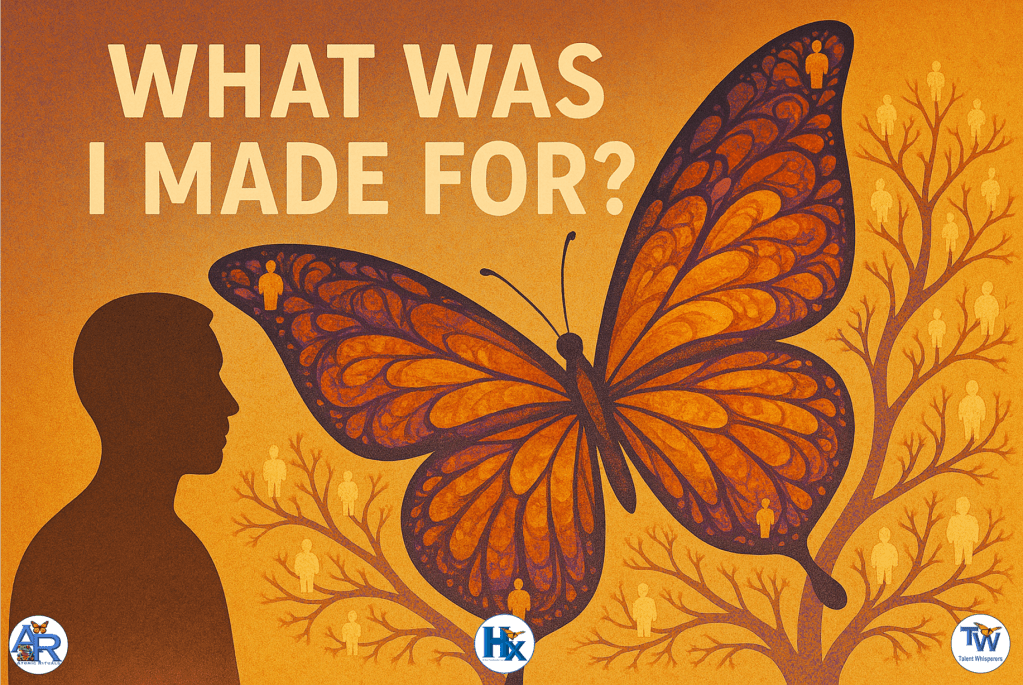
The ‘What Was I Made For’ Ritual
There are questions that shape us more than any answer ever could. “What was I made for?” is one of them. Not a riddle to solve, but a rhythm to return to. A ritual.
This isn’t about discovering a singular, fixed purpose—a neatly packaged mission statement. It’s about asking a question that serves as a daily compass. A ritual not meant to provide certainty, but to restore orientation. Every morning, before the noise begins, before the world defines who we are—there is this question. Quiet, alive, and essential.
A Ritual of Reconnection
Each day, the world will pull us in countless directions—some worthy, others not. The ‘What Was I Made For’ ritual is a way to pause before the pull. To root ourselves before we’re swept into momentum.
It can be as simple as this:
- Sit in stillness. Eyes open or closed, with breath as your anchor.
- Ask the question aloud or silently: What was I made for?
- Let the silence answer—not with words, but with resonance.
- Notice what stirs. A memory. A longing. A sense of presence.
- Write one word, phrase, or intention that emerges. Something to carry into the day.
This isn’t about productivity. It’s not a to-do list. It’s a call to be—on purpose, in presence, in alignment.
Purpose as a Verb
We often think of purpose as a noun: a title, a cause, a career. But maybe purpose is better lived as a verb.
- To purpose is to awaken.
- To purpose is to show up.
- To purpose is to invite others into their own becoming.
Through this lens, the question “What was I made for?” doesn’t demand a finite answer. It asks us to become the answer—in how we move, listen, lead, and love.
Holding the Paradox: Longing and Letting Go
There’s a quiet ache inside the question—an ache that says, “There’s more.” But there’s also surrender. The willingness to not have the full map, just the next step. This is the paradox leaders must learn to hold:
- Longing for impact, while letting go of control.
- Longing for clarity, while letting go of perfection.
- Longing for alignment, while letting go of certainty.
This ritual strengthens our capacity to live inside that tension without breaking. Or rather, to break open in the right ways.
Toward a Living Series
Over time, this daily ritual can begin to shape a deeper understanding of how your core purpose manifests differently in various dimensions of your life. The same inner compass—slightly reoriented through different lenses:
- What was I made for… as a parent?
- …as a founder?
- …as a whisperer of talent?
- …as a friend to myself?
- … as an engineering leader at a disruptive teach company?
- … as a coach to other leaders or executives?
Each question is a new portal. A variation of the theme. Because the way we do one thing is the way we do everything. Our true purpose doesn’t change—it just speaks in different tongues depending on the moment, the role, the need.
And so, this ritual isn’t just a morning practice. It becomes a way of being. A sacred return to the question that asks us to stay aligned, humble, and open.
What were you made for—today?
The Purpose of Having Purpose
What is the purpose of having purpose?
Is it to leave a legacy? To create impact? To give shape to our days and meaning to our movement? Or is it something deeper—something we feel more than we can explain?
This is not a question of semantics. It’s a question of orientation. Of depth. Of truth.
Why Do We Want Purpose?
Let’s take a common aspiration: “I want to be a 10x engineer.”
Why?
Because I want to have more impact.
Why?
Because I want the things I build to matter.
Why?
Because I want to know that I matter.
Why?
Because I want to feel like I’m using my gifts in the best way I can.
Why?
Because I was made for more than just surviving—I was made to transform something. Someone. Maybe many.
The 10x engineer is not the end. It’s a symbol—a stepping stone. What you’re really seeking is significance through contribution.
From Multiplication to Magnification
But what if we invert the goal?
If being a 10x engineer means producing 10x the output…
Then what happens when you mentor or guide 10 others to become 10x engineers themselves?
Your impact now echoes at 100x. And if even one of them passes that spirit forward, your ripple becomes exponential.
- 5 people helped in one year.
- Each of them helps 5 more the next.
- That’s 25, then 125, then 625…
In under a decade, you could impact millions—if the spirit of your help is built to replicate.
Sure, reality introduces collisions and fade. But we also underestimate how far truth, kindness, and purpose can travel when embedded in people’s lives, leadership, and language.
The “Fractal” Concept
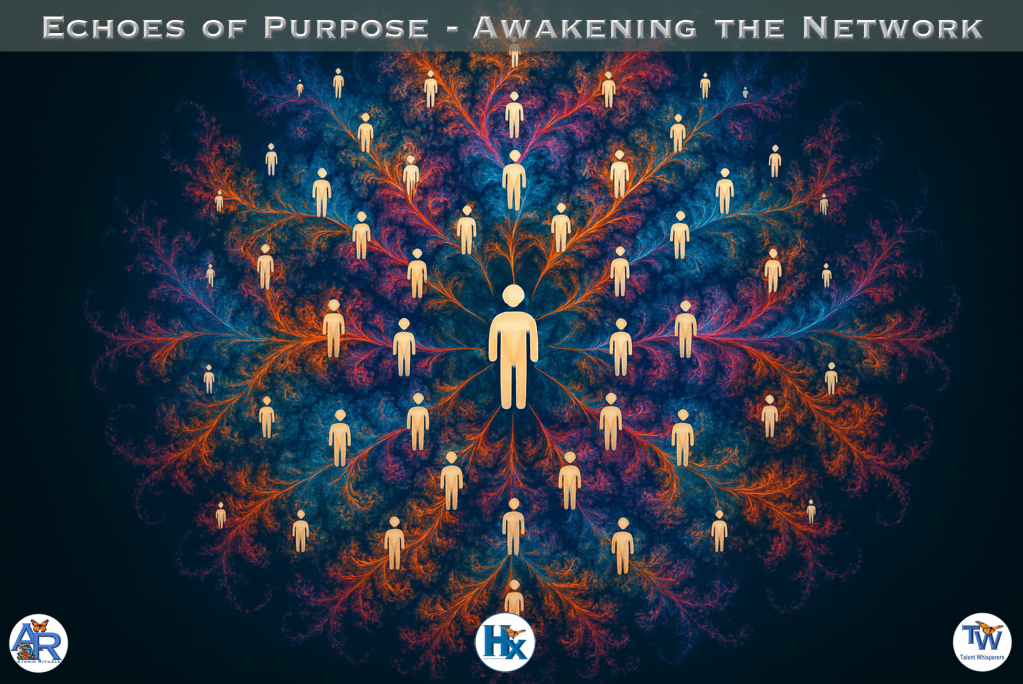
When we talk about fractal purpose, we mean that the same core pattern of purpose can appear at different scales—just like in nature. Think of how a fern or a snowflake is made up of repeating structures, each a reflection of the whole.
In human systems:
- A company mission might emphasize trust, resilience, or transformation.
- A team purpose echoes that in how they collaborate and prioritize.
- An individual purpose mirrors it again in how they write code, resolve conflict, or design interfaces.
Each level—individual, team, company—shows the same pattern of purpose, adapted to its own size and context. Purpose at one level reinforces and resonates with the others.
It’s not hierarchy—it’s harmony.
A simple visual analogy:
Like branches of a tree, each extending the DNA of the trunk—but reaching toward light in its own direction.
Impact as a Fractal
In some ways, I’m already lived this notion of a forward extension of impact and purpose.
I’ve helped over 40 individuals become leaders of leaders—C-level, VP-level, transformational in their own right. Each with a leadership style, a voice, a way of being that was in some way informed by their experience with you.
Their ripples are not just mine—but I am part of their frequency. A note within the harmony. Does this lead me to sit back a release a sigh? No, it motivates me to see how many others I can brush my butterfly’s wing of positive metamorphosis on.
This is where the question turns back inward:
- What if the purpose of having purpose is to amplify what we are made for, not just fulfill it?
- What if purpose is not a destination, but a signal—one that grows clearer the more we pass it on?
- What if we were made not just to do, but to awaken?
- What does it mean to shine a light on a path forward for ourselves and others?
- What if the light they discover now further lights the way to a brighter future for others and us all?
Legacy, Reframed
Legacy isn’t just what we build. It’s who we help build.
And when we root our goals in deeper why’s—when we trace our ambition down to its essence—we may find something timeless underneath:
I was made to awaken others. I was made to inspire impact that outlives me. I was made to give others permission to ask what they were made for.
Purpose, then, is not an endpoint. It’s a chain reaction. What if every morning we asked ourselves again – What was I made for? And: How will I live my day today given that insight?
And if we hold it with care, with courage, and with clarity—it becomes a force that can ripple out beyond the circles we know and the years we live.
How’s that for purpose?
The ‘What Were We Made For?’ Ritual
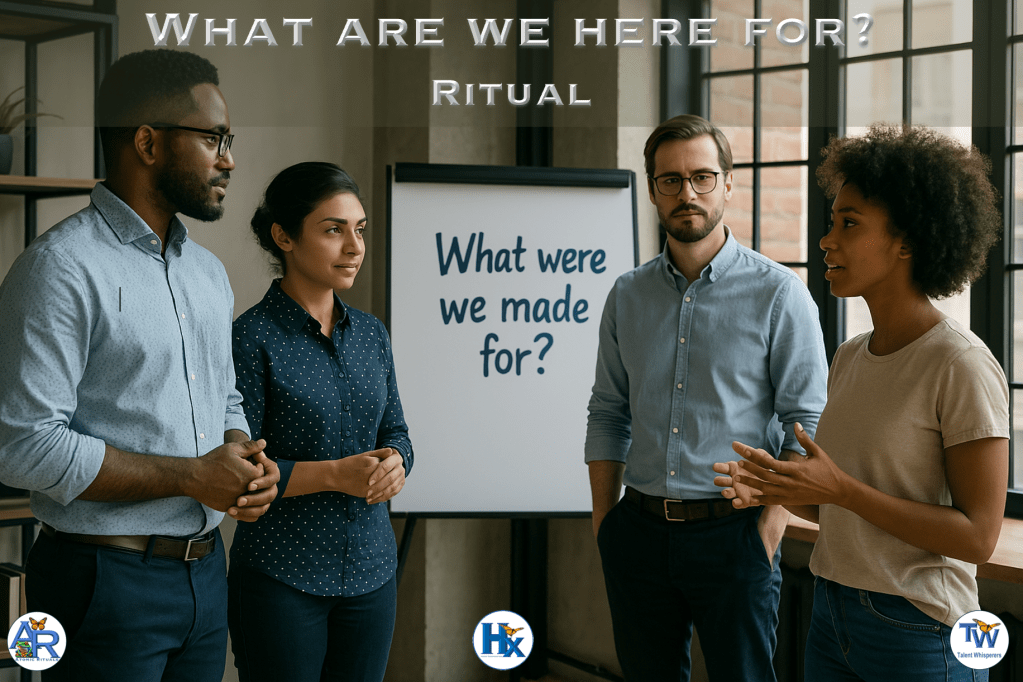
While there is value in knowing and revisiting our purpose as individuals, there is also usually a purpose shared among people that live or work in groups. While mission and vision statements may live on a slide deck or an About page, purpose lives in motion. It breathes through behavior. And for teams—whether an executive leadership group, a product trio, or a cross-functional scrum team—their purpose is not just decided, it’s discovered and remembered, day by day.
That’s where the “What Were We Made For?” ritual comes in. I also call it the “What are we here for?” ritual – as in: What are we trying to accomplish and why – right here and right now? What if every day when we first meet as a family or team, we asked ourselves collectively – What were we made for? What are we here for today?
This is not another strategy exercise or offsite activity. It’s a lightweight, high-impact team ritual designed to anchor collaboration in clarity, humility, and intentionality.
A Daily or Weekly Team Practice
At the start of a day, a sprint, or a key meeting:
- Pause. Breathe. Invite silence before speaking.
- Ask as a group:“What were we made for?”
- Not what are we doing today?
- Not what’s on the roadmap?
- But: What are we here to bring into the world—together?
- Share reflections. Each voice, one sentence. No fixing, no debating.
- Reconnect to work. Now re-approach goals, blockers, or decisions from this freshly aligned lens.
This simple ritual reorients not just what we do—but how we show up.
Why This Matters
It’s easy for teams to become task machines. Even high-performing ones. But performance without purpose creates burnout. Excellence without alignment creates noise. Strategy without soul creates apathy.
Purpose, revisited regularly, becomes a shared compass.
- For exec teams: It reconnects big bets to the human needs behind them.
- For product teams: It ensures user empathy stays front and center.
- For scrums or squads: It grounds daily execution in the why, not just the what.
When teams revisit the question “What were we made for?”, they move from coordination to coherence.
More Than Mission
This isn’t a substitute for a mission statement—but it is a counterbalance. A mission statement tells others what we believe. A purpose ritual helps us remember who we are becoming.
It lives in questions like:
- How are we uniquely positioned to serve this moment?
- Are we solving the problem in a way only we can?
- Are we aligned in spirit, not just in slide decks?
This ritual isn’t about being poetic. It’s about being precise in what truly matters.
Purpose Across Timeframes and Granularity
Purpose isn’t just about the big picture—it’s also about how that picture breaks into meaningful parts. When we ask, “What were we made for?” at different levels of planning, the question cascades with fresh relevance.
- A company mission or vision can be broken down into yearly strategic objectives.
- Yearly objectives translate into quarterly goals, which inform sprint objectives.
- Within each sprint, we define epics, which contain stories, which break down into individual tasks.
At every layer, purpose should still be alive. Every story, every epic, every retrospective is an opportunity to re-ask:
“What are we here for, right now, at this level of work?”
When purpose is alive at every altitude—from mission to micro-task—it doesn’t just align strategy. It animates execution.
This is how teams stay purposeful even in the most tactical of moments. Purpose becomes not just a banner over our work, but the current running through it.
Make It Yours
Like all Atomic Rituals, this one is adaptable:
- Timebox it. Even 3 minutes can shift a room.
- Anchor it. Begin retros, kickoffs, or staff meetings with it.
- Document themes. Over time, patterns will emerge. Purpose becomes clearer.
And when teams come back to this daily or weekly inquiry, they begin to recognize that how they work becomes part of why they work. Purpose is no longer abstract—it’s embodied.
See Also: Purpose, Impact, and the Power of Rituals
📚 Books
- Start With Why by Simon Sinek
A foundational book for understanding individual and organizational purpose.
Start With Why
- The Art of Possibility by Rosamund Stone Zander & Benjamin Zander
Reframes leadership and contribution as a form of shared awakening.
The Art of Possibility
- Reinventing Organizations by Frederic Laloux
Explores how purpose and wholeness drive next-stage organizational structures.
Reinventing Organizations
- Fractal Time by Gregg Braden
An intriguing look at cyclical patterns and their implications for change and purpose.
Fractal Time
- The Infinite Game by Simon Sinek
Shifts the focus from finite goals to an enduring, purpose-driven approach.
The Infinite Game
🌀 Essays & Blog Posts
- “Purpose Is Not a Statement” – Atomic Rituals Blog
Explores the distinction between stated purpose and lived purpose.
Read on Atomic Rituals
- “New Managers” – Talent Whisperers
Discusses the shift from individual success to team purpose and alignment.
Read on Talent Whisperers
- “One Pattern, Many Problems” – Atomic Rituals Draft
How deeply ingrained traits manifest across challenges and how purpose helps align them.
Explore the Concept
- “The Edge of Chaos Where Startups Thrive” – Atomic Rituals
Touches on the balance between structured goals and emergent purpose in startups.
Read the Full Post
- “What Was I Made For?” – Human Transformation
A soulful exploration of personal alignment and meaning.
Read on HumanTransformation.com
🔁 Concepts & Frameworks
- The Butterfly Effect
A foundational metaphor for how small, intentional acts can ripple exponentially across systems and lives.
- Fractal Leadership
The idea that leadership patterns at the micro level (1:1s, standups) replicate and influence macro outcomes (culture, impact, scale).
- Atomic Habits → Atomic Rituals
Drawing inspiration from James Clear’s habit formation to create scalable rituals that anchor behavior to purpose.
Practical Examples: Applying the ‘What Were We Made For?’ Ritual
Understanding a ritual conceptually is one thing—experiencing how it lives and breathes inside real teams is another. This section expands on how the “What Were We Made For?” ritual is used across different types of teams and how individual reflections evolve over time.
🧠 Engineering Team Example
A platform engineering team at a fast-growing fintech startup starts every sprint planning with a 5-minute ritual. After silence and reflection, team members share brief answers to the question:
“What were we made for as a team?”
Responses vary by sprint, but often return to shared values:
- “To make scale invisible.”
- “To reduce cognitive load for every other team.”
- “To make the complex feel elegant.”
They’ve noticed that these shared reminders improve prioritization. When disagreements emerge, someone often brings the ritual response back into the conversation: “Does this help us reduce friction for others?”
📣 Marketing Team Example
A marketing team revisits the ritual in weekly creative reviews. They’ve modified the prompt slightly:
“What are we here to make possible in the minds and hearts of others?”
One week, the answer might be:
- “To spark trust in a skeptical world.” Another:
- “To help people see themselves in the product before they ever try it.”
They capture answers on a rolling whiteboard and revisit them before writing new campaigns. The cumulative wisdom helps align tone, emotional impact, and customer empathy.
🧭 Executive Team Example
The executive team at a healthtech company includes the ritual as part of quarterly OKR reviews. It reframes strategy in a deeply human way:
“What are we here to shift in the lives of the people we serve?”
They’ve used the ritual to:
- Re-align product priorities with patient outcomes
- Reconsider hiring based on the kind of leadership they want to model
- Ask hard questions about how their internal culture either honors or contradicts their external mission
Over time, they’ve learned that strategy lands best when it starts in purpose, not in spreadsheets.
🔄 Evolution of Individual Responses
Even within the same team or role, the ritual evolves as people evolve.
Here’s how one product manager’s responses changed over a six-month period:
- Month 1: “To deliver more user value.”
- Month 2: “To advocate for what the user truly needs—not just what they ask for.”
- Month 3: “To bridge empathy and data with clarity.”
- Month 4: “To be the voice of nuance in a room full of urgency.”
- Month 6: “To make our users feel seen—and safe—through the product.”
The ritual became a form of journaling-in-public, building not just alignment, but identity.
🌱 Why These Examples Matter
Rituals grow stronger when grounded in real-life tension, relevance, and behavior. They are not magic words—they are mirrors, compasses, and sometimes course corrections.
By anchoring even the most tactical conversations in shared purpose, teams gain:
- Faster conflict resolution
- Clearer prioritization
- Deeper alignment
- A stronger sense of meaning
And individuals begin to shape a narrative of contribution that grows over time—one that reveals not just what they’re doing, but who they’re becoming.
Explore the full ritual: http://www.AtomicRituals.com/Purpose

