
Tailored Learning Journeys for Software Development Leaders
Why Reading Can Be a Ritual, Not Just a Resource
In the fast-moving world of software development, leadership isn’t static—it’s an evolving practice that demands reflection, experimentation, and a deep understanding of systems, people, and self. Reading, when done intentionally, becomes more than passive consumption—it becomes a ritual of growth. It anchors insight in rhythm. It unlocks perspective through practice. It allows leaders to connect wisdom to their lived reality in actionable, incremental ways.

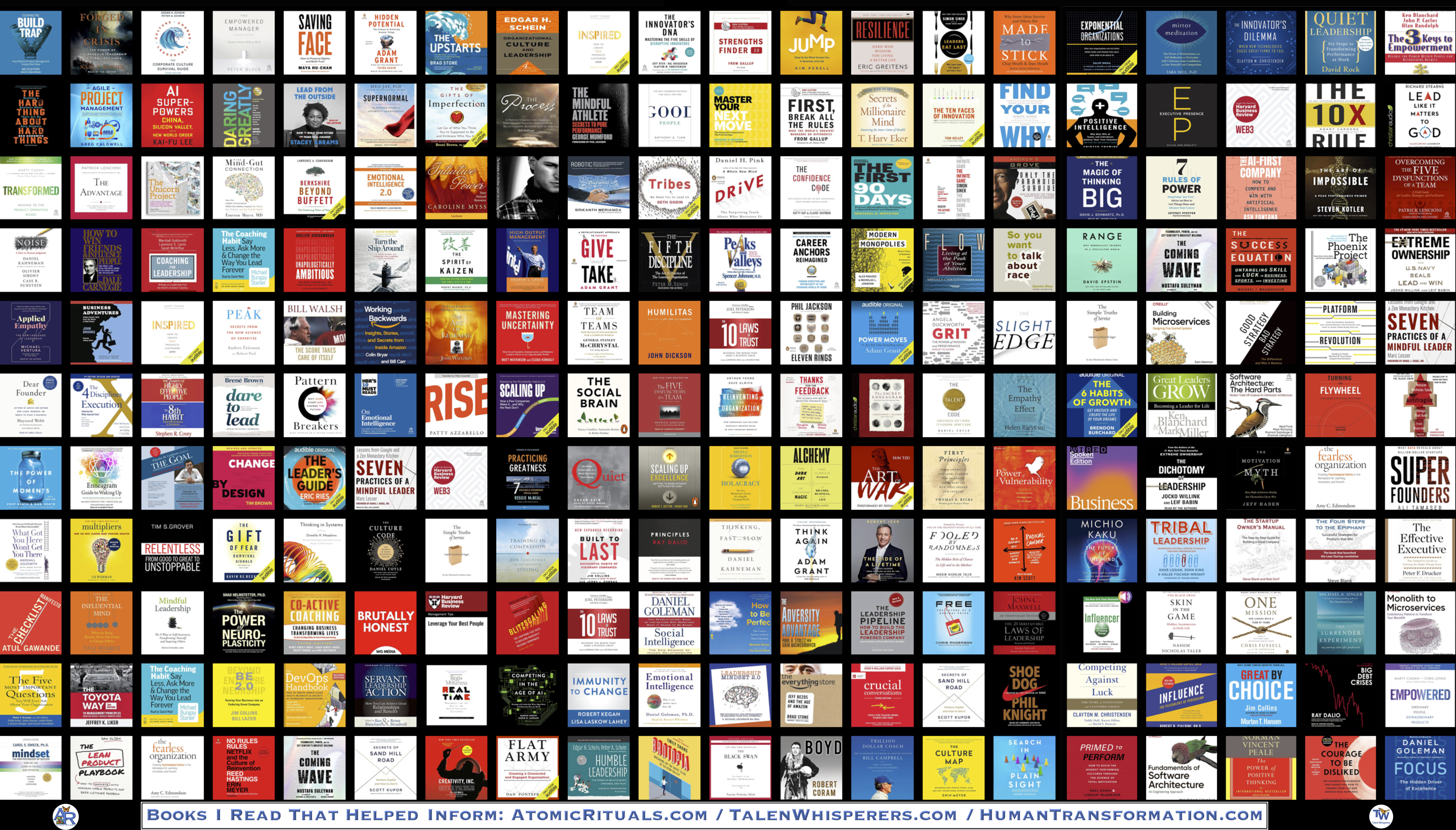
In my quest to better understand what it means to be a good leader, I have sought the insights of many who have researched and written about the subject. Many of these books on leadership I’ve consumed more than once. Of the books I consume in my quest, I believe the books below are of particular value to a Talent Whisperer or anyone interested in continually transforming and growing.
Why Audio Books?
For me, it’s because in a busy day, it’s often hard to find time to read. However, for those of us that commute or travel or workout or do chores or yard-work where our minds can absorb audio, there is a unique opportunity to expand our horizons. With time, it’s also possible to consume them at higher speeds now that they’ve gotten better at compressing audio. Reading at 3x to 4x speeds on an hour’s commute each way provides for the equivalent of 6-8 hours of learning each workday.
Why Personalization Matters
There’s no single reading list that fits everyone. Leaders come from different roles, face different challenges, and learn in different ways. A new tech lead navigating influence without authority needs a different lens than a VP scaling org-wide SDLC maturity. These tailored learning journeys allow individuals to choose a path that resonates with their context and evolve that path over time as their role shifts.
Explore the Learning Journeys
Each of the following pages offers a thoughtfully curated learning path designed for a specific type of leader or challenge:
🔹 Craft-Oriented Leadership
For ICs and tech leads stepping into more influence.
Focuses on leadership through craft, communication, and technical stewardship.
🔹 Agile Without Dogma
For leaders reshaping broken agile cultures.
Emphasizes purpose-driven process evolution, psychological safety, and systems thinking.
🔹 Startup SDLC Scaling
For EMs and VPs implementing structure without killing speed.
Blends execution maturity with agility, balancing rapid delivery with resilience.
🔹 Atomic Change Agent
For quiet leaders driving change through trust, not title.
Explores how consistent, thoughtful actions create transformational cultural impact.
🔹 Building Culture Through Ritual
For cross-functional leaders cultivating resilience and cohesion.
Highlights emotional intelligence, belonging, and the power of shared rituals.
🔹 The End-to-End SDLC: A Learning Journey for Engineering Leader Implementing an SDLC
The most effective SDLCs are holistic and cross-functional, extending beyond engineering to include product discovery, requirements shaping, customer feedback loops, support learnings, and operational excellence. For an engineering leader aiming to level up across this full lifecycle, here’s a curated list of books organized by key SDLC phases.
🔹 Recommended Reading for Product Managers
A curated reading list for Product Managers, featuring foundational thinking, strategic insight, and practical frameworks from respected voices in the field
🔹 TalentWhisperers.com/Books
A broader selection of books on leadership that I have previously consumed at least once.
Making It Yours: How to Track, Share, Reflect
- Track what resonates by keeping a simple learning journal or using tools like Notion or Obsidian.
- Apply each insight incrementally—turn takeaways into atomic rituals within your team.
- Reflect in retrospectives, 1:1s, or weekly notes: “What shifted this week because of what I read?”
- Share the journey—use it in mentorship, team onboarding, or coaching others along the way.
This Is a Living Library

These learning journeys are designed to evolve over time. Books will be added, re-ordered, or retired. Links will expand into reflections, templates, or even guided workshops. I invite you to remix, contribute, and personalize what’s here. Because learning—like leadership—is best when it grows with you. I have found it helpful to go back and reread books years later in a new context and after having put more leadership experiences behind me.
Craft-Oriented Leadership: A Learning Journey for Engineers Stepping Into Influence
Who Is This Reading List Is For?
This journey is designed for senior ICs, staff+ engineers, or new tech leads who want to grow their leadership through the lens of craft, clarity, and influence—without becoming a process-pusher or disconnected from the work. It’s for those who believe that excellent engineering and thoughtful leadership are not mutually exclusive—but mutually reinforcing.
Framing Questions
- How can I lead without direct authority?
- What does it mean to influence through example and technical clarity?
- How can I mentor others while still growing my own craft?
- What are the rituals of communication and collaboration that elevate team delivery?
Start Here: Foundational Reads
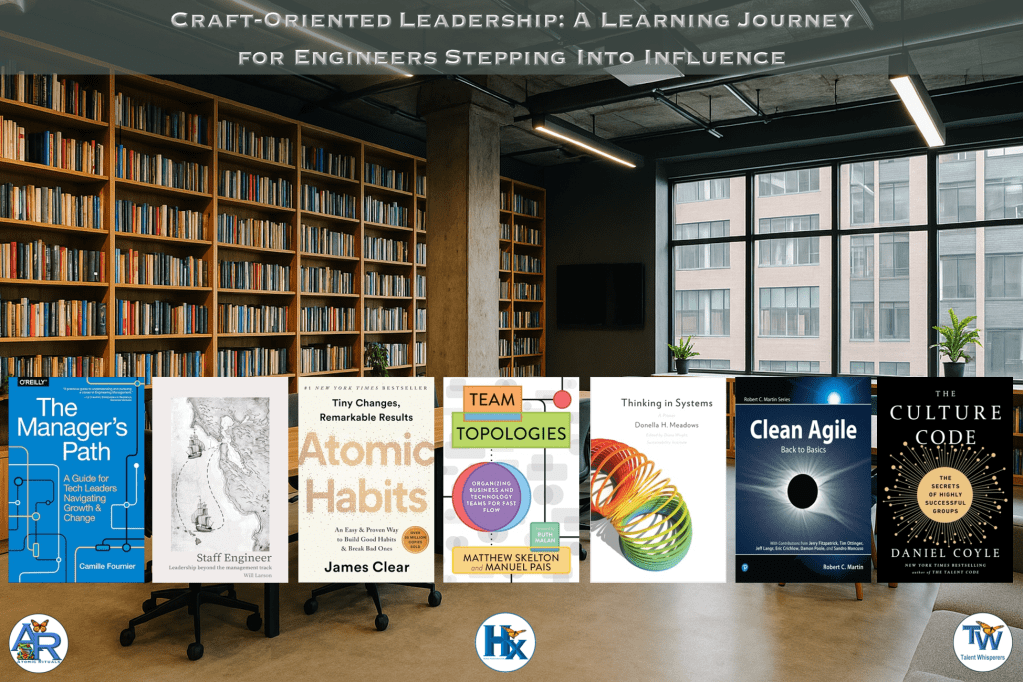
📘 The Manager’s Path — Camille Fournier (Audio available)
While this covers the arc from IC to CTO, the early chapters are gold for ICs learning to support teammates, run effective meetings, and mentor without becoming overly managerial.
📘 Staff Engineer: Leadership Beyond the Management Track — Will Larson (Audio available)
A practical, lived-in guide for staff+ engineers navigating influence, vision setting, and the balance between tech decisions and team alignment.
📘 Atomic Habits — James Clear (Audio available)
Though not tech-specific, this book is core to the Atomic Rituals philosophy: tiny changes compound, identity drives behavior, and systems matter more than goals.
🎧 The Lead Developer Conference Talks
Talks by and for tech leads, covering decision-making, mentoring, communication, and shaping healthy engineering teams.
Deepen: Broader Systems & Leadership Wisdom
📘 Team Topologies — Matthew Skelton & Manuel Pais (Audio available)
Gives craft-focused leaders a vocabulary for improving team boundaries, interfaces, and effectiveness. Especially helpful when you’re influencing across teams.
📘 Thinking in Systems — Donella Meadows (Audio available)
Develops the muscle of zooming out and seeing causal loops, feedback delays, and leverage points in code, teams, and organizations.
📘 Clean Agile — Robert C. Martin (Audio available)
A concise and opinionated take on what Agile was meant to be. Useful as a counterpoint to process-heavy environments.
📘 The Culture Code — Daniel Coyle (Audio available)
For tech leads aiming to shape a culture of safety, clarity, and purpose through micro-interactions and team rituals.
Atomic Practices: How to Apply What You Learn
- Introduce a “definition of done” ritual for your team
- Begin mentoring a junior engineer through weekly office hours
- Share one article per week in a team channel with a reflection prompt
- Lead a retrospective focused not on process, but on communication and team health
- Pair code reviews with system design conversations
Reflection Prompts
- What’s one small change I made this month that improved team delivery or collaboration?
- Where did I influence a decision—not by rank, but by clarity?
- How can I invite more voices into technical decisions while still driving forward?
This is a living journey. As you grow, revisit it. Remix it. Share your learnings with others coming up behind you.
Agile Without Dogma: A Learning Journey for Leaders Redefining Process
Who Is This Reading List Is For?
This journey is for engineering leaders, senior ICs, and product-minded VPs who’ve seen Agile misapplied—used more as a rigid religion than a responsive framework. If you’re rebuilding trust in Agile by starting small, aligning with purpose, and emphasizing outcomes over rituals, this journey offers grounded guidance. It supports those looking to reclaim agility as an adaptive mindset rather than a fixed playbook.
Framing Questions
- How do I introduce agility without triggering past trauma in teams?
- How can we experiment with process and iterate based on evidence?
- What ceremonies and artifacts are actually solving for our needs?
- How do we lead Agile as a philosophy, not a productized system?
Start Here: Foundational Reads
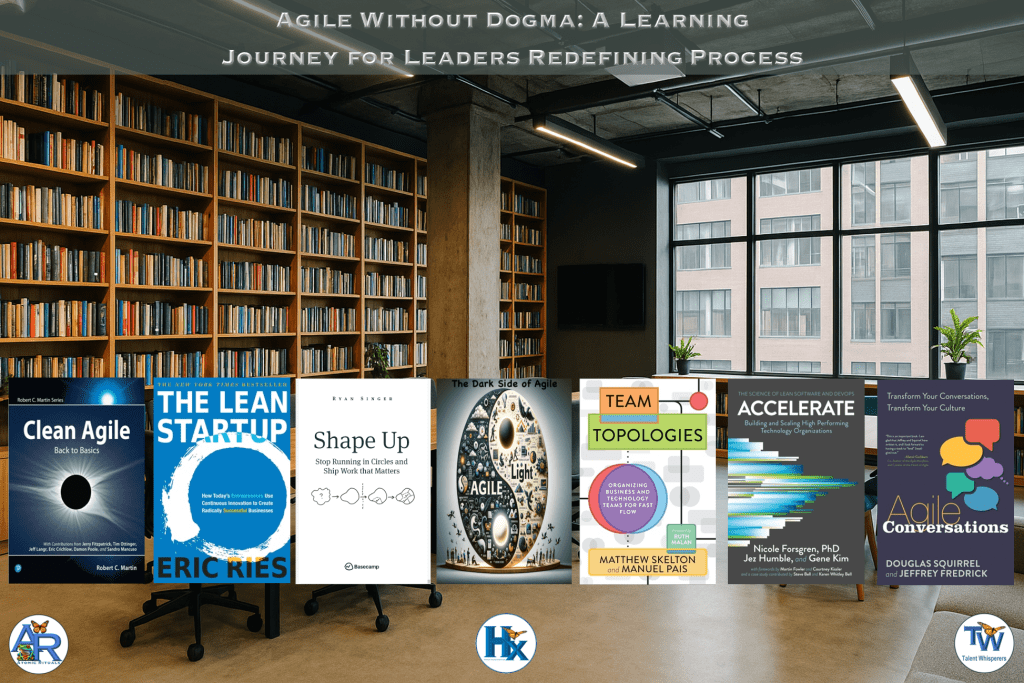
📘 Clean Agile — Robert C. Martin (Audio available)
A refreshingly sharp reset on what Agile was intended to be. Especially useful for diagnosing where your team has gone off course and how to gently steer them back to principles.
📘 The Lean Startup — Eric Ries (Audio available)
Though product-oriented, the Lean mindset offers an essential reframing: treat process as hypothesis, use MVP thinking, and validate improvement through iteration.
📘 Shape Up — Basecamp (Free online)
A contrarian approach to Agile that introduces appetite-based planning, cycles over sprints, and risk management over scope. Great for opening conversations on tailored process.
📄 The Dark Side of Agile — TalentWhisperers
Written from direct experience, this post explores how Agile can be misapplied and how to recover its original intent through more thoughtful, contextual leadership.
Deepen: Context, Coaching, and Organizational Flow
📘 Team Topologies — Matthew Skelton & Manuel Pais (Audio available)
A must-read for making Agile scale without breaking. Helps leaders understand team interactions, flow, and cognitive load—not just ceremonies.
📘 Accelerate — Forsgren, Humble, Kim (Audio available)
Backed by research, this book shows how delivery speed, stability, and team health correlate with certain Agile and DevOps practices. Use it to justify intentional, outcome-driven experiments.
📘 Agile Conversations — Douglas Squirrel & Jeffrey Fredrick (Audio available)
Focuses on the cultural and communication habits that make Agile work—or fail. Helpful for coaching teams into healthier retrospectives, planning sessions, and alignment rituals.
📄 Selling Agile to Executives: 8 Ways to Get Buy-In — Planview Blog
If you’re leading change from the middle, this article helps frame agility in language that matters to stakeholders: value, delivery, predictability.
Atomic Practices: How to Apply What You Learn
- Rebrand retrospectives as “engineering look-backs” and let the team define the format
- Run 2-week work cycles without calling them sprints—focus on outcome alignment
- Introduce 5-Whys postmortems and track action items over time
- Invite the team to identify process pain points as hypotheses to test, not complaints to avoid
- Use a scorecard to track process changes and whether they improved flow, collaboration, or delivery
Reflection Prompts
- What process rituals are we following without understanding their purpose?
- Where might agility improve delivery or reduce team stress?
- What have we recently stopped doing—and did that improve things?
- How can I lead with curiosity rather than certainty when it comes to change?
This journey is for the quiet revolutionaries—those reshaping process from the inside out, one thoughtful change at a time. Let Agile become your team’s way of thinking, not just a set of terms in a tool.
Startup SDLC Scaling: A Learning Journey for Engineering Leaders Implementing Structure Without Killing Speed

Who Is This Reading List Is For?
This journey is for EMs, Directors, and VPs of Engineering in fast-growing startups who are introducing process, structure, and scalability without crushing autonomy, velocity, or morale. If you’re responsible for shaping how product, design, and engineering collaborate at increasing scale, this journey is built to help you balance delivery, quality, learning, and change resilience.
Framing Questions
- How do we introduce SDLC structure that helps, not hinders?
- Where do we need consistency vs. flexibility?
- How do we scale engineering processes without losing the startup spirit?
- What metrics actually matter for alignment, speed, and reliability?
Start Here: Foundational Reads
📘 Accelerate — Nicole Forsgren, Jez Humble, Gene Kim (Audio available)
A research-backed view of what makes high-performing engineering orgs work. Introduces the metrics that matter and the behaviors that predict success—ideal for teams growing fast.
📘 Team Topologies — Matthew Skelton & Manuel Pais (Audio available)
Offers a scalable mental model for how to structure teams, communication pathways, and responsibilities as an org grows.
📘 Software Engineering at Google — Titus Winters et al. (Audio available)
Explores how to build maintainable, scalable systems without slowing innovation. A pragmatic read for leaders moving beyond startup chaos.
📘 The Unicorn Project — Gene Kim (Audio available)
A narrative-driven view into the pain of brittle systems and the joy of DevOps and flow-based delivery. Good for building empathy with ICs.
Deepen: Process, Reliability, and Human Systems
📘 The DevOps Handbook — Kim, Humble, Debois, Willis (Audio available)
A tactical companion to Accelerate. Helps you bridge engineering and operations with deployment practices that support frequent, stable delivery.
📘 Thinking in Systems — Donella Meadows (Audio available)
Vital for leaders navigating complexity. Helps you diagnose issues not as individual mistakes, but as signals from the system’s design.
📄 How to Build an SDLC That Actually Works — Atomic Rituals
A human-centered, end-to-end exploration of SDLC that respects real-world complexity and balances upstream discovery with downstream learning.
📄 What I Talk About When I Talk About Platforms — Martinfowler.com
A short but powerful piece on team accountability and operating ownership. Great for shaping team boundaries and service maturity.
Atomic Practices: How to Apply What You Learn
- Create a cross-functional definition of done that includes monitoring, testing, and rollout readiness
- Introduce demos as a standard SDLC checkpoint tied to PRD success criteria
- Track cycle time, deployment frequency, and rollback incidents—not just story points
- Use retros and postmortems as levers for learning and systemic improvement, not just venting
- Align the team on “SDLC as a service”—something built for them, not imposed on them
Reflection Prompts
- Where is lack of process causing confusion or rework?
- Where is too much process slowing innovation or autonomy?
- What’s one SDLC improvement we could pilot as an experiment?
- Are we using the right metrics to learn and adapt—or just to report?
This journey is for those who build systems around systems—engineering leaders growing not just products, but the ways we build products together.
Atomic Change Agent: A Learning Journey for Quiet Leaders of Transformation
Who Is This Reading List Is For?
This journey is for those who lead not by title, but by trust. Whether you’re an engineer, EM, or cross-functional collaborator, this is for you if you instinctively influence through presence, consistency, and thoughtful contribution. You believe change happens not from heroic disruption, but from small, well-placed interventions over time. If you’ve ever made a team better without needing credit, this is your path.
Framing Questions
- How can I lead without positional authority?
- What’s the smallest act of influence that could change my team’s culture?
- How do I shape the environment instead of trying to control outcomes?
- What does patient, trust-centered change leadership actually look like?
Start Here: Foundational Reads
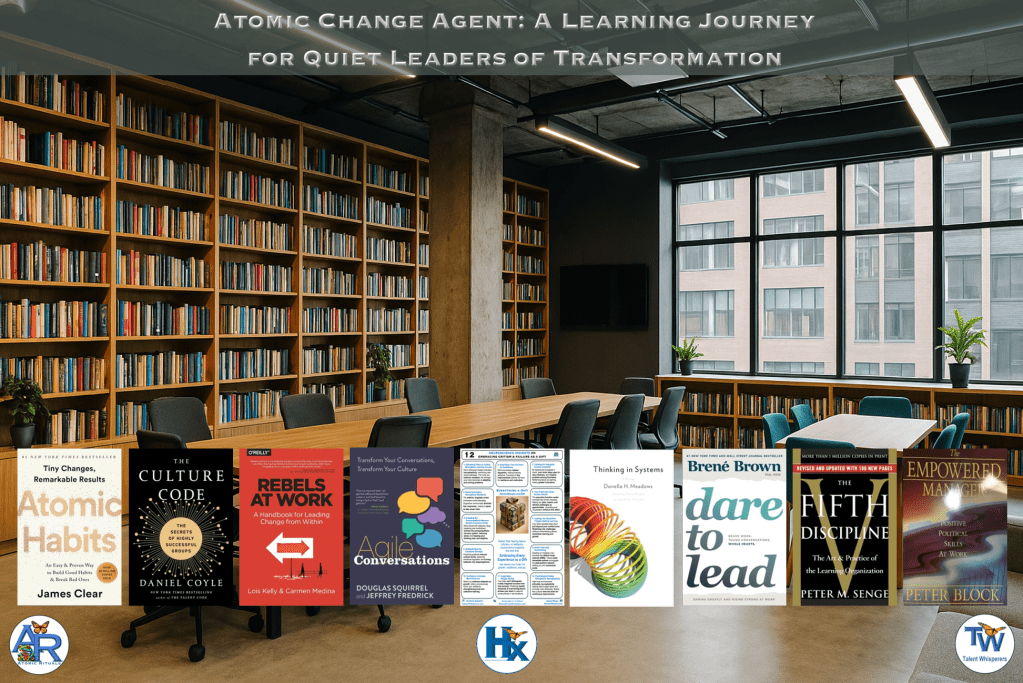
📘 Atomic Habits — James Clear (Audio available)
The cornerstone text for this journey. Clear shows how tiny behaviors compound into identity-shaping transformation—individually and culturally.
📘 The Culture Code — Daniel Coyle (Audio available)
Unpacks how belonging, safety, and shared vulnerability are built in small moments. Great for understanding how rituals shape team identity.
📘 Rebels at Work — Lois Kelly & Carmen Medina
For those who want to lead change from within without becoming adversarial. Offers tactics for quiet persistence, storytelling, and building allies.
📄 Everything is a Gift — Atomic Rituals
A reflection on how to reframe pain, confusion, or friction as opportunities for transformation and learning. Aligns with the mindset of this journey.
Deepen: Systems, Storytelling, and Inner Clarity
📘 Thinking in Systems — Donella Meadows (Audio available)
Change agents must learn to see loops, delays, and leverage points. This book offers a blueprint for influencing from within the system.
📘 Dare to Lead — Brené Brown (Audio available)
Focuses on courage through vulnerability. Particularly useful for those who want to build trust while holding high standards.
📘 The Fifth Discipline — Peter Senge (Audio available)
Introduces “learning organizations” and explains how small shifts in thinking (mental models) drive long-term culture change.
📄 The Empowered Manager (excerpt) — Peter Block [Summary or post TBA]
Explores how to work from a stance of stewardship, even when you’re not the one in charge.
Atomic Practices: How to Apply What You Learn
- Create a recurring team moment (e.g., Gratitude Fridays or weekly tech wins)
- Privately encourage a peer with specific feedback that reinforces growth
- Frame frustrations as patterns and propose small, reversible experiments
- Introduce a new ritual—like a daily team sync question—that invites connection or reflection
- Document and quietly model a better way to do something without demanding others follow
Reflection Prompts
- Where have I influenced without being asked or acknowledged?
- What small patterns could I shift with a tiny experiment?
- What would it look like to lead with less control and more clarity?
- Who can I partner with to grow trust around a shared value?
This journey is for those who believe transformation doesn’t come from force—it comes from resonance, rhythm, and repeated intentional action. Change is a practice. And this is yours.
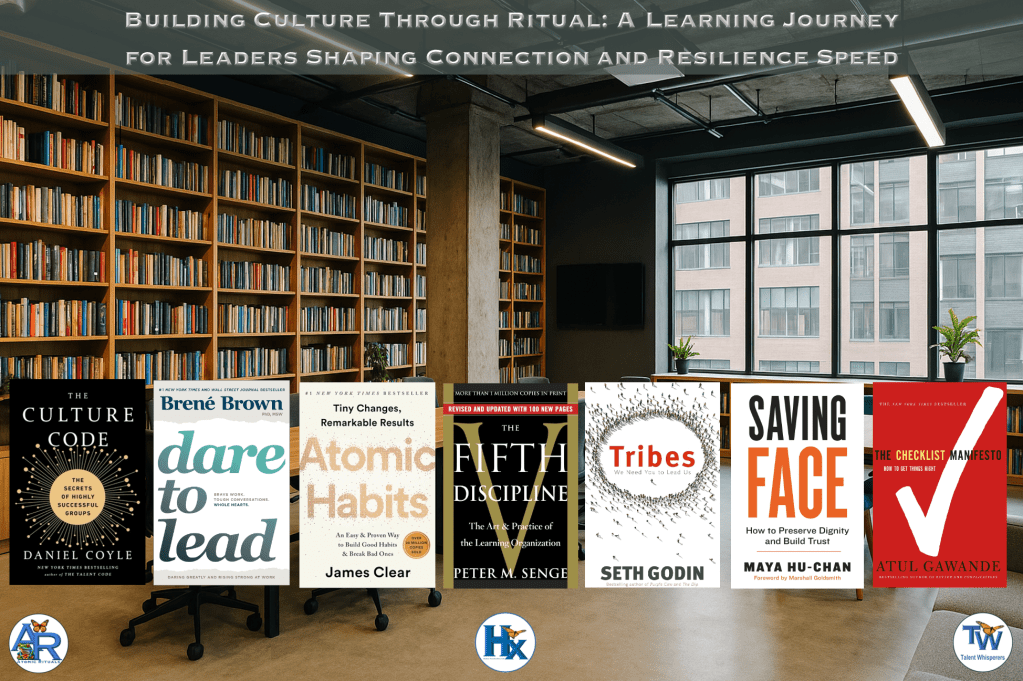
Building Culture Through Ritual: A Learning Journey for Leaders Shaping Connection and Resilience
Who Is This Reading List Is For?
This journey is for cross-functional leaders, engineering managers, founders, and culture carriers who understand that culture isn’t declared—it’s lived. It’s for those who want to create cohesion, clarity, and care through small, repeatable acts that become part of how a team works and belongs. Whether you’re building from scratch or reweaving connection in a scattered org, this path supports leaders ready to anchor culture in practice.
Framing Questions
- How do I build a culture that feels authentic, not performative?
- What small moments reinforce what we value as a team?
- How can rituals create psychological safety and shared identity?
- How do I design practices that scale but still feel personal?
Start Here: Foundational Reads
📘 The Culture Code — Daniel Coyle (Audio available)
Essential for understanding the building blocks of high-performing groups: safety, vulnerability, and purpose. Rich with real-world examples of rituals that stick.
📘 Dare to Lead — Brené Brown (Audio available)
Highlights the role of trust, transparency, and shared language in cultivating resilient cultures. Perfect for leaders creating rituals around courage and belonging.
📘 Atomic Habits — James Clear (Audio available)
While habit-focused, this book is a tactical guide to how small, repeated behaviors shape identity—at both individual and team levels. Use it to design rituals that stick.
📄 Everything Is a Gift — Atomic Rituals
Invites a cultural lens of learning, resilience, and reframing. Great for teams navigating challenge or change.
Deepen: Systems, Symbols, and Sustainable Practice
📘 The Fifth Discipline — Peter Senge (Audio available)
A masterwork on learning organizations. Focuses on team learning, shared vision, and systems thinking—all supported by daily habits and small group rituals.
📘 Tribes — Seth Godin (Audio available)
Explores the human need for connection and shared mission. Ideal for leaders seeking to build internal communities within their organization.
📘 Saving Face — Maya Hu-Chan (Audio available)
For leaders navigating diverse teams and cross-cultural dynamics, this book explores how small actions preserve dignity and reinforce belonging.
📘 The Checklist Manifesto — Atul Gawande (Audio available)
Though procedural, it illustrates how simple, repeatable checklists (rituals of clarity) drive consistency, trust, and shared responsibility.
📄 How Rituals Build Culture — Harvard Business Review
A concise article on how small, symbolic acts reinforce connection and reduce anxiety—especially in times of uncertainty.
Atomic Practices: How to Apply What You Learn
- Start or end meetings with a consistent human check-in ritual
- Celebrate “small wins” each Friday in a shared space or Slack thread
- Introduce a learning ritual (e.g., weekly 15-minute idea share or team read-aloud)
- Create a team “ways we work” page that evolves over time
- Reflect rituals back to the team: “This is something we do here. Why does it matter?”
Reflection Prompts
- What’s one micro-practice we’ve done lately that others have naturally adopted?
- Where might a lightweight ritual reinforce our values or purpose?
- What’s a moment of friction we could smooth out through consistent structure?
- What ritual would I want to see if I were joining this team today?
Culture is not declared. It’s practiced. This journey is for those ready to weave meaning into motion—through repeatable, human-scale moments that build belonging and resilience over time.
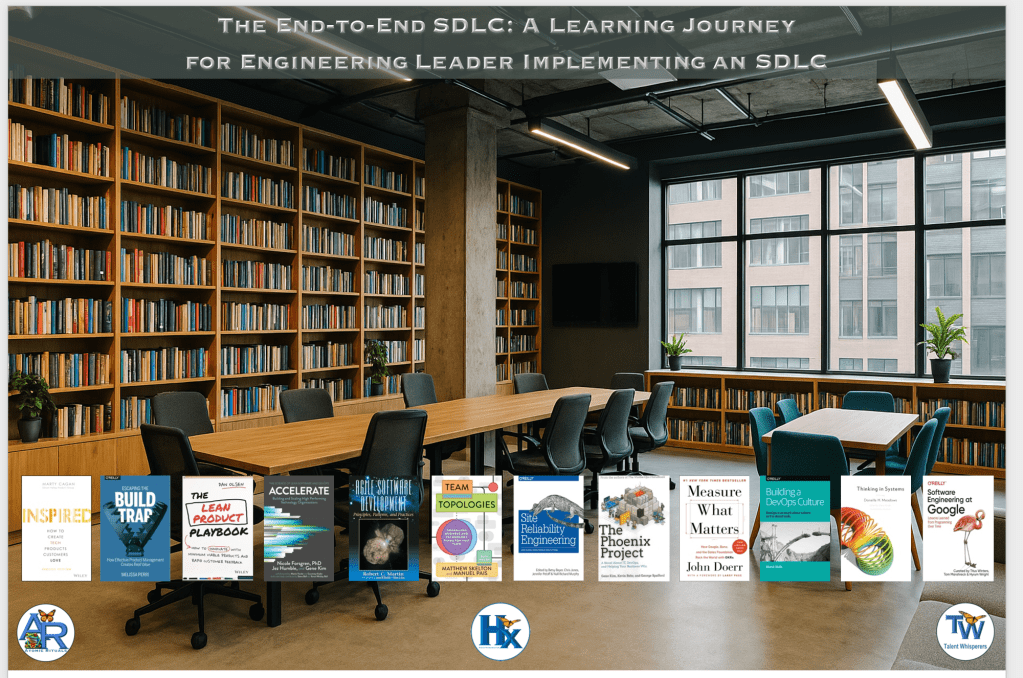
The End-to-End SDLC: A Learning Journey for Engineering Leader Implementing an SDLC
🔍 Upstream: Shaping Ideas Before They Reach Engineering
- Inspired: How to Create Products Customers Love by Marty Cagan
Excellent for understanding how strong product discovery and PRD development create a better foundation for engineering success.
- Escaping the Build Trap by Melissa Perri
Focuses on aligning product strategy with delivery, ensuring you’re building the right things—not just building efficiently.
- The Lean Product Playbook by Dan Olsen
Offers practical tools for validating ideas, defining MVPs, and connecting user needs to product requirements.
🏗️ Midstream: Execution, Engineering Process, and Collaboration
- Accelerate: The Science of Lean Software and DevOps by Nicole Forsgren, Jez Humble, and Gene Kim
A data-driven look at what makes high-performing software teams succeed—core reading for SDLC process improvement.
- Agile Software Development, Principles, Patterns, and Practices by Robert C. Martin
- Solid foundation on agile engineering principles, team collaboration, and sustainable codebases.
- Team Topologies by Matthew Skelton & Manuel Pais
How to structure engineering teams and responsibilities for scalable, decoupled, high-performing delivery pipelines.
🚀 Downstream: Reliability, Feedback, and Continuous Learning
- Site Reliability Engineering by Betsy Beyer et al. (Google)
The gold standard on running software at scale, blurring the lines between engineering, ops, and support.
- The Phoenix Project by Gene Kim et al.
A fictional but accurate journey into IT ops, DevOps, and building feedback loops post-deployment.
- Measure What Matters by John Doerr
Using OKRs to align goals across the business—crucial for connecting engineering effort to business impact.
Note, for those that have read it, don’t forget there are two key ideas – 1. Measure, 2. What Matters. The second is actually more important. You need to understand what matters and how to measure it. All too often, people focus on meauring and end up measuring the wrong things in the wrong ways. See 2:18 in John’s TED Talk
- Building a DevOps Culture by Mandi Walls
A concise guide to fostering the collaboration needed across delivery, ops, and support teams.
🔁 Systemic Thinking: Bringing It All Together
- Thinking in Systems by Donella Meadows
To really understand SDLC as a system, this is one of the best books on feedback loops, delays, and complexity.
- Software Engineering at Google by Titus Winters et al.
Not just about coding at scale—also about organizational design, culture, and long-term maintainability.
a curated reading list for Product Managers, featuring foundational thinking, strategic insight, and practical frameworks from respected voices in the field:
Recommended Reading for Product Managers
- Inspired: How to Create Tech Products Customers Love – Author: Marty Cagan
A modern classic offering deep insights into what makes a successful product team and how great products are brought to life. - Empowered: Ordinary People, Extraordinary Products – Authors: Marty Cagan & Chris Jones
Focuses on how to structure, lead, and empower product teams to make critical decisions and drive innovation. - Competing Against Luck: The Story of Innovation and Customer Choice – Author: Clayton Christensen
Introduces the “Jobs to be Done” framework, a game-changing way to think about customer needs and innovation. - Lean Product and Lean Analytics – Authors: Ben Yoskovitz & Alistair Croll
A must-read for anyone practicing Lean Startup principles in product development and decision-making. - 5. The Lean Product Playbook – Author: Dan Olsen
Provides a repeatable, easy-to-follow process for iterating on ideas and finding product-market fit. - Escaping the Build Trap – Author: Melissa Perri
Helps PMs and companies shift focus from delivering features to delivering outcomes and real customer value. - Hooked: How to Build Habit-Forming Products – Author: Nir Eyal
A behavioral science-based framework to help product teams build stickier, more engaging user experiences. - Continuous Discovery Habits – Author: Teresa Torres
Teaches how to embed discovery into your product development lifecycle for more effective decisions. - Product Roadmaps Relaunched: How to Set Direction while Embracing Uncertainty – Authors: C. Todd Lombardo, Bruce McCarthy, Evan Ryan, Michael Connors
Clarifies how modern product roadmaps should evolve to remain agile and aligned. - Measure What Matters – Author: John Doerr
Introduces the OKR framework used by Google and other leading companies to drive alignment and results.
Reading as a Ritual
Start Small, Revisit Often
Each journey is an invitation—not a syllabus. You don’t have to read everything. Start where your curiosity pulls you, apply one idea, and observe the ripple. Return later with new questions. These paths are designed to grow with you—and to help you grow others through learning, reflection, and quiet influence.
See also TalentWhisperers.com/Books – books on leadership that I have previously consumed at least once.

And if a book, article, or moment shifts your perspective, share it. That’s how culture grows: one insight, passed on with care and as a gift.

