
EMBRACING FAILURE AS A GIFT
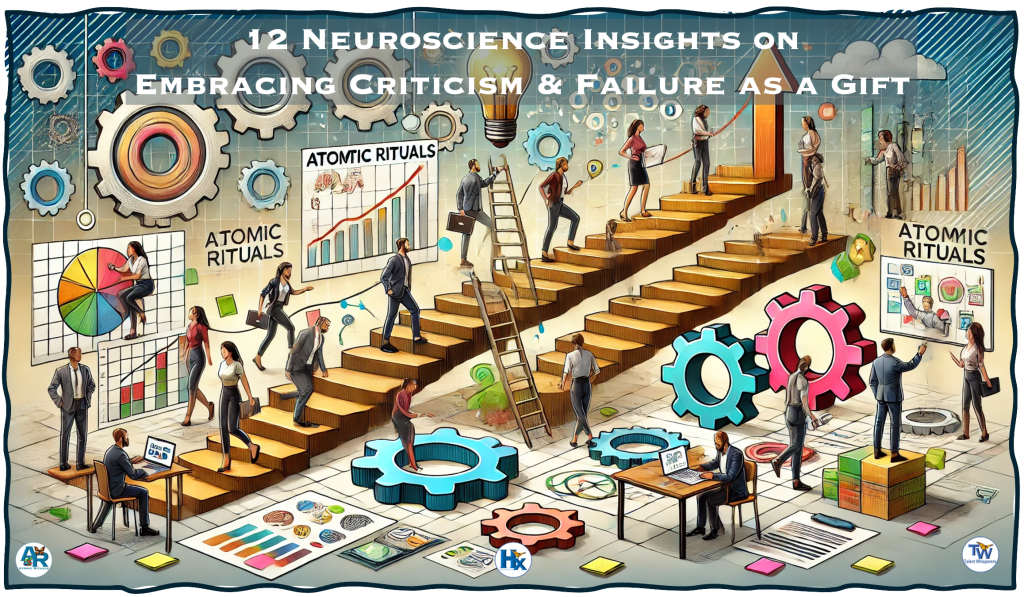
Our brains are designed to evolve. Each failure, criticism, or setback is a gift that strengthens our mindset, resilience, and abilities. The smaller, more atomic, our increments of progress on our journey, the greater the opportunity to receive gifts. When we embrace learning over fear, shame or resentment, we unlock unlimited growth one neural connection at a time.
“Joy is the matriarch of the family of emotions. She won’t enter a house where any of her children are not welcome.“
- from Karla McLaren in her 2010 book, The Language of Emotions; Also used by Joe Hudson
Contents
- Rewiring Your Brain for Growth, Innovation & Resilience 12 Neuroscience Insights
- Giving and Receiving as Gifts: Rewiring Your Relationships for Growth
- Giving Gifts Rather Than “Winning” Arguments
- Receiving Life as a Gift: A Leadership and Coaching Perspective
- Receiving Criticism as a Gift: The Power of Transforming Perception
- Neuroscience insights on the positive impact of a critic, attacker, shamer or onlooker
- Receiving Everything as a Gift: The Growth Mindset in Atomic Rituals: A Perspective Inspired by Carol Dweck
- Michael Jordan’s Reframing Mechanism
- Shame as an Atomic Growth Opportunity: A Perspective Inspired by Brené Brown
- API – Assume Positive Intent as a core premise behind receiving everything as a gift
- The Gift of What We’ve Banished
- The Gift of Language — How Ritual Speech Helps Us Receive Hardship as Gift
- Code, Design, Doc Reviews – The more powerful reasons for giving and receiving them.
- Supporting Material/References
- Infographic
- When the Darkness Is a Door
In my own journey, I have discovered both grace and power in receiving everything as a gift. Every setback, criticism, failure, attack can be an atomic step forward. A step forward not only on my own journey, but anyone that may have come with a criticism or attack as well as any observers. The gift is not alone for me, it is for all present. Each such received gift is an atomic step forward in the growth of the individual and the growth of the group.
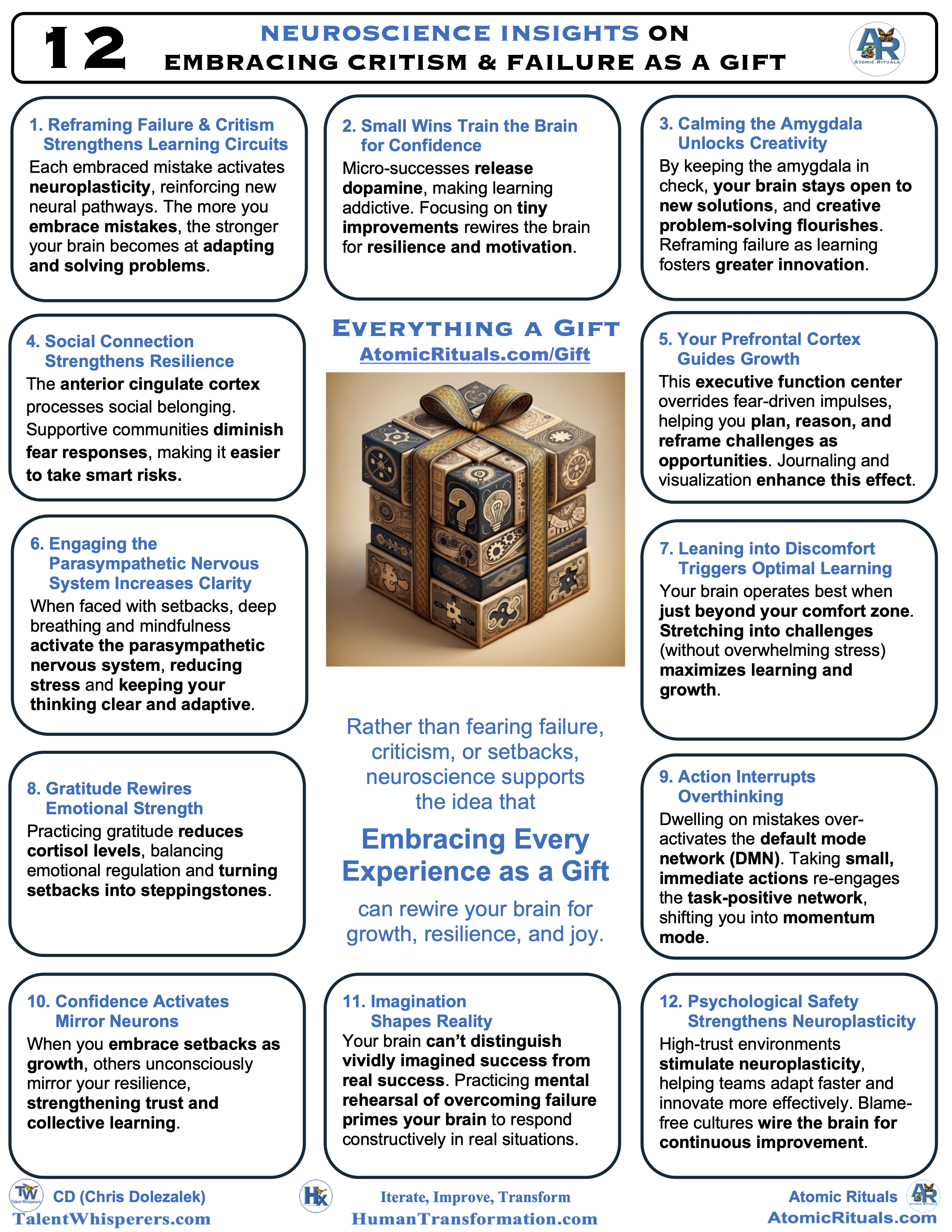
Rewiring Your Brain for Growth, Innovation & Resilience
1. Reframing Failure Strengthens Learning Circuits
Each mistake activates neuroplasticity, reinforcing new neural pathways. The more you embrace mistakes, the stronger your brain becomes at adapting and solving problems.
Tip: Reframe failures as valuable neural upgrades.
2. Small Wins Train the Brain for Confidence
Micro-successes release dopamine, making learning addictive. Focusing on tiny improvements rewires the brain for resilience and motivation.
Tip: When receiving criticism, say “Thank you for this perspective” to engage the brain’s reward system. . This also helps avoid letting a blow land.
3. Calming the Amygdala Unlocks Creativity
By keeping the amygdala in check, your brain stays open to new solutions, and creative problem-solving flourishes. Reframing failure as learning fosters greater innovation.
Tip: View setbacks as puzzles rather than threats—this engages the prefrontal cortex, improving problem-solving. The 5-Why analysis is a beautiful way to unravel several levels of learning.
4. Social Connection Strengthens Resilience
The anterior cingulate cortex processes social belonging. Supportive communities diminish fear responses, making it easier to take smart risks.
Tip: Keep a “Lessons Learned” journal to reinforce positive neuroplasticity.
5. Your Prefrontal Cortex Guides Growth
This executive function center overrides fear-driven impulses, helping you plan, reason, and reframe challenges as opportunities. Journaling and visualization enhance this effect.
Tip: Speak to yourself as a supportive mentor: “This is a lesson, not a loss.”
6. Engaging the Parasympathetic Nervous System Increases Clarity
When faced with setbacks, deep breathing and mindfulness activate the parasympathetic nervous system, reducing stress and keeping your thinking clear and adaptive.
Tip: Model resilience by responding to failures with curiosity, not frustration.
7. Leaning into Discomfort Triggers Optimal Learning
Your brain operates best when just beyond your comfort zone. Stretching into challenges (without overwhelming stress) maximizes learning and growth.
Tip: Model resilience by responding to failures with curiosity, not frustration.
8. Gratitude Rewires Emotional Strength
Practicing gratitude reduces cortisol levels, balancing emotional regulation and turning setbacks into steppingstones.
: Replace “I failed” with “I’m learning something new” to trigger a dopamine release.
9. Action Interrupts Overthinking
Dwelling on mistakes over-activates the default mode network (DMN). Taking small, immediate actions re-engages the task-positive network, shifting you into momentum mode.
Tip: Seek out challenges that stretch, but don’t break you.
10. Confidence Activates Mirror Neurons
When you embrace setbacks as growth, others unconsciously mirror your resilience, strengthening trust and collective learning.
Tip: Assume nobody remembers your failures—because they don’t.
11. Imagination Shapes Reality
Your brain can’t distinguish vividly imagined success from real success. Practicing mental rehearsal of overcoming failure primes your brain to respond constructively in real situations.
Tip: Celebrate small improvements—this trains your brain to enjoy progress.
12. Psychological Safety Strengthens Neuroplasticity
High-trust environments stimulate neuroplasticity, helping teams adapt faster and innovate more effectively. Blame-free cultures wire the brain for continuous improvement.
Tip: Instead of asking “Who made the mistake?”, ask “What can we learn?” to activate solution-oriented thinking.
Giving Gifts Rather Than “Winning” Arguments
Winning an argument at the expense of the relationship is a hollow victory. If a colleague or partner walks away feeling dejected, unheard, or resentful, then—even if you were “right”—you’ve likely lost something more important: trust, collaboration, and long-term alignment.
Winning Over vs. Winning Against
- Arguments Create Defensiveness – When criticism is framed as an attack, it triggers a fight-or-flight response. The other person becomes defensive rather than reflective, shutting down meaningful dialogue.
- Collaboration Over Competition – In a professional or personal setting, the goal should not be to “defeat” someone in an argument but to arrive at the best possible solution together. A great outcome isn’t about proving who is right, but about discovering what is right.
- People Remember How They Felt – Even if your points are valid, if the other person feels dismissed or diminished, they may disengage from the conversation—or worse, from the relationship altogether. You may have won the argument, but you’ve lost their openness, creativity, or willingness to collaborate.
- Turning Criticism into a Gift – When you reframe even harsh criticism as an opportunity to learn, you shift from reacting to receiving. If you can extract any insight or value from what’s being said—whether in tone or substance—you disarm the attack and turn it into constructive engagement.
- The Power of Emotional Intelligence – Responding with curiosity instead of counterattacks builds bridges instead of walls. Instead of meeting aggression with aggression, meeting it with genuine curiosity (“Help me understand why you feel that way”) can shift the entire dynamic.
- Leading with Empathy – People often lash out because they feel unheard, undervalued, or frustrated. A great leader or colleague recognizes that and acknowledges the emotion before addressing the logic of the situation. “I see this is really important to you. Let’s figure this out together.”
A Better Way Forward:
Tip: Instead of: “That’s completely wrong.”
Try: “I see where you’re coming from. Have you considered…?”
Tip: Instead of: “That makes no sense.”
Try: “I think we may be looking at this from different angles. Can we explore both?”
Tip: Instead of: “You always do this.”
Try: “I noticed this pattern—do you see it too? Let’s work through it.”
By focusing on winning people over, not winning against them, you create an environment where people feel safe to challenge ideas, contribute openly, and grow together. And in the long run, that’s a far greater victory.
Giving and Receiving as Gifts: Rewiring Your Relationships for Growth
In the fast-paced, demanding environment of disruptive tech startups, relationships can be strained by tight deadlines, conflicting priorities, and the pressure to perform. However, strong relationships are the foundation of a healthy and productive workplace. They foster collaboration, innovation, and resilience, enabling teams to navigate challenges and achieve shared goals. This appendix explores how the principle of “giving and receiving as gifts” can strengthen relationships, enhance communication, and create a more positive and supportive work environment.
The Neuroscience of Giving and Receiving
Research in neuroscience and psychology has shown that giving and receiving gifts, both tangible and intangible, activates the brain’s reward system, releasing dopamine and other feel-good neurochemicals. This creates a positive feedback loop, strengthening social bonds and promoting cooperation.
Key Principles of Giving and Receiving as Gifts
- Assume Positive Intent: Approach interactions with the assumption that others have good intentions, even when their actions or words may seem critical or challenging. This helps to defuse defensiveness and create an open and receptive mindset.
- Reframe Criticism as Feedback: View criticism as a gift, an opportunity to learn and grow. Instead of reacting defensively, seek to understand the other person’s perspective and extract valuable insights.
- Express Gratitude: Express gratitude for the gifts you receive, whether it’s a thoughtful suggestion, constructive feedback, or a helping hand. This reinforces positive behaviors and strengthens relationships.
- Give Generously: Offer your own gifts generously, whether it’s your time, expertise, or support. This creates a culture of reciprocity and strengthens bonds within the team.
- Embrace Vulnerability: Be willing to be vulnerable and share your own challenges and mistakes. This creates trust and encourages others to do the same, fostering a more open and supportive environment.
- Focus on Learning: View every interaction as an opportunity for learning and growth. Seek to understand different perspectives, challenge your own assumptions, and expand your knowledge.
Actionable Atomic Steps
- Start with Small Gestures: Practice giving and receiving small gifts, such as a word of encouragement, a helpful suggestion, or a simple “thank you.” These small gestures can have a big impact on building positive relationships.
- Reframe Negative Interactions: When faced with criticism or negativity, take a moment to reframe the situation. Ask yourself, “What can I learn from this?” or “How can I use this feedback to improve?”
- Practice Active Listening: Listen attentively to others, seeking to understand their perspectives and concerns. Ask clarifying questions and reflect back what you’ve heard to ensure understanding.
- Express Appreciation: Make it a habit to express appreciation for your colleagues and their contributions. This could involve verbal thank-yous, written notes, or public acknowledgment.
- Offer Support: Be willing to offer support to your colleagues, whether it’s helping with a challenging task, providing guidance, or simply lending an ear.
- Celebrate Successes: Celebrate team successes and individual achievements, reinforcing positive behaviors and fostering a sense of shared accomplishment.
- Create Rituals of Appreciation: Establish rituals that promote appreciation and gratitude, such as team lunches, peer-to-peer recognition programs, or regular feedback sessions.
Conclusion
By embracing the principle of giving and receiving as gifts, individuals and teams can rewire their relationships for growth, resilience, and mutual support. This creates a more positive and productive work environment, where challenges are seen as opportunities for learning and collaboration, and where everyone feels valued and appreciated.
Receiving Life as a Gift: A Leadership and Coaching Perspective
In leadership, coaching, and personal growth, one of the most profound shifts we can make is moving from control to openness, from entitlement to gratitude, and from resistance to acceptance. This perspective aligns with an idea found across multiple philosophies:
“Life is better when you receive everything as a gift.”
This idea isn’t about passive acceptance or blind optimism—it’s about adopting a mindset that transforms how we lead, grow, and help others. It’s deeply connected to fulfillment, resilience, and the ability to embrace both success and challenge with equal curiosity.
1. Leadership Through the Lens of Gifts (Taoism & Stoicism)
- Great leaders don’t resist reality—they work with it. Instead of lamenting the obstacles they face, they treat each challenge as an opportunity for refinement.
- Taoist wisdom suggests that when we stop clinging to what “should” be and embrace what is, we move with greater ease and impact.
- Stoicism teaches Amor Fati—loving one’s fate. A leader who embraces every situation as a gift to be used rather than a burden to be fought is far more adaptable, effective, and inspiring. See more below Stoicism.
Application:
- Instead of asking “Why is this happening?” ask “What can this teach me?”
- Treat setbacks as lessons rather than losses.
- Recognize that even the hardest conversations, the toughest decisions, and the biggest failures are all gifts in the long run.
2. Coaching and Growth: The Gift of Learning (Existentialism & Zen)
- Great coaching is about helping people see gifts they don’t yet recognize. Whether it’s uncovering hidden strengths, reframing challenges, or realizing that growth comes through discomfort, coaching helps people shift from resistance to reception.
- Shunryu Suzuki’s “Beginner’s Mind” reminds us that when we approach situations without assumption, we unlock far more possibilities than if we see only what we expect to see.
Application:
- When working with a client, challenge them to see what gifts their current struggles are offering them.
- Encourage a mindset shift: “What if this isn’t happening to you, but for you?”
- Emphasize that being wrong is a gift—because every moment of realization expands understanding.
3. The Gift Mindset in Practice (For Founders, Leaders, and Coaches)
- Receiving feedback as a gift. Instead of defending against criticism, receive it with gratitude.
- Seeing uncertainty as a gift. The unknown is not a threat; it’s an opportunity.
- Approaching relationships as gifts. Every person—whether mentor, teammate, or adversary—has something to teach you.
- Making decisions from abundance, not fear. A leader who views challenges as gifts will never lead from scarcity, but from growth.
A Leadership Reframe:
Most people approach life as a transaction—“If I do X, I should get Y.”
Great leaders, thinkers, and coaches approach life as a gift—“What is this moment offering me?”
If we believe that everything—success, failure, feedback, challenge, and opportunity—is ultimately a gift, then our work as leaders and coaches becomes not about controlling outcomes, but about receiving and responding with wisdom, humility, and adaptability.
Reframing Criticism: The Leadership Mindset
In leadership, coaching, and creative work, criticism is inevitable. But what differentiates strong, adaptable leaders from fragile, defensive ones is how they receive it.
Most people see criticism as a challenge to their competence, reputation, or authority. But truly effective leaders and high-performing teams treat criticism as what it really is: a gift.
This isn’t about blind acceptance or people-pleasing. It’s about flipping the power dynamic—turning feedback, even when delivered poorly, into an opportunity for growth, credibility, and influence.
The Two Paths: Resistance vs. Reception
When faced with criticism—whether in a code review, a document critique, a design discussion, or after a meeting or talk—you have two choices:
- Resist it. Defend yourself, explain why the other person is wrong, or let it shake your confidence. This reaction positions you as fragile, reactive, and at odds with those around you.
- Receive it. Treat the feedback as a gift, even if it’s wrapped in hostility. This doesn’t mean you have to agree, but it means you own the response, extract value, and set the tone.
The choice to receive feedback as a gift doesn’t just make you stronger—it changes the entire power dynamic of the situation.
The Power Shift: How Gratitude Disarms Criticism
If someone delivers criticism in a way that’s meant to undermine or attack you, responding with defensiveness fuels their power. But responding with gratitude does the opposite:
- If someone calls you out in a meeting in a way that feels like an attack, responding with “That’s a great point—thank you for sharing that perspective. I’ll take that into account.” removes their ability to frame you as defensive or resistant.
- If someone leaves a harsh comment in a review, responding with “I really appreciate you pointing that out—it helps me see where I can improve.” instantly flips the power structure.
- If someone questions your decision publicly, responding with “I hadn’t thought of it that way—let’s explore that.” turns you into the leader in the conversation.
By doing this, you not only extract value from the feedback, but you also remove any perception that you’ve been “brought down” in the eyes of others. Instead, you are elevated for taking the higher road.
This approach doesn’t mean you blindly accept all criticism—it means you own your response and position yourself as someone who learns, adapts, and welcomes challenge.
Criticism as Elevation: A Leadership Superpower
Great leaders and impactful coaches operate with this mindset:
✔ Feedback is always an opportunity. Even if it’s poorly delivered, there is always something to learn.
✔ Receiving criticism well increases credibility. People trust and respect those who can handle feedback without crumbling or lashing out.
✔ The way you react defines how others see you. In a room full of people, how you respond to criticism determines whether you are seen as composed and open or defensive and fragile.
✔ Even bad-faith criticism can be turned into a win. If you respond with grace, you disarm hostility and demonstrate confidence.
The Ultimate Power Move: Owning the Gift – A Martial Arts Perspective
In martial arts, one of the most fundamental principles is the ability to redirect an opponent’s energy against them rather than meeting force with force. This principle applies just as powerfully in leadership when dealing with criticism:
- You neutralize attacks before they land. Just as in Aikido or Judo, where an attacker’s force is redirected instead of resisted, receiving criticism with gratitude prevents the negativity from taking hold.
- You turn conflict into collaboration. Like a skilled martial artist using an opponent’s movement to control the fight, a leader who receives feedback openly transforms potential conflict into an opportunity for mutual growth.
- You gain respect, even from those who disagreed with you. In martial arts, demonstrating control, humility, and composure commands more respect than brute force. Responding to criticism with grace earns the respect of both critics and onlookers.
- You set the tone for how others should behave. Just as a disciplined fighter leads by example, a leader who absorbs criticism and turns it into a tool for improvement inspires those around them to adopt the same mindset.
Ultimately, martial arts teach that true strength is not about overpowering an opponent, but about being adaptable, fluid, and in control of your response. Leadership operates the same way—it isn’t about proving you’re right all the time, but about using every challenge to refine your skill, strategy, and presence.
Reframing the Internal Narrative
Most people instinctively react to criticism with one of two unhelpful mindsets:
- Defensiveness (“They’re wrong, and I need to prove it.”)
- Self-doubt (“Maybe I’m not good enough.”)
Both of these responses make you smaller in the moment. Instead, train yourself to hear every piece of feedback through this internal reframe:
“This is a gift. Whether or not I agree with it, there is value in hearing this perspective.”
Even if the criticism is misguided, mean-spirited, or completely wrong, it reveals something useful—about how others perceive you, about gaps in communication, or about dynamics at play in the room.
When you stop fearing criticism and start welcoming it as a tool for growth, you become unshakable.
The Ultimate Power Move: Owning the Gift
When you thank someone for their critique, you don’t just take the high road—you change the game entirely.
- You neutralize attacks before they land.
- You turn conflict into collaboration.
- You gain respect: of yourself, from observers, and even from those who disagreed with you.
- You set the tone for how others should behave.
And ultimately, you reinforce the truth that leadership isn’t about being right all the time—it’s about being open, adaptable, and always willing to grow.
Final Reframe: A Mindset Shift for Life and Leadership
- Old Mindset: Criticism is something to fear, avoid, or defend against.
- New Mindset: Criticism is a gift—whether it was meant that way or not, it is mine to use for growth and influence.
By treating everything as a gift—even critique, even challenge—you become the kind of leader, coach, and thinker who cannot be shaken.
Receiving Everything as a Gift: The Growth Mindset in Atomic Rituals
Growth as an Incremental Journey: A Perspective Inspired by Carol Dweck
Carol Dweck’s concept of a Growth Mindset teaches that abilities, intelligence, and resilience are not fixed—they evolve through challenge, effort, and adaptation. In the framework of Atomic Rituals, this means that every criticism, setback, failure, or even attack is an atomic step in a continuous journey of growth.
Rather than seeing obstacles as threats, we reframe them as essential gifts, each offering an opportunity to improve, refine, and transform—whether at the level of an individual, a team, or an entire organization.
The Core Principle: Every Challenge Is a Gift
In an Atomic Rituals approach to leadership and collaboration, we embrace the idea that nothing is wasted. Every piece of feedback, every moment of discomfort, and every confrontation serves a purpose—if we choose to see it that way. This is true not just for individuals but for entire groups, where collective resilience is built through graceful engagement with difficulty.
- Criticism: A new perspective that forces us to reassess, adapt, and strengthen our approach.
- Failure: A necessary iteration in learning what does and does not work.
- Setbacks: A pause that allows reflection, recalibration, and preparation for the next step.
- Attacks: An invitation to disarm conflict through grace, shifting the energy toward productive growth.
Atomic Steps: Growth for All Involved
The power of receiving everything as a gift extends beyond the individual—it ripples outward to impact everyone involved in the exchange.
1. The Individual’s Growth
When a person embraces every challenge as an atomic growth step, they build:
- Resilience – The ability to persist and evolve through difficulty.
- Adaptability – A willingness to learn from mistakes and adjust course.
- Mastery – The refinement of skill through continuous incremental improvement.
2. The Group’s Growth
A team, company, or community that embodies this mindset moves from a culture of fear and defensiveness to one of learning and iteration.
- Constructive Feedback Becomes Normative: When criticism is seen as fuel for growth rather than a personal attack, trust deepens.
- Failure Becomes Iteration: Teams move from blame to learning, increasing agility and innovation.
- Conflict Becomes Collaboration: Differences in opinion become opportunities to co-create better solutions.
3. The Critic’s Growth
The person offering criticism or initiating an attack is also transformed. When their words are met with grace and curiosity instead of resistance or hostility, they are given an opportunity to reflect, refine, and even grow themselves.
- They witness the power of humility and openness.
- They see an alternative to defensiveness, one that invites dialogue instead of division.
- They become part of the learning process, rather than positioned as an adversary.
4. The Observers’ Growth
Every interaction in a group setting is witnessed by others. When someone in a leadership or team position receives criticism or attack with gratitude and strength, it:
- Sets the standard for future interactions.
- Creates a ripple effect of learning.
- Shifts the group culture toward one of continuous improvement.
Receiving Everything as a Gift: The Ultimate Ritual for Growth
The concept of Atomic Rituals is about small, deliberate changes that compound into transformational progress. When receiving everything as a gift becomes habitual, it reshapes the very fabric of how a person, a team, or an organization operates.
Instead of seeing setbacks as interruptions, we see them as part of the process.
Instead of fearing criticism, we invite it.
Instead of resisting challenges, we use them as fuel.
This is not about blind optimism—it is about leveraging reality itself as the curriculum for growth.
And in doing so, …
- The individual grows.
- The group grows.
- The critic grows.
- The observers grow.
Every moment is a gift. Every step is atomic. And the journey never stops.
Neuroscience insights on the positive impact of a critic, attacker, shamer or onlooker
When an individual responds to criticism or attacks with grace and gratitude, this behavior can have significant neurochemical and psychological effects on observers, including the critic, the recipient, and any bystanders.
- Observers (Including the Critic):
- Activation of Reward Pathways: Witnessing acts of kindness or positive social interactions can stimulate the brain’s reward centers, leading to feelings of pleasure and reinforcing prosocial behavior.
- Promotion of Empathy: Observing someone respond positively to criticism can enhance empathetic responses, as the observer may vicariously experience the emotions involved and appreciate the constructive handling of negative feedback.
- Modeling Behavior: Such observations can serve as powerful behavioral models, encouraging observers to emulate similar responses in future situations, thereby fostering a culture of openness and resilience.
- The Recipient:
- Emotional Regulation: By reframing criticism as a gift, the recipient engages in cognitive reappraisal, a strategy known to regulate negative emotions and reduce stress responses.
- Neural Adaptation: This positive reframing can alter neural pathways associated with emotion processing, leading to increased resilience and a more balanced emotional state.
- The Critic:
- Disarming Hostility: When criticism is met with gratitude, it can neutralize any negative intent, reducing potential conflict and promoting a more collaborative interaction.
- Encouraging Reflection: Such a response may prompt the critic to reflect on their approach, potentially leading to more constructive and empathetic communication in the future.
In summary, responding to criticism with grace and gratitude not only benefits the individual but also has positive neurochemical and psychological impacts on all parties involved, promoting a more empathetic and resilient social environment.
Michael Jordan’s Reframing Mechanism
Michael Jordan’s Hall of Fame acceptance speech serves as the definitive case study in extreme cognitive reframing. He did not ignore his critics. He weaponized their doubt. This behavior exemplifies the “everything is a gift” framework in its most aggressive form. He transformed external negativity into internal fuel.
The Mechanism of Reframing
Jordan treated every insult as a tuition payment on and education. He did not internalize the critique as a truth about his identity. Instead, he projected the criticism outward. He viewed it as a necessary catalyst for his own performance. This approach is the direct opposite of learned helplessness. He used the external heckler to strengthen his internal ally.
The “I Took That Personally” Mindset
Jordan’s famous mindset acts as a robust mental filter. When someone claimed he could not achieve a goal, he converted that claim into a performance requirement. He did not prove them wrong to appease them. He did so to validate his own internal standard of excellence. He maintained complete authority over his mental boardroom. He prevented the external heckler from gaining entry.
A High-Octane Strategy
We must view this through a lens of psychological sustainability. Jordan’s approach is a high-octane survival strategy. It requires an immense amount of internal stability to utilize hostility as fuel without becoming consumed by it. Most people who attempt this without Jordan’s level of self-mastery risk burning out. They often mistakenly believe they must fight the world to prove their worth. Jordan, however, understood that the critic’s intent was irrelevant. He cared only about the utility he could extract from the critique.
Converting Setbacks to Tuition
This strategy effectively demonstrates how to convert a hostile environment into a training ground. Jordan did not let the critics define the outcome. He defined the outcome himself. He proved that even a malicious put-down can provide valuable data. It tells you exactly where you need to improve to render the criticism obsolete. He mastered the art of extracting the “gift” from the dirt.
Shame as an Atomic Growth Opportunity: A Perspective Inspired by Brené Brown
The Nature of Shame and Its Impact
Brené Brown’s research on shame highlights that shame thrives in secrecy, silence, and judgment. It is one of the most painful emotions because it strikes at the core of self-worth. Shame makes us feel small, unworthy, and disconnected. It creates fear and defensiveness, often leading to cycles of blame, withdrawal, or aggression.
However, shame loses its power when it is met with empathy and self-awareness. When someone receives shame—not with collapse or resistance, but with the openness of receiving it as a gift—its energy shifts. Instead of being a weapon that wounds, it becomes fuel for growth. This transformation is not just beneficial to the person experiencing shame, but also to the shamer and to the witnesses observing the interaction.
The Atomic Ritual of Receiving Shame as a Gift
Rather than allowing shame to shrink or define us, receiving it as a gift reframes it as an atomic growth step—a moment that offers insight, wisdom, and connection. This act of openness is a profound shift, one that creates ripples across individuals, teams, and entire cultures.
When shame is received with grace and curiosity rather than internalized or rejected, it disarms the shamer, enlightens the witnesses, and elevates everyone involved.
1. The Growth of the One Being Shamed
When someone is shamed—whether in a meeting, a social setting, or a personal interaction—the instinctive response is often to shrink or retaliate. But by embracing the moment as a learning opportunity, an individual can:
- Separate identity from behavior: Shame says, I am bad instead of I did something that needs improvement. Receiving shame as a gift allows a shift from self-judgment to self-growth.
- Strengthen resilience: Instead of being crushed, the individual develops emotional strength and learns how to navigate difficult emotions with self-compassion.
- Transform shame into curiosity: Asking, What is this moment trying to teach me? instead of Why am I not good enough? turns shame into wisdom.
2. The Growth of the Shamer
Most people who shame others do so from their own unresolved wounds, fear, or need for control. When a person responds to shaming not with defensiveness or collapse, but with grace and gratitude, it forces the shamer into a moment of self-awareness. This shift can:
- Disarm aggression: Shame often expects resistance or withdrawal. When neither happens, its power evaporates.
- Trigger reflection: The shamer is confronted with the unintended consequence of their action—an invitation to examine their own motivations and emotional state.
- Invite transformation: By seeing shame received as a gift, the shamer is offered an opportunity to grow beyond behaviors that harm connection.
3. The Growth of the Witnesses
Shame is rarely a private experience. There are always observers—whether in a meeting, a conversation, or a cultural moment. The way shame is handled teaches profound lessons to those who witness it.
When an individual receives shame with grace, the witnesses experience:
- A model of emotional mastery: They see that shame doesn’t have to destroy—that it can be met with confidence and wisdom.
- Permission to change the culture: If shame loses its sting when received as a gift, entire organizations and communities can shift from blame to learning.
- A redefinition of power: True power is not in avoiding shame but in transmuting it into something constructive.
Neuroscience: The Ripple Effect of Disarming Shame
Shame activates the brain’s threat response, releasing stress hormones like cortisol and triggering defensive behaviors. However, when someone meets shame with gratitude, calm, and curiosity, it initiates a neurochemical shift:
- Observers experience prosocial activation: Witnessing emotional resilience and self-compassion releases oxytocin, the neurochemical associated with trust and connection.
- The shamer’s aggression is neutralized: Without the expected fight-or-flight reaction, the shamer’s brain experiences cognitive dissonance, creating space for reflection.
- The person receiving shame rewires their response to criticism: Instead of reinforcing negative self-beliefs, the brain learns to reframe feedback in a growth-oriented way.
Atomic Rituals: The Collective Growth Opportunity
Receiving shame as a gift is not just about personal resilience—it creates an opportunity for the collective to grow. Every time someone receives shame with grace, they perform an atomic ritual that shifts culture:
✔ For the individual, it becomes an act of self-empowerment.
✔ For the shamer, it becomes an invitation to reflect and transform.
✔ For the witnesses, it becomes a lesson in emotional intelligence and leadership.
Over time, these small moments compound into an entirely new approach to how communities, organizations, and relationships navigate shame, feedback, and growth.
Final Reframe: Shame as a Catalyst for Growth
- Old Mindset: Shame is something to avoid, suppress, or fear.
- New Mindset: Shame is a gift—an opportunity for reflection, growth, and transformation.
By shifting our relationship with shame, we reclaim its energy and use it as fuel for personal and collective evolution. We move from fear to wisdom, from disempowerment to leadership, and from isolation to deep connection.
When shame is received as a gift, everyone grows.
The Gift of What We’ve Banished

What if what we most fear, avoid, or exile within ourselves isn’t a flaw—but a fragment of something sacred trying to return?
This is the shared heartbeat between what’s discussed above and the perspective offered by author and psychotherapist Francis Weller in his book The Wild Edge of Sorrow: Rituals of Renewal and the Sacred Work of Grief. Weller’s work centers around the idea that grief is not a pathology to be fixed, but a profound and necessary part of being human—one that connects us to what we value, love, and have lost. He invites us to treat grief and emotional pain not as burdens but as sacred companions, offering pathways back to wholeness.
In both frameworks, we are called to confront discomfort, not to conquer it but to reclaim its wisdom. Not everything that disrupts our flow is a defect. Sometimes it’s an invitation.
Banished Selves, Hidden Gifts
As discussed above:
Even the hardest moments—especially the ones that test us—are invitations to growth. Everything is a gift if we’re willing to receive it as one.
Weller echoes this through grief:
“Grief is not a feeling we have. It is a faculty of being human.”
Where society teaches us to banish sorrow, rage, or self-doubt, these frameworks teach us to befriend them. What we call a “Saboteur” may in fact be a protector born of pain—a loyal internal figure who once helped us survive. These internal forces are often dismissed as obstacles to performance, when in truth, they are evidence that something inside still longs to be heard.
Emotional integration provides the foundation for genuine psychological wholeness. Karla McLaren offers a stunning metaphor for this process in her book, The Language of Emotions. She describes joy as the matriarch of the entire emotional family. Furthermore, this matriarch will not enter a house where any of her children are unwelcome. These children are the very emotions we often fear or banish. Sorrow, anger, and fear are vital members of this internal family. If we lock the door on them, we inadvertently lock out joy too.
Joy as the Emotional Matriarch
This perspective strengthens the practice of befriending internal forces rather than conquering them. It validates the idea that a Saboteur is often a protector born of pain. We often dismiss these voices as obstacles to our performance. However, McLaren suggests they are prerequisites for our happiness. We cannot selectively numb our pain without also numbing our delight. This concept prepares the reader for the practical steps in the next section. It moves the focus from fixing a flaw to restoring a relationship. Therefore, the act of hospitality becomes the first atomic step toward re-integration. By honoring the difficult children, we build a home where the matriarch feels safe to reside.
The Necessity of Total Reception
- Systemic Unity: Joy remains a guest only when the entire emotional family is invited inside.
- Wisdom of Children: Each banished emotion carries specific gifts intended to guide our growth.
- Active Hospitality: Welcoming difficult parts transforms them from disruptive threats into sacred companions.
The Learned Resilience T.H.R.I.V.E. Loop provides the repeatable framework for this hospitality. We can target a moment of reactivity or shame as an entry point. Then, we hypothesize what that banished child needs to be heard. We reach into the discomfort with resolve and vigor. Consequently, we inspect the results through a 5-Whys analysis to find the root cause. This deep inquiry transforms raw pain into durable wisdom. Finally, we value the lesson and energize the system for the next challenge. Every step is an atomic ritual of return. This loop ensures that no experience is wasted.
The Ritual of Return
Weller’s emphasis on ritual mirrors the core structure explored above: small, intentional practices that bring fragmented parts of us back into the fold.
Just as grief needs a container to be metabolized, so too do our Saboteur moments need a ritual of re-integration. Not to silence the voice, but to meet it with dignity. Not to fix the flaw, but to recognize the gift.
When we ritualize the return of what we’ve banished, we:
- Create safe space for parts of ourselves that feel unlovable
- Transform shame into truth-telling
- Reframe internal struggle as a signal of hidden values and unmet needs
The Collective Implication
This isn’t just about individual growth. The parts we exile in ourselves are often the same parts we judge in others. When we practice welcoming what we’ve banished internally, we expand our capacity for empathy, compassion, and connection externally.
This, too, is a gift.
An Invitation
Next time you feel reactive, ashamed, or tempted to hide a part of yourself, pause.
Ask:
- What might this discomfort be pointing to?
- Who in me is asking to be welcomed back?
- What ritual could help me receive the gift here?
The goal is not resolution. It’s relationship. One rooted in mercy, curiosity, and the belief that what we’ve banished may be exactly what we need to grow.
If even what we’ve exiled can return as gift, it points to something deeper: the way we name and frame experience shapes the very reality we inhabit. Across traditions, language itself has been ritualized as a way to transform suffering into resilience.
Yet modern science is now catching up to what ritualists and mystics have long practiced—revealing how these subtle shifts in perception reshape not only the mind but also the brain itself.
The Science of Seeing Everything as a Gift
Modern psychology has begun to validate what ancient traditions and lived experience have long suggested: gratitude is not simply a feeling—it’s a way of perceiving. Research by Wood and colleagues (PLOS ONE, 2013) describes gratitude as a “life orientation”—a steady lens that turns ordinary experience into evidence of connection, meaning, and possibility. This orientation operates through cognitive reappraisal, the same mental process that allows ritual to transform suffering into understanding.
When we reframe hardship as a form of offering or lesson, we engage the same neural pathways that gratitude strengthens. Studies show that repeated gratitude practice—writing, reflection, or deliberate acknowledgment—shifts activity in brain regions tied to reward and empathy. Over time, these practices train perception itself. We begin to register subtle forms of support, grace, and reciprocity that our survival instincts often overlook.
Gratitude, then, is not the denial of difficulty—it’s the transformation of attention. By ritualizing that transformation, we convert pain into pattern recognition: seeing how moments of loss or failure reveal the deeper circuitry of interdependence. The research affirms what ritual makes tangible—that well-being grows not from what we have, but from how we hold what happens. Each act of reframing becomes an embodied hypothesis: that life, even in its roughest textures, is still offering something essential.
Neuroimaging now reveals the hidden choreography beneath that shift. Gratitude dampens the amygdala’s alarm response and activates the medial prefrontal cortex—the seat of cognitive reappraisal and emotional regulation. It lights up the ventral striatum, the brain’s reward hub, and strengthens neural links with the anterior cingulate, deepening empathy and social connection. Through these circuits, dopamine and oxytocin rise in concert, tuning our chemistry toward trust, safety, and possibility. Gratitude, in this sense, becomes a biological ritual of reframing—a molecular affirmation that meaning is still available even in hardship.
Just as atoms form the unseen architecture of matter, these micro-moments of gratitude form the unseen architecture of resilience. Each small act of reappraisal—each moment we choose to see through the lens of gift—creates a subtle but lasting shift in how we experience reality. Over time, these atomic rituals accumulate into transformation, re-patterning not just our thoughts but the emotional chemistry of our days.
(For further reading, see: Wood, A. M., Froh, J. J., & Geraghty, A. W. A. (2013). Gratitude and well-being: A review and theoretical integration
The Gift of Language — How Ritual Speech Helps Us Receive Hardship as Gift
Language does more than describe; in many traditions it operates like a ritual instrument — a technology purposely shaped to transform suffering into habit, meaning, and shared strength. When a person reads “everything is a gift,” that idea lands in the private mind. When a community speaks a phrase in unison at moments of trial, that same idea changes how bodies move through fear. Across cultures and histories, people have learned to name, reframe, and thereby transmute hardship through intentionally engineered speech. These are not metaphors; they are public practices that rewire affect, redistribute courage, and make resilience transmissible.
Khalsai Bole — Thundering Reframing of the Nihangs
Among the Akali-Nihangs — Sikh warrior-saints whose identity formed in long eras of persecution — the language of speech itself was sharpened into a morale practice. Khalsai Bole (sometimes called Khalsa bole) used terse, bold turns-of-phrase and euphemism to recast danger as bravado. Rather than let suffering define the moment, phrases would treat it as an occasion for jocular triumph or ritual inversion: the sting is named and then laughed at. The effect is both psychological and social. Psychologically, speaking in that register interrupts fear circuits — the threat becomes a scripted event, not a chaotic horror. Socially, the shared speech binds people in a joint frame: everyone who adopts the phrase is publicly refusing collapse. In short, Khalsai Bole functioned as a communal reframe, converting vulnerability into collective Chardi Kala — the steady, high-spirited optimism that sustains action under duress.
Naming Grief: Jewish Blessings and the Ritual of Loss
Judaism embeds grief in language through rites that make sorrow legible and held. When death is announced, the traditional response — Baruch Dayan Ha’Emet (“Blessed is the True Judge”) — does not remove the pain. Instead it frames that pain within a theological and communal narrative: the moment is consecrated and circumscribed. The blessing performs multiple functions simultaneously. It acknowledges the reality of loss, connects it to a larger meaning structure, and gives those present a common utterance that organizes their response. As a result, grief becomes a shared object: something to be witnessed, named, and carried together rather than suffered in isolated shame. Language here is a container; the blessing is a ritual mouthpiece that converts raw sorrow into a defensible, shared experience.
Songs That Survive: African American Spirituals as Encoded Resilience
When people lacked power and were subject to brutality, they often turned to layered speech — forms that said more than outwardly met the ear. African American spirituals are a paradigmatic example. On their surface, spirituals are hymns of lament and hope. Beneath the melody and the steady cadence, many songs carried encoded information: routes to escape, warnings about patrols, metaphors that preserved dignity and the internal map of liberation. Singing itself became a ritual of endurance: in voice and communal rhythm, sorrow and strategy coexisted. The songs reframed an unbearable present as an ongoing, shared journey toward a promised future. Language became a tool for practical survival and a repository of hope.
Rehearsal as Medicine: Stoic Premeditatio Malorum
The Stoics taught another linguistic practice: rehearse the worst to blunt its power. Premeditatio malorum — the premeditation of evils — asks the practitioner to name potential losses or humiliations in advance, to speak them aloud, and to mentally rehearse responding. The cognitive effect is clear: by bringing feared scenarios into daylight and giving them language, they stop dangling in the dark as imagined monsters. The rehearsal converts abstract dread into a script for action. Practically, this reduces surprise, heightens preparedness, and turns possibility into practice.
What these traditions share
- Intentionality. Speech is deliberately structured (phrases, blessing formulas, songs, rehearsals).
- Shared frame. The same words used by a group create collective meaning and mutual regulation.
- Practical effect. Naming or singing changes physiological responses and social expectations; it isn’t decorative.
- Transmission. These are learnable practices that communities pass forward — language as cultural memory and technique.
A short ritual practice you can teach instantly
- Three Gift Phrases (use these aloud when a setback lands):
- “This is tuition not trauma” — reframes failure as paid learning.
- “Give me the gift of curiosity” — turns criticism into inquiry.
- “Chardi Kala: we rise” — a one-line anchor that summons steadiness and collective resolve.
- Practice: Choose one phrase. Say it aloud at the end of your workday when a mistake surfaces, or at the start of a tough conversation. Repeat it with breath 3 times. Make it a micro-ritual until the phrase becomes a trigger for the reframed response.
See Also for the Gift of Language
Learned Resilience — framing setbacks as gift or curse
- In the Learned Resilience framework, every failure or challenge presents a turning point: it can lead to resilience if reframed as a gift, or to helplessness if received as a curse. This highlights how our interpretive language shapes whether hardship weakens or strengthens us, individually or collectively.
Khalsai Bole — Sikh coded language of resilience
- Entry from the Encyclopaedia of Sikhism on Nihang Bole (also called Gargaj/Gar Gaj Bole, “thundering language”). It explicitly describes a “grandiloquent patois” built of euphemisms and jargon that embody high-spirited courage—language used to make light of hardship and keep spirits in Chardi Kala. This is the clearest reference for the claim that Nihangs ritualized speech to transmute adversity.
Zen kōans — paradox as a language-tool
- Britannica’s overview explains kōans as paradoxical statements/questions used to exhaust the analytic intellect and prepare an intuitive response—i.e., a deliberate linguistic device to loosen suffering’s grip by undoing rigid perception. This is exactly the “speech as practice” move we’re highlighting.
Primary text: The Gateless Gate
- A reliable English presentation of Wumen’s classic kōan collection. The preface and notes make explicit that the intention is awakening beyond conceptualization—using language to push past language, a refined form of reframing at the edge of words.
Navajo (Diné) Blessingway — ritual speech for harmony
- Britannica’s article situates Blessingway (Hózhóójí) within the Diné chantways as ceremonies designed to restore equilibrium—that is, to move a person back into hózhó (beauty, balance) through songs and spoken prayer. This is a direct example of linguistic ritual transforming hardship into restored order.
Museum handout on Blessingway chants (education resource)
- One-page PDF from the Natural History Museum of Utah summarizing how Blessingway songs preserve and enhance a state of hózhó. Useful as a concise, classroom-level reference that foregrounds song/chant as the mechanism.
African American spirituals — language coded for survival and hope
- Library of Congress overview of spirituals as a tradition born in slavery; it outlines function, form, and historical context—establishing the bedrock before you explore codes. It’s the best single doorway into the topic from a primary U.S. institution.
Hidden messages in spirituals (lesson/analysis)
- An educator resource showing how specific lyrics encoded information (routes, timing) while sustaining communal faith—language doing double duty as resistance and resilience. Pair this with the LOC piece above for both foundation and examples.
Stoicism (primary text): Epictetus, Enchiridion §5
- The canonical passage: “Men are disturbed, not by things, but by the principles and notions which they form concerning things.” This is reframing in its purest linguistic form—judgment (wording) creates the felt world—and it’s the right source to point to when we claim Stoics used language to transform suffering.
Stoicism (primary text): Marcus Aurelius, Meditations 5.20
- The famous line rendered in context: “the mind converts and changes every hindrance to its activity into an aid … what stands in the way becomes the way.” This isn’t a meme; it’s Marcus’ explicit instruction to reword obstacles as fuel, i.e., a linguistic/attentional pivot.
Code, Design, Doc Reviews – The more powerful reasons for giving and receiving them
What is your answer to the question:
- “Why do we do code, design and reviews?“
Most managers, engineers and leaders of all sorts will answer ~ it is to ensure we don’t create and release bad code. However, they can and should have a much higher purpose as well. If done in the right way, they level-up the author of whatever is being reviewed. Ideally in ways that fewer and fewer things show up in reviews that need adjusting.
They can be lead with something like
- “I see what you’re trying to achieve, and that’s great. I’m curious, why did you choose that approach and did you consider this approach?” Or,
- “Hey, I’m just the dumb manager here, and you’re the expert. Help me understand why you decided on that approach.”
There are times where the reviewer can also level-up – when they learn that they didn’t recognize the value of taking an approach that differs from how they would have done it. Hence, I like to suggest for reviews – don’t offer criticisms, offer gifts. They will be much less likely to be received with defensiveness.
Likewise, for the recipient of a review, it’s really helpful to look for the gifts in reviews. Seeing the comments not as criticisms but as gifts, leads to curiosity as there may well be something of value to be extracted even if its as simple as – I could have presented my choice or reasoning better such that the reader would have appreciated the wisdom in that choice.
Whenever I’ve introduced the notion that reviews are opportunities to level each other up, it has significantly changed how they are given and received, has helped level up the team, has increased the desire to offer things for review and to give review feedback. Furthermore, it has improved the culture as well.
Supporting Material/References:
General:
- Saboteurs and Allies – in many ways, it is not the outer critic that impacts us most. It is the inner critics, our personal saboteurs that impact us much more. Furthermore, an outer critic’;s criticism or attack really only lands when it triggers one of our inner Saboteurs. Understanding these and what tirggers that can be very helpful in receiving everything as a gift.
- The Power of Appreciation: The Key to a Positive Workplace by Noelle Nelson: This book explores the transformative power of appreciation in the workplace and provides practical strategies for expressing gratitude and building positive relationships.
- The 7 Habits of Highly Effective People by Stephen R. Covey: This classic self-help book emphasizes the importance of empathy, collaboration, and seeking to understand different perspectives.
- Nonviolent Communication: A Language of Life by Marshall B. Rosenberg: This book provides a framework for communicating compassionately and resolving conflicts peacefully.
- Mindset: The New Psychology of Success by Carol S. Dweck: Explores how a growth mindset transforms setbacks into learning experiences.
- The Art of Learning by Josh Waitzkin: How embracing mistakes fuels mastery and rapid skill acquisition.
- The Fearless Organization by Amy Edmondson: Why psychological safety drives innovation and learning in high-performing teams.
- The Upside of Stress by Kelly McGonigal: How changing our perception of stress improves performance and resilience.
- Daring Greatly by Brené Brown: The power of vulnerability in embracing criticism and failure.
Other Supporting Material/References:
- The Brain that Changes Itself by Norman Doidge: Explores the concept of neuroplasticity and how the brain can rewire itself through experience.
- Hardwiring Happiness by Rick Hanson: Provides practices for rewiring the brain for positivity and resilience.
- The Chimp Paradox by Steve Peters: Offers a model for understanding and managing the emotional and rational parts of the brain.
- Emotional Agility by Susan David: Provides strategies for navigating emotions effectively and building emotional resilience.
- The Power of Full Engagement by Jim Loehr and Tony Schwartz: Emphasizes the importance of managing energy, not just time, for optimal performance and well-being.
Gratitude: Receiving the Present in the Present
Gratitude isn’t just a feeling — it’s a practiced orientation toward life. It tunes our awareness to what is already here, already given, even amidst uncertainty or pain. In the philosophy of Everything is a Gift, gratitude becomes the gateway: a ritual of reception. It helps us receive not just the obvious blessings, but also the disguised ones — the setbacks, delays, and detours that carry hidden wisdom.
Modern neuroscience has confirmed what ancient wisdom traditions intuited: gratitude changes the brain. It shifts our chemistry and rewires our perception in ways that reinforce resilience, presence, and connection.
- Activation of Reward Centers: Gratitude activates the brain’s medial prefrontal cortex, increasing pleasure and reinforcing prosocial behavior. (See: Mind & Body – How Gratitude Changes You and Your Brain)
- Mood Regulation Through Neurotransmitters: Expressing gratitude boosts dopamine and serotonin — the same chemicals targeted by many antidepressants. (See: Calm – The Science of Gratitude)
- Stress Reduction: Regular gratitude practice lowers cortisol, the body’s primary stress hormone, leading to greater calm and emotional stability. (See: UCLA Health – Health Benefits of Gratitude)
- Enhanced Sleep Quality: Gratitude journaling improves sleep by reducing intrusive thoughts and activating a sense of peace before bed. (See: Positive Psychology – The Neuroscience of Gratitude)
- Cardiovascular Benefits: A grateful mindset is associated with lower blood pressure, reduced inflammation, and improved heart health. (See: UCLA Health – Health Benefits of Gratitude)
In a culture that often equates ambition with dissatisfaction, gratitude teaches us to celebrate enoughness. It’s not complacency — it’s clarity. Gratitude allows us to move forward not from lack, but from love. It prepares us to give freely, because we’ve already received so much.
Gratitude is a ritual of perception. Practiced daily, it transforms the mundane into the meaningful — and opens us to the deeper gifts already unfolding.
Neuroscientific Insights into Gratitude:
Incorporating gratitude into daily life, such as through journaling or mindful reflection, can lead to these positive neural changes and contribute to overall health.
- Activation of Brain Regions: Gratitude activates the brain’s reward centers, such as the medial prefrontal cortex, enhancing feelings of pleasure and reinforcing prosocial behavior. See Mind & Body – How Gratitude Changes You and Your Brain
- Neurotransmitter Production: Expressing gratitude stimulates the release of dopamine and serotonin, neurotransmitters associated with happiness and mood regulation. See Calm – The science of gratitude and how it can affect the brain
- Stress Reduction: Regular gratitude practice can lower cortisol levels, the body’s primary stress hormone, leading to decreased anxiety and improved resilience. See ULCA Health – Health benefits of gratitude
- Enhanced Sleep Quality: Individuals who maintain a gratitude journal report better sleep quality, likely due to reduced negative thoughts and a more positive pre-sleep mindset. See Positive Psychology – The Neuroscience of Gratitude and Effects on the Brain
- Improved Heart Health: Gratitude is linked to better cardiovascular health, potentially through its effects on reducing stress and promoting positive emotions. See UCLA Health – Health benefits of gratitude
See Also: Gratitude – Foundational Perspectives
- Robert Emmons – Thanks!: How the New Science of Gratitude Can Make You Happier A landmark book by the foremost scientific researcher on gratitude, presenting evidence-based insights into how gratitude improves health, happiness, and relationships.
- Martin Seligman – Positive Psychology Center: Gratitude (University of Pennsylvania) A foundational resource outlining key gratitude interventions like the “Gratitude Letter” and journaling exercises, with strong clinical backing.
- David Steindl-Rast – TED Talk: Want to Be Happy? Be Grateful A soulfully delivered TED Talk on the spiritual and emotional richness of gratitude, watched over 10 million times.
Spiritual Perspectives:
These resources offer diverse spiritual perspectives on the transformative power of perceiving life’s moments and interactions as gifts, encouraging a mindset of gratitude and generosity.
So why offer religious and spiritual perspectives here? I believe the way we do one thing is very much how we do everything. For some of us, our religious or spiritual beliefs help shape how we are and how we see the world.
Also, I have found in Silicon Valley and in various disruptive tech startups, there tends to be a very wide diversity of cultural, spiritual and religious perspectives blended into one place. While, particularly in California, it is considered a faux-pas to raise religious or spiritual topics in the work place, I find there can be value it showing that are shared beliefs and values shared among most if not all of them.
- Gratitude Across Cultures: Spiritual Perspectives on Thankfulness
A look into how various spiritual traditions emphasize gratitude as a means to recognize and cherish life’s gifts. - The Art of Receiving: How Different Religions Embrace Life’s Gifts
This article explores various religious practices that teach adherents to perceive life’s events as divine gifts, fostering gratitude and acceptance. - Embracing the Present: Mindfulness in World Religions
An examination of how different faiths incorporate mindfulness and present-moment awareness to appreciate life’s unfolding experiences. - Your Gifts Were Made for God and Others
This article discusses the importance of using one’s talents to serve others, highlighting the spiritual significance of selfless giving. - If Every Gift Comes from God, Why Thank Anyone Else?
Exploring the idea that all gifts originate from the divine, this piece delves into the importance of gratitude towards both God and fellow humans. - Dāna
In Hinduism and Buddhism, Dāna refers to the virtue of generosity, emphasizing the importance of selfless giving as a path to spiritual growth. - Holy Moments – Matthew Kelly’s Holy Moments emphasizes recognizing and embracing everyday opportunities to collaborate with the divine, transforming ordinary instances into profound experiences. This perspective aligns with the broader spiritual concept of viewing life’s events as gifts, fostering gratitude and growth.
- Receiving the Gifts of God
This speech highlights how accepting divine gifts can lead to personal transformation and a deeper connection with the divine. - The Art of Giving and Receiving Gifts
This article reflects on the grace involved in both giving and receiving, emphasizing the mutual enrichment that comes from these acts.
Various religious viewpoints on embracing life’s experiences as gifts
These perspectives illustrate a common theme across diverse religions: the encouragement to view life’s experiences, whether joyous or challenging, as opportunities for growth, learning, and deeper connection with the divine. For deeper dives see Deeper look into Spiritual / Religious Perspectives on Seeing Everything as a Gift
Hinduism:
In Hindu philosophy, the concept of Prasada signifies divine grace. Devotees offer food or items to deities, which are then returned as Prasada, symbolizing the acceptance of life’s events as blessings from the divine. This practice encourages humility and gratitude, viewing all experiences as part of a divine plan.
Buddhism:
Buddhism teaches the principle of mindfulness, emphasizing acceptance of the present moment. By embracing each experience without judgment, practitioners learn to see challenges and setbacks as opportunities for growth and enlightenment, fostering a mindset that views every moment as a valuable part of the journey.
Islam:
In Islam, the concept of Sabr (patience) and Shukr (gratitude) are central. Believers are encouraged to remain patient during hardships and express gratitude during times of ease, recognizing that both are tests and gifts from Allah. This perspective cultivates resilience and a deep appreciation for all circumstances.
Sikhism:
Sikhism emphasizes the acceptance of God’s will (Hukam). Sikhs strive to see all events, whether perceived as positive or negative, as expressions of divine will, encouraging a balanced mindset that remains steadfast amidst life’s fluctuations.
Judaism:
In Judaism, the practice of reciting blessings (Brachot) for various daily occurrences instills a sense of gratitude. By acknowledging God’s hand in all aspects of life, adherents learn to appreciate every experience as a divine gift, reinforcing a continual awareness of the sacred in the mundane.
Christianity:
Christian teachings often highlight the idea of grace, viewing life’s challenges and blessings as part of God’s benevolent plan. Believers are encouraged to trust in God’s wisdom, embracing each experience as an opportunity for spiritual growth and deeper faith.
Info-Graphic
Deeper look into Spiritual / Religious Perspectives on Seeing Everything as a Gift
Gratitude and Divine Awareness in Judaism: The Power of Brachot
- Buddhism
- Christianity
- Hinduism
- Islam
- Judaism
- Sikhism
- Stoicism
- Indigenous and Tribal Religions
- Other Philosophies (Taoism, Existentialism, Zen Buddhism)
- Ray Dalio’s View
Buddhism
Mindfulness and Acceptance in Buddhism: Seeing Every Moment as a Gift
Buddhism teaches that suffering and joy are both part of life’s natural flow, and true peace comes from mindful acceptance of the present moment. By letting go of resistance and judgment, practitioners cultivate equanimity, wisdom, and gratitude, seeing every experience—whether pleasant or painful—as a step toward spiritual growth and enlightenment.
1. Mindfulness: Being Present with Gratitude
• Mindfulness (Sati) encourages full awareness of the present moment without attachment or aversion.
• “Do not dwell in the past, do not dream of the future, concentrate the mind on the present moment.” (The Buddha)
• Recognizing the impermanence (Anicca) of all things helps practitioners appreciate each moment as it is.
2. Challenges as a Path to Enlightenment
• Buddhism teaches that suffering (Dukkha) is an inevitable part of existence, but it also provides opportunities for awakening.
• “Pain is certain, suffering is optional.” (Ajahn Chah)
• By embracing difficulties with curiosity and acceptance, one learns detachment and resilience.
3. Impermanence: Appreciating Life’s Fleeting Nature
• Nothing is permanent, and understanding this truth leads to deeper gratitude for the present.
• “Whatever is subject to arising is subject to ceasing.” (The Buddha)
• Seeing experiences as passing clouds reduces attachment and fosters inner peace.
4. Gratitude Through Non-Attachment
• Clinging to desires and expectations leads to suffering, while gratitude arises from accepting things as they are.
• “Let go of what has passed, let go of what may come, let go of what is happening now. Don’t try to figure anything out, don’t try to make anything happen. Relax, right now, and rest.” (Tilopa, Buddhist Master)
• True gratitude is not about possessing but about appreciating life’s unfolding nature.
5. Every Interaction as a Teacher
• Buddhism emphasizes that every person and situation is a mirror for our inner growth.
• “If you light a lamp for someone else, it will also brighten your path.” (Buddhist Proverb)
• Challenges with others become opportunities to practice patience, kindness, and understanding.
6. Generosity (Dana): The Practice of Giving
• The greatest form of gratitude is giving without expecting anything in return.
• “If you knew what I know about the power of giving, you would not let a single meal pass without sharing it in some way.” (The Buddha)
• Service to others transforms gratitude from an internal state to an outward expression of compassion.
7. Equanimity: Finding Peace in Every Moment
• Equanimity (Upekkha) means remaining calm and accepting whatever arises, without being disturbed by highs or lows.
• “He who has realized the Truth, does not dispute over what is pleasant or unpleasant. He remains calm in all circumstances.” (Dhammapada 83)
• Through equanimity, practitioners find gratitude not just in pleasure, but in all of life’s experiences.
8. Walking the Middle Path
• The Buddha taught The Middle Way, avoiding both indulgence and extreme asceticism.
• “There is pleasure when one’s own needs are fulfilled, but even greater joy when one fulfills the needs of another.”
• Gratitude is cultivated through balance—appreciating both abundance and simplicity.
Conclusion: The Gift of Every Moment
Buddhism teaches that each moment—whether joyful or difficult—is a valuable teacher. By practicing mindfulness, acceptance, and generosity, practitioners cultivate a deep appreciation for life’s impermanence and interconnectedness. When seen through this lens, every experience becomes a gift on the journey to enlightenment.
Grace and Gratitude in Christianity: Trusting in God’s Plan
Christianity teaches that every experience—both joyful and challenging—is part of God’s divine plan, offering opportunities for spiritual growth, faith, and transformation. Through the lens of grace, Christians are called to trust in God’s wisdom, embracing both trials and blessings as expressions of His love and guidance.
1. Grace as a Gift from God
• Christianity emphasizes grace—the unmerited favor of God—as the foundation of faith.
• “For by grace you have been saved through faith, and this is not from yourselves, it is the gift of God” (Ephesians 2:8).
• Recognizing life itself as a gift fosters a spirit of gratitude and humility.
2. Gratitude in All Circumstances
• Christians are called to give thanks in all situations, recognizing God’s wisdom in both joy and hardship.
• “Give thanks in all circumstances; for this is God’s will for you in Christ Jesus” (1 Thessalonians 5:18).
• This perspective shifts focus from complaints to appreciation, deepening faith.
3. Challenges as a Path to Spiritual Growth
• Suffering is often viewed as a means to deepen reliance on God and develop perseverance.
• “Consider it pure joy, my brothers and sisters, whenever you face trials of many kinds, because you know that the testing of your faith produces perseverance” (James 1:2-3).
• Hardships become opportunities for spiritual refinement and trusting in God’s purpose.
4. The Power of Thanksgiving and Praise
• Gratitude is central to Christian worship—expressed through prayer, praise, and acts of kindness.
• Jesus Himself demonstrated gratitude, giving thanks before performing miracles (Luke 9:16) and teaching the importance of a thankful heart.
• Many Christian traditions incorporate thanksgiving prayers, such as:
• The Lord’s Prayer – “Give us this day our daily bread” expresses reliance and gratitude.
• The Doxology – “Praise God from whom all blessings flow” centers on worship as gratitude.
5. Trusting in God’s Wisdom
• Faith means surrendering control and trusting in God’s plan, even when it is unclear.
• “Trust in the Lord with all your heart and lean not on your own understanding” (Proverbs 3:5).
• Letting go of fear and embracing each moment as part of God’s work leads to peace and contentment.
6. Living Out Gratitude Through Service
• True gratitude is reflected in acts of kindness, generosity, and love toward others.
• “Freely you have received; freely give” (Matthew 10:8).
• Service to others—whether through charity, encouragement, or forgiveness—becomes a living expression of gratitude to God.
Conclusion: Embracing Life as a Divine Gift
Christianity teaches that God’s grace sustains every moment, and gratitude transforms how believers experience the world. Through thanksgiving, trust, and service, Christians embrace both blessings and challenges as opportunities to deepen faith. In doing so, they discover joy, peace, and fulfillment in God’s greater plan.
Hinduism
Prasada and the Gift of Life: Gratitude in Hinduism
Hindu philosophy teaches that all experiences—joyful or challenging—are divine gifts meant to guide us toward wisdom, humility, and spiritual growth. The concept of Prasada, meaning divine grace, reflects the belief that what is received from the universe should be accepted with gratitude and devotion.
1. Prasada: A Symbol of Divine Blessing
• In Hindu rituals, devotees offer food (Naivedya) to the deity, which is then returned as Prasada—a sacred blessing.
• This act represents surrendering one’s ego, desires, and efforts to the divine.
• “Take everything as Prasada, whether pain or pleasure, as God’s gift.” (Swami Sivananda)
2. Karma Yoga: Gratitude Through Selfless Action
• Karma Yoga teaches that selfless service (Seva) is an expression of devotion and gratitude.
• “The best way to find yourself is to lose yourself in the service of others.” (Mahatma Gandhi)
• By acting without attachment to results, one cultivates contentment and trust in the divine flow.
3. Accepting Life as Divine Will (Ishwara Pranidhana)
• Hinduism teaches Ishwara Pranidhana, or surrendering to divine will, fostering inner peace and acceptance.
• “Whatever happened, happened for the good. Whatever is happening, is happening for the good. Whatever will happen, will also be for the good.” (Bhagavad Gita 2.3)
• Gratitude arises from trusting that all experiences serve a higher purpose.
4. Dharma: Fulfilling One’s Purpose with Gratitude
• Dharma refers to one’s sacred duty, and fulfilling it with devotion transforms every task into an offering.
• “Perform your duty without attachment to the outcome.” (Bhagavad Gita 2.47)
• Seeing one’s work as a service to others and the universe fosters a deep sense of meaning and appreciation.
5. The Sacredness of Giving and Receiving
• Dana (giving) is central to Hindu traditions, reinforcing the idea that true gratitude is expressed through generosity.
• “The hand that gives is always full.” (Hindu Proverb)
• Just as one receives Prasada with reverence, one should also give freely without expectation.
6. The Law of Karma: Gratitude for Every Experience
• The doctrine of Karma teaches that every action has consequences, shaping one’s future experiences.
• Accepting both success and hardship as opportunities for growth leads to detachment and gratitude.
• “Even misfortunes are stepping stones to spiritual progress.” (Swami Vivekananda)
7. Finding Joy in Simplicity: The Power of Contentment (Santosha)
• Santosha, or contentment, is the practice of finding peace in the present moment.
• “There is no higher happiness than contentment.” (Manusmriti 4.12)
• When desires are reduced, gratitude for what is already present naturally arises.
8. Aarti: Offering Light as a Symbol of Gratitude
• Aarti, the ritual of waving light before a deity, is a symbolic act of offering oneself to the divine with gratitude.
• Just as the flame illuminates the deity, gratitude illuminates the heart, fostering joy and devotion.
9. Yoga and Meditation: The Inner Path to Gratitude
• Through meditation and breathwork (Pranayama), practitioners learn to cultivate gratitude by quieting the mind and embracing the present.
• “Meditation brings wisdom; lack of meditation leaves ignorance.” (Bhagavad Gita 2.65)
• By connecting with the self, one sees every experience as part of a divine tapestry.
10. Seeing the Divine in All Beings
• Hinduism teaches Vasudhaiva Kutumbakam—“The world is one family.”
• “See the divine in every being, for God resides in all.” (Bhagavad Gita 5.18)
• True gratitude emerges when one recognizes the sacred in everything and everyone.
Conclusion: Gratitude as a Spiritual Practice
Hinduism encourages seeing every experience, every challenge, and every joy as a sacred offering. Whether through Prasada, selfless service, contentment, or devotion, gratitude is not just an emotion—it is a way of life. By surrendering to the divine flow, one finds peace, joy, and fulfillment in every moment.
Islam
Sabr and Shukr: Gratitude and Patience in Islam
Islam teaches that every moment—whether of ease or difficulty—is an opportunity for spiritual growth and gratitude. The twin concepts of Sabr (patience) and Shukr (gratitude) form the foundation of a believer’s approach to life, fostering resilience, trust in Allah’s wisdom, and appreciation for every circumstance.
1. Sabr: The Strength in Patience
• Sabr is not passive endurance but an active trust in Allah’s plan, even in hardship.
• “Indeed, Allah is with the patient.” (Qur’an 2:153)
• Recognizing that challenges refine the soul cultivates acceptance and inner peace.
2. Shukr: Gratitude as a Path to Abundance
• Shukr is expressed through both words and actions, acknowledging Allah’s countless blessings.
• “If you are grateful, I will surely increase you in favor.” (Qur’an 14:7)
• Gratitude shifts focus from what is lacking to what is already abundant, fostering contentment and joy.
3. Understanding Tests as Blessings
• Life’s trials are not punishments but opportunities for spiritual growth and purification.
• “Do the people think that they will be left to say, ‘We believe’ and they will not be tested?” (Qur’an 29:2)
• Accepting hardships as divine wisdom nurtures resilience and unwavering faith.
4. Dhikr: The Power of Remembrance
• Dhikr (remembrance of Allah) strengthens gratitude and brings tranquility.
• “Verily, in the remembrance of Allah do hearts find rest.” (Qur’an 13:28)
• Practicing daily gratitude through Dhikr reinforces positivity and mindfulness.
5. Salat: A Daily Ritual of Gratitude
• The five daily prayers (Salat) are acts of both worship and gratitude.
• Each prostration (Sujood) signifies humility and recognition of Allah’s endless mercy.
• The consistency of Salat serves as a reminder to appreciate life’s blessings, big and small.
6. Tawakkul: Trust in Allah’s Plan
• Tawakkul (reliance on Allah) is about letting go of worry and embracing divine wisdom.
• “Whoever relies upon Allah, then He is sufficient for him.” (Qur’an 65:3)
• True gratitude includes trusting that every situation—whether joyful or difficult—is leading to something better.
7. Giving as an Act of Gratitude: The Importance of Charity (Sadaqah)
• Islam teaches that gratitude is not just felt—it is acted upon through generosity.
• “The best charity is that given when one is in need and struggling.” (Hadith, Bukhari and Muslim)
• Helping others reinforces gratitude for one’s own blessings and strengthens community bonds.
8. Recognizing the Blessings of Health and Time
• The Prophet Muhammad (PBUH) reminded that health and free time are two often-overlooked blessings.
• “Take advantage of five before five: your youth before your old age, your health before your illness, your wealth before your poverty, your free time before your busyness, and your life before your death.” (Hadith, Tirmidhi)
• Expressing gratitude means making the most of these blessings before they are gone.
9. Gratitude in Relationships: Good Character (Akhlaq)
• Expressing gratitude in daily interactions strengthens relationships.
• “He who does not thank people does not thank Allah.” (Hadith, Abu Dawood)
• A simple “JazakAllah Khair” (May Allah reward you with goodness) fosters kindness, humility, and appreciation.
10. The Beauty of Saying Alhamdulillah
• The phrase Alhamdulillah (“Praise be to Allah”) is a powerful expression of gratitude.
• It acknowledges that every moment—whether joyous or challenging—is part of Allah’s divine wisdom.
• “Alhamdulillah for everything. Always.”
11. The Quran as a Source of Gratitude and Reflection
• The Qur’an constantly reminds believers to reflect on Allah’s countless blessings.
• “And if you should count the favors of Allah, you could not enumerate them.” (Qur’an 16:18)
• Regular recitation of the Qur’an deepens faith and appreciation for the gift of guidance.
12. Gratitude Through Serving Others
• True gratitude is reflected in how we treat and uplift others.
• “The best of people are those who bring the most benefit to others.” (Hadith, Ahmad)
• By being a source of goodness, we multiply the blessings in our own lives.
Conclusion: Gratitude as a Way of Life
Islam teaches that both joy and hardship are gifts from Allah. Through Sabr (patience) and Shukr (gratitude), believers cultivate a mindset of trust, humility, and appreciation. Whether through prayer, generosity, or remembrance, expressing gratitude is not just an act—it is a way of life.
Judaism
In Judaism, the practice of reciting Brachot (blessings) throughout daily life serves as a profound reminder of gratitude, mindfulness, and divine presence. By offering blessings over food, experiences, and even life’s challenges, adherents cultivate an awareness that everything is a gift from God.
1. Brachot and the Practice of Gratitude
• The Talmud states: “A person is obligated to recite at least 100 blessings each day” (Menachot 43b).
• This practice encourages constant gratitude—from waking up in the morning to eating, witnessing beauty, or experiencing joy.
• Even blessings over hardships reinforce that life itself is sacred, reminding individuals to trust in God’s plan.
2. Seeing the Divine in the Mundane
• Judaism teaches that holiness is not separate from daily life; rather, it is found within it.
• Saying blessings over food, for example, transforms eating into a spiritual experience, acknowledging the divine role in sustenance.
• Common blessings include:
• HaMotzi – Over bread, recognizing God as the ultimate provider.
• Shehecheyanu – Expressing gratitude for reaching a significant moment.
• Modeh Ani – Recited upon waking, thanking God for the gift of life.
3. Brachot in Times of Challenge
• Judaism does not teach gratitude only for positive experiences but for all aspects of life.
• The Talmud teaches that one must bless God for the “bad” just as for the “good” (Berakhot 54a).
• This fosters resilience, trust, and an expanded perspective, acknowledging that even difficulties have purpose.
4. Gratitude as a Path to Joy (Simcha)
• Recognizing divine gifts in every moment brings a deeper sense of joy (Simcha) and connection to the divine.
• The Psalms repeatedly emphasize gratitude:
• “Give thanks to the Lord, for He is good; His love endures forever” (Psalm 136:1).
• Jewish holidays, such as Passover, Sukkot, and Hanukkah, are deeply tied to gratitude—celebrating redemption, provision, and miracles.
5. Gratitude as a Ritual of Mindfulness
• The daily recitation of blessings serves as a ritual of presence, redirecting focus from what is lacking to what is abundant.
• The Amidah (central prayer) contains modim anachnu lach (“we give thanks to You”), emphasizing gratitude as central to Jewish prayer.
Conclusion: Living a Life of Blessings
Through the practice of Brachot, Judaism instills a deeply ingrained habit of gratitude. This transforms everyday actions into moments of spiritual awareness, fostering resilience, joy, and a recognition that life itself is a divine gift. By acknowledging God’s presence in all aspects of existence, Judaism teaches that every experience—both joyful and challenging—is sacred.
Sikhism
Sikhism teaches that everything happens according to Hukam (God’s divine will or command), and true wisdom comes from recognizing and accepting this. This principle fosters equanimity, encouraging Sikhs to remain steadfast, resilient, and centered amidst life’s ups and downs.
Key Aspects of Hukam in Sikhism:
1. Living in Acceptance (Hukam Rajāī Chalṇā)
• Guru Nanak Dev Ji, the founder of Sikhism, emphasized that everything unfolds according to God’s will:
“Hukam rajāī chalṇā, Nānak likhiā nāl.”
(“O Nanak, one who walks in accordance with Hukam is at peace.”) (Guru Granth Sahib, Ang 1)
• Accepting Hukam doesn’t mean passivity but rather embracing trust and surrender to the divine order while still acting with righteousness.
2. Hukam and Detachment from Ego (Haumai)
• The ego (Haumai) makes people believe they are fully in control of their lives, leading to suffering when things don’t go as planned.
• By surrendering to Hukam, Sikhs cultivate humility and contentment, realizing they are part of a greater cosmic order.
3. Hukam and Equality
• Since everything is governed by divine will, Sikhism rejects discrimination based on caste, gender, or background.
• All people are equal, and success or hardship is seen as an opportunity for growth rather than a reason for pride or despair.
4. Hukam and Resilience
• Life will bring joy and suffering, but Sikh teachings encourage Sikhs to stay Chardi Kala (high spirits, unwavering optimism).
• Even in times of hardship, accepting Hukam leads to inner peace and fearlessness.
5. Action and Hukam
• Accepting Hukam does not mean being passive. Instead, Sikhs are encouraged to act with integrity, courage, and selfless service (Seva), knowing that their efforts align with divine will.
• The Sikh warrior tradition of Sant-Sipahi (Saint-Soldier) embodies this: living righteously while fearlessly protecting others.
Practical Lessons from Hukam
• Adapting to Change: Accepting Hukam helps individuals navigate uncertainty with grace.
• Staying Grounded: Success does not lead to arrogance, and failure does not lead to despair.
• Spiritual Growth: Trusting in divine will brings inner peace and a deeper connection to God.
Conclusion on Hukam
Hukam is not about fatalism but about aligning one’s mindset, actions, and intentions with a higher wisdom. It teaches balance, surrender, and resilience, allowing one to live with gratitude and unwavering trust in life’s unfolding journey.
The Ultimate Power Move: Owning the Gift – A Sikh Perspective
Sikh philosophy emphasizes humility, service, and resilience in the face of adversity. When you thank someone for their critique, you don’t just take the high road—you change the game entirely in a way that aligns deeply with Sikh values:
- You neutralize attacks before they land. Sikh teachings emphasize remaining calm and steadfast in the face of challenge, transforming negativity into a space for growth.
- You turn conflict into collaboration. The Sikh principle of Sarbat da Bhala (welfare for all) encourages turning disputes into opportunities for unity and shared understanding.
- You gain respect, even from those who disagreed with you. By responding with grace and humility (Nimrata), you earn deeper respect from your peers and even from those who sought to undermine you.
- You set the tone for how others should behave. Sikh history is filled with examples of leaders who met criticism and even persecution with unwavering strength, inspiring those around them to do the same.
Ultimately, Sikhism teaches that leadership isn’t about being right all the time—it’s about being open, adaptable, and always willing to grow. This aligns with Guru Nanak’s wisdom: “Speak only that which will bring you honor.” True strength lies in how one receives and transforms criticism, not in resisting it.
Stoicism
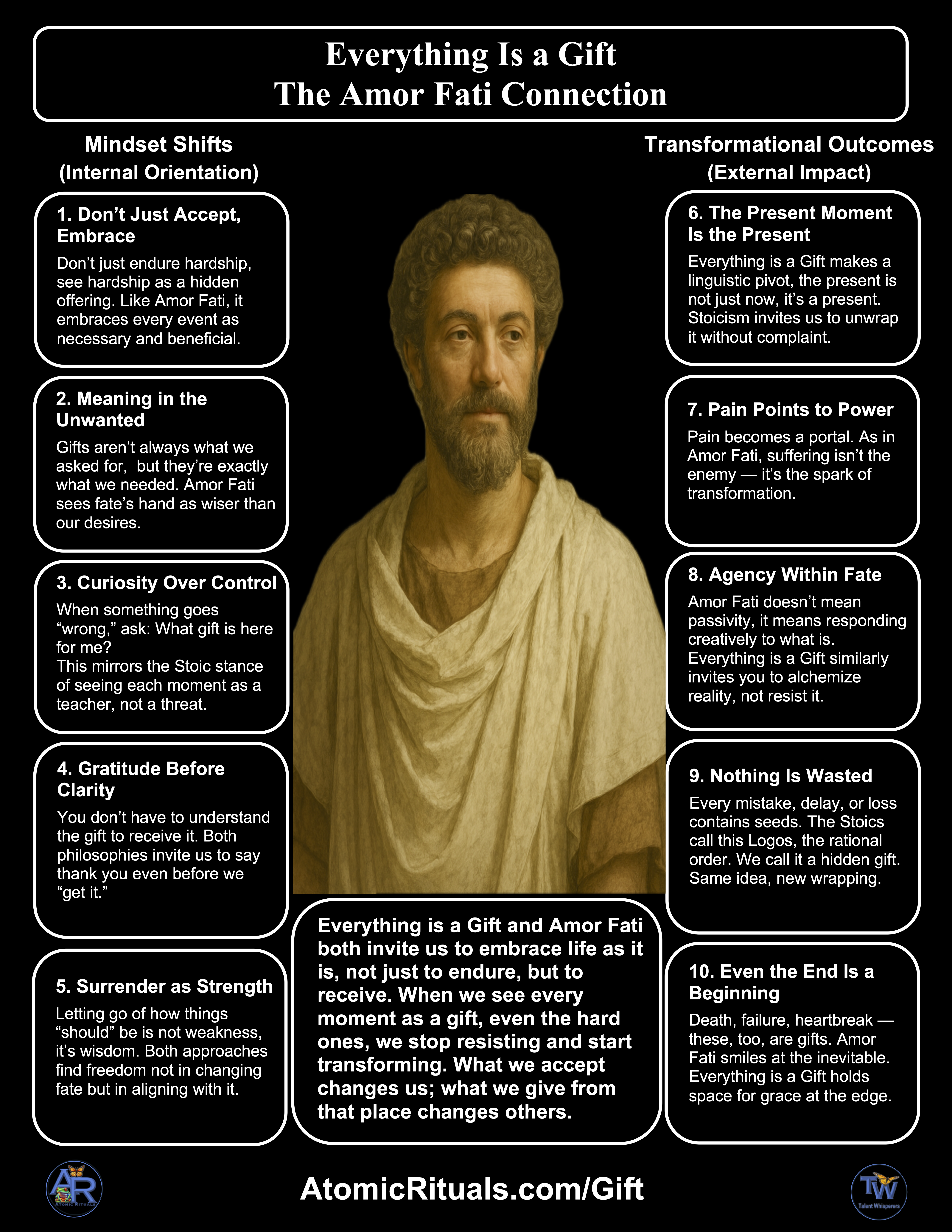
“The impediment to action advances action. What stands in the way becomes the way.” – Marcus Aurelius
Stoicism (Amor Fati – Love of Fate)
- Marcus Aurelius, Epictetus, and Seneca emphasized accepting life’s events as neither inherently good nor bad, but simply as what is given.
- Amor Fati (Love of Fate) – The idea that one should embrace everything in life, including suffering, as if it were chosen for them.
- Paraphrased Principle: “Do not wish for things to happen as you want them to happen. Rather, wish for them to happen as they do happen, and your life will go smoothly.” (Epictetus, Enchiridion)
- Connection: Seeing everything as a gift (even challenges) aligns with stoic gratitude, which recognizes that everything serves a purpose—even adversity.
In the Stoic tradition, the concept of embracing all events as gifts is central to cultivating resilience and wisdom. This philosophy is encapsulated in the practice of Amor Fati, a Latin phrase meaning “love of fate.” Amor Fati encourages individuals to not only accept but also embrace everything that happens in life, viewing each event—whether perceived as positive or negative—as an integral part of one’s journey.
Marcus Aurelius on Embracing Fate

Marcus Aurelius, the Roman emperor and Stoic philosopher, frequently reflected on the importance of accepting one’s fate. In his personal writings, known as Meditations, he advises:
“Convince yourself that everything is the gift of the gods, that things are good and always will be.”
“The impediment to action advances action. What stands in the way becomes the way.”
This perspective transforms challenges and adversities into opportunities for growth, suggesting that by perceiving every occurrence as a divine gift, one can maintain tranquility and purpose.
The Essence of Amor Fati
Amor Fati is more than mere acceptance; it is a profound appreciation for all aspects of life. Friedrich Nietzsche, though not a Stoic, articulated this mindset succinctly:
“My formula for greatness in a human being is Amor Fati: that one wants nothing to be different, not forward, not backward, not in all eternity. Not merely bear what is necessary, still less conceal it… but love it.”
This philosophy encourages individuals to embrace their experiences fully, recognizing that each moment contributes to personal development and understanding.
Practical Applications in Leadership
In leadership, adopting an Amor Fati mindset fosters adaptability and resilience. Leaders who view every situation as a gift are better equipped to navigate challenges and inspire their teams. Practical steps include:
- Reframing Challenges: Instead of viewing obstacles as setbacks, see them as opportunities to learn and grow.
- Embracing Change: Recognize that change is a natural part of life and leadership. Embracing it can lead to innovation and improvement.
- Cultivating Gratitude: Regularly reflect on experiences, acknowledging how both successes and failures have contributed to personal and professional growth.
By integrating Amor Fati into leadership practices, individuals can develop a more resilient and appreciative approach to the complexities of guiding others.
Conclusion
Embracing the Stoic principle that “everything is a gift” through the practice of Amor Fati offers a transformative approach to life’s challenges. By perceiving every event as an opportunity for growth and understanding, individuals can cultivate resilience, wisdom, and a deeper sense of purpose.
See Also:
The Daily Stoic:
- Convince Yourself That Everything Is A Gift
- Amor Fati: The Formula for Human Greatness
- It’s All A Gift
In “The Obstacle Is the Way,” Ryan Holiday emphasizes the Stoic principle that obstacles are not merely challenges to be overcome but opportunities for growth and advancement. This perspective aligns closely with the idea of viewing everything as a gift.
Holiday draws inspiration from Marcus Aurelius, who wrote, “The impediment to action advances action. What stands in the way becomes the way.” This suggests that obstacles themselves guide us toward progress. Holiday interprets this to mean that every challenge presents a chance to practice virtue and resilience. By embracing difficulties, we can transform them into advantages.
A key theme in the book is the discipline of perception—training oneself to see events objectively. Holiday argues that our perceptions shape our reality; by choosing to view obstacles as beneficial, we can turn setbacks into opportunities. This mindset shift enables us to approach challenges with clarity and purpose, recognizing them as gifts that foster personal development.
Holiday also highlights the importance of action and will. He encourages readers to persistently and creatively engage with obstacles, using them as stepping stones rather than viewing them as hindrances. This proactive approach transforms adversity into a catalyst for improvement, reinforcing the notion that challenges are gifts in disguise.
In essence, “The Obstacle Is the Way” advocates for a perspective where every difficulty is seen as an opportunity to grow stronger and wiser. By adopting this viewpoint, we can appreciate that everything, including obstacles, is a gift that contributes to our personal and professional evolution.
Indigenous and Tribal Religions
Many indigenous and tribal religions emphasize the concept of receiving everything as a gift, viewing life and nature’s offerings with deep gratitude and respect. This perspective fosters a reciprocal relationship between humans and the natural world. Here are some examples:
1. Native American Traditions:
In many Native American cultures, gratitude is a foundational principle. Daily practices often include giving thanks to the Earth, the sun, and all living beings. This constant expression of gratitude reflects the belief that all elements of life are gifts. Ceremonies and rituals are performed to honor these gifts and to maintain harmony with the natural world.
2. Anishinaabe Teachings:
The Anishinaabe people follow the Teachings of the Seven Grandfathers, which include principles such as Wisdom, Love, Respect, Bravery, Honesty, Humility, and Truth. These teachings guide individuals to live harmoniously with creation, recognizing the gifts provided by nature and the importance of gratitude and respect in daily life.
3. Ainu Spirituality:
The Ainu people of Japan practice animism, believing that spirits inhabit all aspects of the natural world. They view natural resources and animals as gifts from the kamuy (gods or spirits). Rituals, such as the Iyomante (bear sending ceremony), are performed to honor and send back the spirits of animals, expressing gratitude for the gifts they provide.
4. Indigenous Gift-Giving Practices:
In various indigenous cultures, the act of gift-giving holds profound significance. It is a way to show respect, honor relationships, and express gratitude. For instance, among some Native American tribes, individuals are taught from a young age to give away cherished items, reinforcing the value of community and the understanding that possessions are gifts to be shared.
These examples illustrate a common theme in many ethnic and tribal religions: the recognition of life’s offerings as gifts and the importance of gratitude, respect, and reciprocity in maintaining balance with the natural world.
Other Philosophies (Taoism, Existentialism, Zen Buddhism)
The philosophical premise that aligns with “Life is better when you receive everything as a gift” can be found in Taoism, Stoicism, and certain existentialist and spiritual traditions. Here are a few related concepts:
- Taoism (Wu Wei & Gratitude)
- Laozi’s Tao Te Ching (especially Stephen Mitchell’s translation, which you resonate with) conveys the idea of non-attachment, effortless action (wu wei), and flowing with life rather than resisting it.
- A core Taoist idea is that everything is part of the natural flow of the universe, and accepting life as it comes—rather than clinging, resisting, or forcing outcomes—leads to peace and fulfillment.
- Paraphrased Principle: “The sage does not hoard. The more he gives to others, the more he has himself.” (Tao Te Ching, Chapter 81)
- Existentialism & Grace (Gift Perspective)
- Thinkers like Simone Weil and Albert Camus discuss the idea of grace—not in the religious sense, but as a way of perceiving life with an openness to wonder, rather than entitlement or resistance.
- Weil’s perspective on suffering and joy argues that by receiving everything as a gift, we transcend ego and suffering.
- Paraphrased Principle: “To be always looking for what is good and beautiful in every situation—this is the only true way to live.”
- Zen Buddhism (Beginner’s Mind & Non-Attachment)
- Shunryu Suzuki (Zen master) wrote about Shoshin (“Beginner’s Mind”), which means approaching life with openness, curiosity, and a lack of preconceptions.
- If everything is received as a gift, then nothing is taken for granted, and we cultivate joy in the ordinary.
- Paraphrased Principle: “In the beginner’s mind, there are many possibilities. In the expert’s mind, there are few.” (Shunryu Suzuki, Zen Mind, Beginner’s Mind)
Best Summary of the Premise:
✔ Taoism: Flowing with life and letting go of resistance.
✔ Stoicism: Loving what happens to you as if it were a chosen gift.
✔ Existentialism: Experiencing life with a sense of grace.
✔ Zen Buddhism: Approaching life with openness and curiosity.
A modern, refined version of this philosophy might be:
“Life is better when you treat everything as a gift—because gratitude transforms even difficulties into meaning.”
Major world religions, spiritual beliefs, and philosophies, ordered by the estimated number of adherents
There are more perspectives to explore and learn from …
1. Christianity: Approximately 2.3 billion followers.
2. Islam: Approximately 1.9 billion followers.
3. Hinduism: Approximately 1.1 billion followers.
4. Buddhism: Approximately 500 million followers.
5. Chinese Folk Religions: Approximately 457 million followers.
6. Ethnic or Tribal Religions: Approximately 288 million followers.
7. Agnosticism: Approximately 744 million individuals.
8. Atheism: Approximately 147 million individuals.
9. New Religious Movements: Approximately 67 million followers.
10. Sikhism: Approximately 29 million followers.
11. Spiritism and Spiritualism: Approximately 14.8 million followers.
12. Judaism: Approximately 14.8 million followers.
13. Shinto: Approximately 104 million followers.
14. Taoism: Approximately 12 million followers.
15. Confucianism: Approximately 6 million followers.
16. Jainism: Approximately 5 million followers.
17. Bahá’í Faith: Approximately 7 million followers.
18. Zoroastrianism: Approximately 192,000 followers.
19. Cao Dai: Approximately 4.4 million followers.
20. Tenrikyo: Approximately 2 million followers.
21. Neo-Paganism: Approximately 1 million followers.
22. Unitarian Universalism: Approximately 800,000 followers.
23. Rastafarianism: Approximately 700,000 followers.
24. Scientology: Approximately 500,000 followers.
Please note that these figures are estimates and can vary depending on the source and methodology used. Additionally, the number of adherents for certain beliefs, such as agnosticism and atheism, may overlap with those of organized religions, as individuals might identify culturally with a religion while personally holding secular beliefs.
Ray Dalio’s Principles
Ray Dalio, in his book Principles: Life and Work, emphasizes the importance of embracing reality and viewing challenges as opportunities for growth. He introduces a five-step process to achieve one’s goals:
- Have clear goals.
- Identify and don’t tolerate problems.
- Diagnose problems to get at their root causes.
- Design a plan.
- Push through to completion.
Central to this approach is the belief that encountering and addressing problems is a natural part of the journey toward success. Dalio suggests that by confronting issues head-on and learning from them, individuals can transform setbacks into valuable lessons. He encapsulates this idea with the formula:
“Pain + Reflection = Progress.”
This perspective aligns with the notion of viewing every experience, including challenges, as a gift that contributes to personal and professional development.
In more recent discussions, Dalio has continued to advocate for embracing challenges. He advises professionals to view career obstacles as integral to a larger journey, emphasizing that these experiences provide valuable insights and perspectives. By fostering meaningful relationships and practicing radical transparency, individuals can navigate difficulties more effectively and appreciate the growth that comes from them.
In essence, Dalio’s philosophy encourages a mindset where every event, whether perceived as positive or negative, is seen as an opportunity—a gift—that fosters learning and growth.
API – Assume Positive Intent
A core premise behind receiving everything as a gift
In fast-moving, high-stakes environments—especially in disruptive tech companies—miscommunication, conflicting priorities, and unexpected challenges are inevitable. Under pressure, it’s easy to slip into a defensive mindset, assuming bad faith in others’ actions, decisions, or even in the constraints imposed by company policies and processes. However, just as Everything is a Gift invites us to see obstacles as opportunities, the principle of API—Assume Positive Intent (as explored in AtomicRituals.com/API) extends this mindset into how we engage with people and systems around us.
The Gift of Trust in Others
When we assume positive intent, we choose to believe that our colleagues, stakeholders, and even the company itself are not acting out of malice or incompetence but are doing the best they can with the information, constraints, and pressures they face. This perspective transforms workplace interactions in profound ways:
- Reduces Defensive Posturing: Instead of reacting emotionally to a difficult email or an abrupt decision, assuming positive intent allows space for curiosity—“What constraints or pressures might this person be under?”
- Encourages Constructive Dialogue: Rather than escalating tension, this mindset fosters conversations where we seek to understand before we judge.
- Builds Psychological Safety: High-trust teams perform better because members feel safe taking risks and making mistakes, knowing they won’t be unfairly blamed.
The Gift of Trust in Systems and Processes
The principle of Everything is a Gift doesn’t just apply to how we perceive individual actions—it also extends to how we interpret company processes, rules, and structures. When leaders and employees assume that organizational processes are designed with positive intent (even when they appear frustrating or bureaucratic), it reframes our engagement with them:
- From Resistance to Inquiry: Instead of dismissing a rule as “pointless red tape,” ask, “What problem was this designed to solve?”
- From Compliance to Iteration: When we assume that processes were created with good intent but may need refinement, we can improve them rather than reject them outright.
- From Friction to Adaptation: Just as constraints can drive innovation, assumed-positive-intent processes can provide clarity, structure, and alignment—gifts that enable better decision-making.
Bringing It Together: Everything as a Gift in Leadership
Great leaders don’t just tolerate uncertainty and ambiguity; they embrace them as gifts. They recognize that:
- People generally want to succeed and contribute positively.
- Processes and constraints, even when flawed, likely emerged from a genuine need.
- Every interaction—especially in moments of tension—offers a chance to lead with clarity, understanding, and adaptability.
The principle of Assuming Positive Intent (API) encourages individuals to interpret others’ actions as well-intentioned, fostering trust and effective collaboration. This mindset is particularly valuable in high-stress environments, such as fast-growing, disruptive tech companies, where miscommunications can easily escalate.
Key Insights on Assuming Positive Intent:
- Enhancing Team Dynamics: Assuming positive intent reduces defensive reactions and promotes open communication. By giving colleagues the benefit of the doubt, teams can address issues collaboratively rather than assigning blame.
See: A CEO’s advice: Assume Positive Intent - Building Trust and Empathy: Embracing this mindset fosters a culture of trust and empathy. Recognizing that most individuals aim to contribute positively helps in understanding underlying motivations, leading to stronger interpersonal relationships.
See: Assuming Positive Intent - Navigating Organizational Processes: Assuming positive intent extends beyond interpersonal interactions to include company policies and procedures. Viewing processes as designed with good intentions encourages employees to engage constructively, seeking to understand the rationale behind them and contributing to continuous improvement.
See: Positive Intent in the Workplace
Challenges and Considerations:
- Avoiding Naivety: While assuming positive intent is beneficial, it’s essential to balance this perspective with discernment. Not all actions stem from good intentions, and being aware of this helps in addressing issues appropriately.
See: The Weaponization of “Assume Good Intent” - Impact Over Intent: Focusing solely on presumed positive intent can overlook the actual impact of actions. It’s crucial to acknowledge and address any harm caused, regardless of the original intention.
See: Your Impact Outweighs Your Intention
Incorporating the API mindset aligns with the philosophy that “everything is a gift.” By interpreting interactions and processes through a lens of positive intent, individuals can transform potential conflicts into opportunities for growth and collaboration, enhancing both personal development and organizational culture.
By integrating Everything is a Gift with API—Assume Positive Intent, we shift from a mindset of resistance and frustration to one of curiosity, growth, and trust. This not only improves decision-making but also fosters a culture where people and ideas thrive.
The magic you’re looking for is in the work you’re avoiding
The quote “The magic you’re looking for is in the work you’re avoiding” is often attributed to Dipen Parmar. This saying suggests that the growth, success, or fulfillment we seek often lies within the tasks or challenges we tend to procrastinate or shy away from. By confronting these avoided tasks, we can unlock potential opportunities and personal development.
A similar sentiment is expressed by mythologist Joseph Campbell, who stated, “The cave you fear to enter holds the treasure you seek.” Both quotes emphasize the idea that facing our fears and tackling the work we resist can lead to profound rewards and self-discovery.
For a deeper exploration of this concept, you might find the following video insightful:
Appendix: Mercy as a Gift
Mercy and the Gift of Perspective
My friend Ron recently shared with me a presentation he gave on Mercy. It led me to reflect on the connection between Mercy and seeing everything as a gift. Mercy is often seen as an act of compassion or forgiveness, but when viewed through the lens of Everything as a Gift, it becomes a profound shift in perspective. Mercy is both something we give and something we receive, an invitation to see challenges, relationships, and even our own failures as opportunities for growth and grace.
Receiving Mercy: The Gift of Grace
To accept mercy is to acknowledge our own imperfections and recognize that we are constantly being given grace—whether from God, others, or life itself. This aligns with the idea that everything, even our mistakes and struggles, is a gift meant to refine and shape us.
- In Christian teachings, Jesus’ words in Matthew 5:7 emphasize that “Blessed are the merciful, for they will be shown mercy.” This reciprocity highlights that mercy, when accepted, becomes something we naturally extend to others.
- My friend Ron reflected on his career experiences as a Refiner’s Fire, where moments of failure ultimately became gifts, shaping his understanding of mercy.
- Just as we are given second chances, understanding, and compassion, we are invited to offer these same gifts to others.
Extending Mercy: The Gift of Letting Go
Giving mercy is not just about offering forgiveness; it is an active decision to let go of resentment, disappointment, or judgment and instead recognize the hidden gifts within difficult situations.
- Seeing Others as a Gift: When we extend mercy, we shift from seeing someone as an obstacle to seeing them as a part of our journey—a teacher, a mirror, or even an unexpected blessing.
- Letting Go of Ego: Mercy requires releasing our sense of entitlement to be right, to punish, or to demand an outcome. Instead, it invites openness and trust in a greater process.
- Breaking Cycles of Hurt: Just as accepting life’s challenges as gifts allows us to transform suffering, extending mercy allows us to disrupt cycles of anger and judgment.
Mercy and the Challenge of the Present Moment
One of the greatest barriers to both giving and receiving mercy is distraction—being caught up in ego, emotions, or expectations that keep us from seeing the deeper gift in a moment.
- My friend Ron asks, “What distractions and other feelings prevent me from being merciful?” This is a powerful question that applies not only to mercy but to the broader concept of receiving everything as a gift.
- Mercy, like gratitude, is a practice of presence—it requires stepping outside of the immediate emotional reaction and seeing the bigger picture.
- When we meet a difficult person or situation, we can ask: “What if this is a gift? What am I meant to learn?”
The Role of Mercy in Everything as a Gift
Mercy is one of the most profound ways we can embody the principles of Everything as a Gift because it requires us to trust in hidden goodness, unexpected grace, and deeper wisdom.
- When we receive mercy, we embrace that our own mistakes and missteps are part of our journey, shaping us into more compassionate, humble individuals.
- When we extend mercy, we acknowledge that others are also on their own journeys and that every moment holds the potential for transformation.
- When we choose mercy, we open the door to seeing even life’s difficulties as part of a greater, unfolding gift.
Refiner’s Fire
The term “Refiner’s Fire” carries significant meaning and connotations, particularly in religious and spiritual contexts.
Biblical and Theological Meaning
- The phrase originates from Malachi 3:2-3 in the Bible:
“But who can endure the day of his coming? Who can stand when he appears? For he will be like a refiner’s fire or a launderer’s soap. He will sit as a refiner and purifier of silver; he will purify the Levites and refine them like gold and silver.”
- It symbolizes the purification process that believers undergo to remove impurities, much like how a metal-smith refines gold or silver by heating it until the impurities rise to the surface and can be removed.
Broader Connotations
- Spiritual Growth & Testing: It often refers to the trials, hardships, or challenges that “refine” a person’s character, making them spiritually stronger or purer.
- Moral and Ethical Development: The phrase implies that struggles serve a purpose in shaping one’s virtues, such as patience, humility, and wisdom.
- Pain as Transformation: The fire metaphor suggests that suffering, when endured with faith and reflection, can lead to greater self-awareness and spiritual elevation.
Application in Your Context (Everything as a Gift)
In the context of Everything as a Gift, Refiner’s Fire aligns well because:
- It frames challenges as gifts—rather than viewing hardship as punishment, it can be seen as a necessary process for personal growth.
- It supports the idea that mercy, humility, and grace often emerge through trials, much like Ron’s reflections on his career struggles shaping his understanding of mercy.
- It emphasizes acceptance and transformation, which is a key theme in your work—seeing even the most difficult moments as refining gifts.
Reflection on Mercy
Mercy teaches us that gifts are not always obvious—sometimes they come disguised as disappointments, conflicts, or personal failures. But when we embrace mercy, we learn to trust that there is meaning and purpose in even the hardest of experiences.
Challenge: Where in your life do you struggle to extend or receive mercy? What would shift if you saw mercy itself as a gift?
When the Darkness Is a Door
There are times when it feels like the world is unraveling. The headlines point to collapse. The climate is unstable. Institutions falter. People feel more disconnected than ever. And beneath it all is a quiet, creeping question:
Is it too late?
It’s easy to lose hope in moments like this — to become numb, bitter, helpless. But if everything is a gift, then even this season of uncertainty must carry something for us. Not because suffering is noble or deserved — but because it can still be alchemized.
Throughout history, darkness has often preceded transformation:
- The Great Depression gave rise to the New Deal, social safety nets, and a generation that redefined resilience.
- The Second World War, at its most horrific depth, became the forge for international cooperation, human rights declarations, and the birth of the United Nations.
- The Civil Rights Movement emerged from centuries of systemic oppression, sparked by people who refused to let despair become silence.
- The COVID-19 pandemic, painful as it was, accelerated innovation in healthcare, remote work, and forced a cultural reevaluation of what matters most.
In each case, humanity didn’t just survive the crisis — we changed because of it. We looked into the void, and instead of falling in, we built bridges. We found new ways to come together. We awakened.
This moment may feel like collapse.
But collapse is not always the end. Sometimes, it’s the compost for the next beginning.
Sometimes, the fire clears the underbrush so new growth can reach the light.
If we treat this time as a wake-up call rather than a death sentence, we might one day look back and say:
That was the moment we remembered who we were.
That was when we chose to build again — not back, but forward.
That was when we learned to turn even despair into fuel.
The darkness is not the opposite of the gift.
The darkness may be the wrapping.



 Atomic Rituals